

In my last post, I suggested that both leadership and management were important skills needed for businesses to build success. I explored the differences and how to build the skills for both.
In this edition, I investigate why businesses need both functions and and different people for each and how to build both into your business structure.
Almost since their founding, organizations have seen the need for two types of leaders. One that focuses on leading itself. Another that focuses on managing. Many terms have been used:
- Leader = CEO = Entrepreneur = Why-Types = Visionary
- Manager = COO = Operator = How-Types = Integrator
One of the strongest ideas to come out of EOS is the concept that organizations should have the functions of Visionary and Integrator in their organizations. While this concept is not new, Gino Wickman has brought the concept mainstream in his book “Traction” and detailed it in “Rocket Fuel.” I’ll use these terms as the functions needed at the top of any business.
Wickman argues that companies that embrace both roles and understand how they best work together will grow faster and have higher profitability, more cohesiveness, freedom, fun, and a better culture. So, what are the differences and how do they best collaborate?
Visionaries
These leaders focus on what is often described as business leadership. The work involves recognizing, preparing for, and delivering change in uncertainty. Normally, this delivers growth or at least, prevents obsolescence. It creates the transformation needed to take advantage of market, technology, or other systemic shifts.
Visionaries are often founders. Their key strengths are:
- Setting Vision = 10 yr+
- Creating culture
- Alignment
- Motivating
- Growing Relationships (key vendors and customers, partnerships, potential acquisitions)
Integrators
These leaders focus on managing complexity. Good Integrators bring consistency and order that delivers better quality, value, and profits.
Integrators can be founders, but normally are more operationally focused and take fewer risks. Their key strengths are:
- Executing Strategy = 2-5 yrs
- Managing Operations
- Ensuring Profitability and Quality
- Developing People, Processes, and Systems
Comparing and Contrasting*:
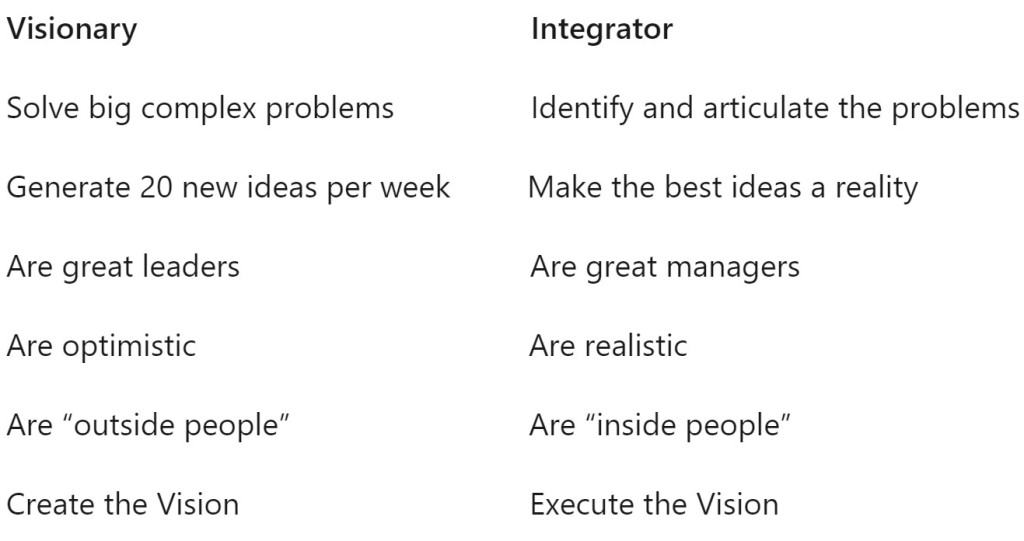
*Wickman, Gino; Winters, Mark C.. Rocket Fuel (p. 67). BenBella Books.
Working Together
Working together starts with understanding the different strengths and weaknesses each type of person brings. Ensure the visionary and integrator functions are filled with people who have an innate desire and ability to fill each position.
It then involves creating understanding and alignment between the two functions. This requires consistent work to continue to stay coordinated and aligned. Wickman suggests 3 tools to keep visionaries and integrators working together:
- The “Accountability Chart”
- The Same Page Meetings
- The 5 Rules
An Accountability Chart is a fancy org chart with roles listed for each function. Or, you can use an AOR = area of responsibility list as Matt Mochary suggests in “The Great CEO Within”: Create a document that lists all of the company’s functions, the areas of responsibilities for the function, and the directly responsible individual (DRI) for each responsibility.
The first step for coordinating visionaries and integrators is to have them agree to and document the roles/areas of responsibilities that each will fill in their respective functions. Be clear that there are no overlaps.
A visionary function’s five most common roles/responsibilities are typically:
- New ideas/R&D
- Creative problem solving
- Major external relationships
- Culture
- Selling big deals
The Integrator function’s five roles/responsibilities might be:
- Leading, Managing, and holding people Accountable
- Executing the business plan/P&L results
- Integrating major functions
- Resolving cross-functional issues
- Communication across the organization
Next, Same Page Meetings keep visionaries and integrators aligned. They should happen at least monthly and can take 2 to 4 hours or more. The objective should be to ensure agreement and alignment before the meeting is over. I suggest an agenda with these topics:
- Check in – Personal, Business, and Role Effectiveness assessment and highlights.
- A.C.T. to raise any issues that need to be addressed. Decide who should own each issue or if you should collectively address any.
– Accountability: Follow up on any action items from past meetings. Share key project milestones and deliverable status that are important to both.
– Coaching: Assess the state of the business. Share the good and not good about the state of the business. Areas to cover include RPM =
o Relevance: Do we still have the right business model?
o Progress: Are we making the right progress?
o Mood: Is everyone still onboard?
– Transparency: Share both ways – Like: “These are the specific actions that I like that you are doing.” Wish that: “These are the specific actions that I wish you would do differently.” Follow good feedback protocol.
- Issue Resolution: Prioritize any issues raised above and any that are brought to the meeting by either person. Work all high priority issues to resolution using an appropriate problem-solving approach. Ensure ownership and timeframe for resolving the resulting action items.
The 5 Rules are developed by Wickman to keep the relationship between visionaries and integrators on track. They are mostly self-explanatory. You can explore details on pg. 105 of “Rocket Fuel”:
- Stay on the Same Page
- No End Runs – always defer roles/responsibilities back to the right function
- The Integrator Is the Tie Breaker – except in very, very rare circumstances
- You Are an Employee When Working “in” the Business – no special privileges
- Maintain Mutual Respect – always
Does your business have people for both visionary and integrator functions? Should it? How do you stay coordinated and aligned between the functions?
Please connect, share, comment, like, and reach out if I can answer any questions or serve in any way.
May you find Passion, Joy, and Freedom in all your pursuits.
 Horizon Line Group