
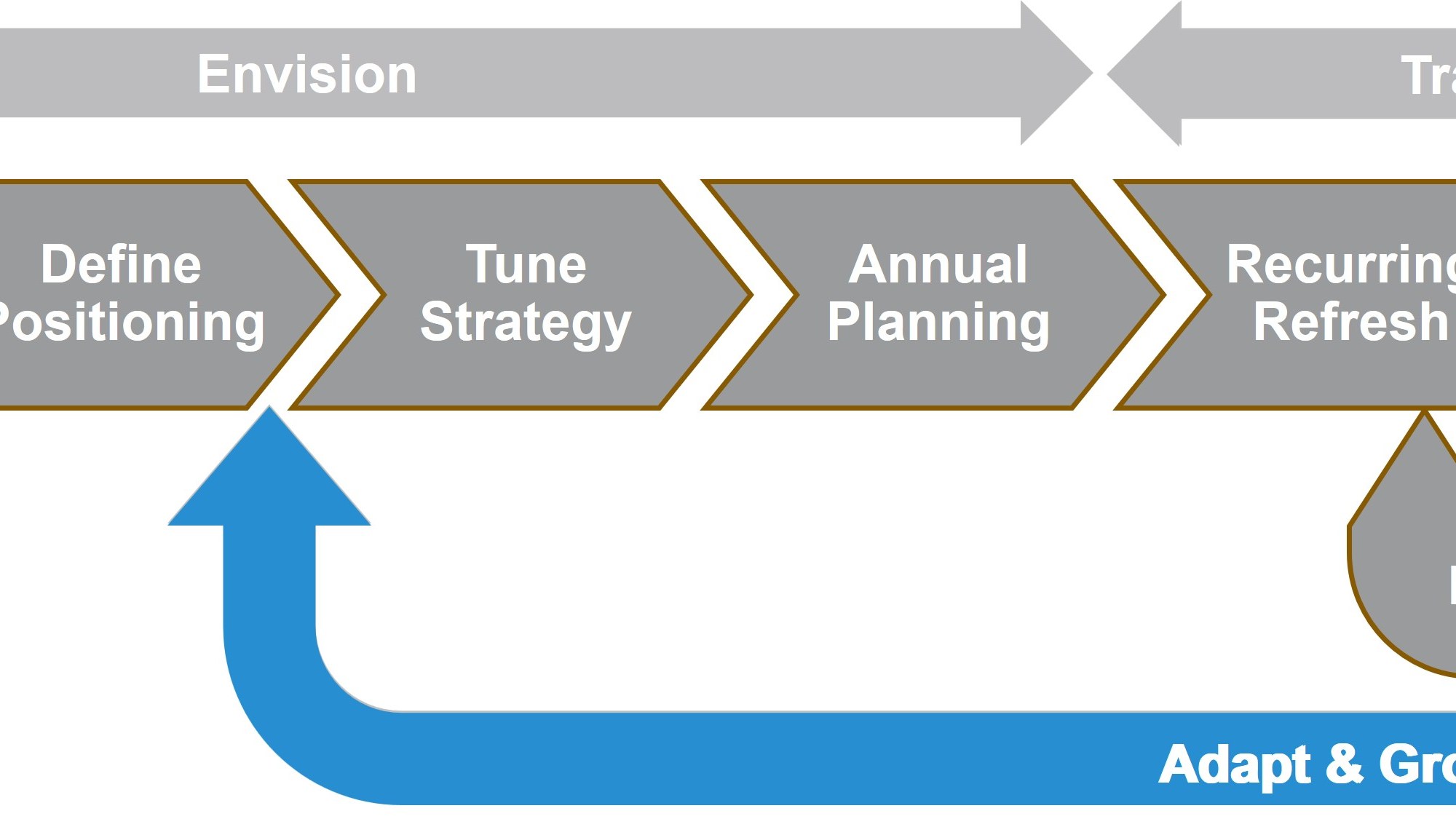
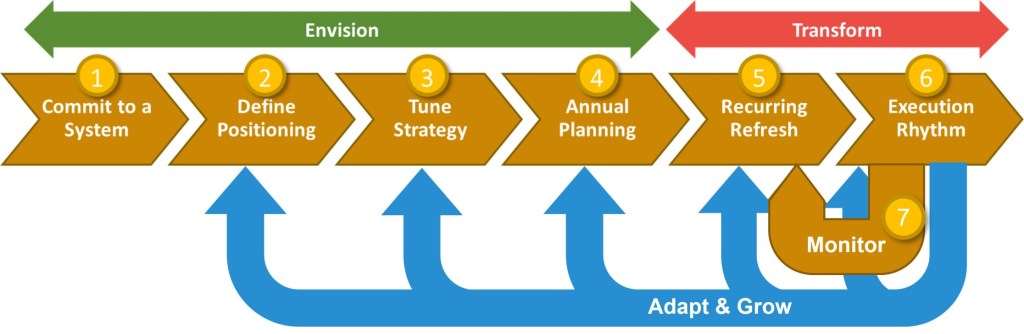
This edition investigates the Adapt and Grow phase of #StrategyOS. It investigates the purpose of the phase, how to evaluate what is needed to stay relevant and thrive, and how to implement changes when they are needed.
Purpose
This phase of StrategyOS focuses on creating the feedback loop that all complex systems need to be successful. The overall goal is to evaluate what parts of your strategy are working. Add to or modify what accelerates obtaining your vision and stop or reduce anything that does not work or creates friction.

This adaptive approach to strategy takes the pressure off of getting started and allows for accelerating the flywheel of your business model. According to Jim Collins, just like with a mechanical flywheel, these small wins accumulate over time, add momentum, and align your entire organization around delivering your Positioning.
To do this, leaders need to monitor the environment or Context in which their business competes to ensure Positioning, Strategy and the resulting Themes remain effective and adapt to changing trends that impact how you operate.
As a reminder, Context underlays our business model and impacts strategy through internal resources and capabilities relative to external trends.

Your strategy must continue to update and refine how you will compete to win within an evolving Context through your product market fit, go-to-market activities, and other Themes.
Assessing Context
Assessing Context is an activity where strategy practitioners make their work seem complicated. Some of the many ways created to evaluate context include: SWoT analysis, 5-forces, competitive positioning, customer segmentation, value chain analysis, adjacent markets, best practices, and internal gap analysis! While these can add understanding, they can also add confusion, time delays, and complexity.
There are 3 easier ways to assess context:
- Listen to Customers and Employees
- Allow for breaks to work “on” the business
- Council meetings
The most important thing leaders can do to support this step is to listen to customers and employees. Support reps on sales calls. Conduct customer surveys. Check your support desk and other customer-facing processes that define your business to the world. Understand their needs and ensure customers see you how you want to be seen.
Similarly, find ways to get feedback from your employees. Additional tactics include: open office hours, suggestion boxes, management by walking around, and team-level council meetings (discussed below.)
The next most impactful thing leaders should do is to schedule time to work “on” the business away from the day-to-day “in” the business work. Many leaders I know schedule weekly blocks for this “thinking time.” The best leaders schedule longer blocks of time monthly and schedule full day or longer blocks each quarter and annually. Wickman (pg 214) calls these Clarity Breaks. This is not time to catch up on work tasks. Instead be alone, away from work, with a notepad, and no distractions. Focus on important questions like Positioning, Context, priorities, people, processes, products, nagging issues, emerging trends, and how you structure your own time and work. You can start with written questions from the week, or focus on what comes to you. The outcome should be ideas that can lead to expanded opportunities, accelerated success, and more relevance.
Peer groups and advisory boards are another way to create time to work “on” the business. Ideally, these groups bring diverse perspectives, take a long-term view, meet regularly, and have the best interests of the leader and the business as their only agenda.
Further, in his book, One Hour Strategy, Jeroen Kraaijenbrink suggests that everyone works on strategy at their own level and from their own perspective. Executive leaders should spend at least 1 hour per day, managers should spend 1 hour per week, and all team members should spend 1 hour per month considering strategy. These times of reflection should consider three questions:
- Q1. Relevance: Do we still have the right strategy?
- Q2. Progress: Did we make the right progress?
- Q3. Mood: Is everyone still on board?
From these different perspectives, the goal is to uncover the most important of 3I’s:
- I1. Issues: Any problem, bottleneck, or mistake that you have identified
- I2. Insights: Any fact, observation, or experience that you learned
- I3. Ideas: Any solution, improvement, or innovation that you identified
Council meetings help ensure your company stays in touch with its Positioning and that it stays relevant with evolving changes and trends in the Context in which it operates. These meetings combine the idea of listening to customers and employees with a formal agenda focused on working “on” the business. Where other rhythm meetings are focused on execution, this meeting is focused on strategy and the business model itself. (See Great Council)
Staying Relevant
Action items from customers, employees, clarity breaks, and council meetings should be documented, further developed, and solved using your problem solving approach at the appropriate rhythm meeting.
Many of the action items can be added as Issues for your Leadership Team meetings and solved and implemented quickly. Or, they can be larger Issues to work on at the next Recurring Refresh or Annual Planning meeting. The most important insights create a learning loop that feeds back into Define Positioning or Tune Strategy. In early stage companies, it can create a pivot causing major changes to create a pivot in Positioning. Or, more typically in established companies, it impacts the understanding of Positioning and helps Tune Strategy by creating new Themes and re-envisioning needed focus.
How does your business ensure strategy stays relevant? How do you apply any insights generated to reach your vision? What questions do you have?
Please feel free to reach out if I can help you build more rigor to accelerate your business flywheel.
May you find Passion, Joy, and Freedom in all life’s adventures.
 Horizon Line Group
2 Replies to “Adapt and Grow Phase Keeps Strategy Relevant”