

There’s been a lot of debate about how to best set goals for a business. SMART suggests they should be Achievable. Stretch suggests they should be motivational. BHAG suggests they should be inspirational. So, what’s the right approach? Eric Kish, spoke at our last Vistage meeting and I believe he has cracked the code. In his presentation, book, and blog, he proposes a three-tiered system that includes a Threshold, Target, and Stretch goal. Let’s look at how and why it works.
Stretch goals have a mixed track record. Motorola famously reduced product development time by tenfold in the 1990s after mandating stretch goals. But when too ambitious or unrealistic, they have demotivated and overwhelmed people. They caused ethical issues at Wells Fargo, and led to failure at Yahoo. SMART goals meanwhile suggest that goals should be Attainable. These can fail to challenge teams to perform above minimal levels.
A three-tiered goal system balances the need for challenge and attainability. It includes goals set at a:
- Threshold: The minimum acceptable level of performance that must be achieved. These goals should be achievable 85% of the time. It is the point below which the performance is considered unacceptable.
- Target: The realistic and committed level of performance that is expected to be achieved. These goals should be achievable 50-60% of the time. Up to this point, performance is considered satisfactory.
- Stretch: The exceptional and ambitious level of performance that is aimed to be achieved. These goals are achievable about 10-15% of the time. Any performance above Target is considered outstanding.
Why include the three tiers? Kish’s system is based on a behavioral psychology concept known as anchoring. When buyers are presented with only two choices, say an economy ($10) brand and a standard ($20) brand, they will most often anchor on the economy brand and choose it. However, when also given a premium ($40) option, they more often anchor on and choose the standard brand. So, by including the Stretch goal, the idea is to have employees anchor on the Target goal and be more likely to be motivated to achieve it.
The other beauty of the system is that it allows for a common scale and nomenclature across all business metrics. This makes it easy to compare performance across all metrics and know the metric’s health regardless of the absolute measure. The different goals are analogous to how the temperature scale is set:
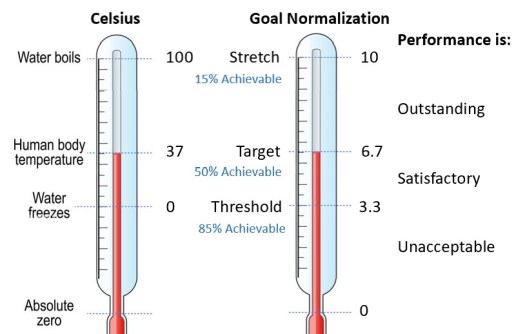
A metric that performs at the Threshold goal is normalized to 3.3. Everything below this is ‘Unacceptable.’ The Target is normalized to 6.7. Between a normalized score of 3.3 and 6.7, performance is ‘Satisfactory’. The closer to 6.7, the closer we are to Target. The Stretch goal is normalized to 10; any metric at or above 6.7 is considered ‘Outstanding’ performance and we can tell how close we are to the Stretch goal by how close we are to 10. Above 10 and we have exceeded even the Stretch goal.
These normalized scales can also be used to calculate performance bonuses. This practice has been used in finance for many years, and these normalized metrics give structure to allow for a level playing field for any organization.
Setting goals can be contentious and hotly debated. Properly set goals can motivate and challenge. Poorly set goals can demoralize. How can a three-tiered approach help your business?
To learn more, see Kish’s articles, The Tricky Job of Setting Targets and Metrics? Anything can be Measured. You can also learn more about how to set the different goals at Best Practices in Performance Goal-Setting.
Please follow, share, comment, and like. Message me if I can serve in any way.
May you find adventure, joy, passion, and freedom in all your pursuits.
 Horizon Line Group