

Hello, I’m Veronica
The sky is not completely dark at night. Were the sky absolutely dark, one would not be able to see the silhouette of an object against the sky.


-
Four Strategies to Build Confidence

Confidence is an essential trait for great leaders, yet it remains elusive. Every leader, regardless of experience or accolades, has faced moments of self-doubt, hesitation, or fear of failure.
This lack of confidence can manifest in several ways. Maybe you “play it safe” and avoid risks, preventing innovation and growth. You might try to “control everything” and micromanage teams, signaling a lack of trust and lowering team morale. It can affect your mood, decision-making, and ability to foster a positive work environment, stifling both personal and organizational progress.
Or, imposter syndrome, as Adam Grant suggests, can benefit leaders when it fosters humility and encourages growth by highlighting gaps between your perceived abilities and others’ expectations. This recognition is a first step toward intentionally building confidence.
Confidence isn’t magic; it’s a skill that can be nurtured and refined. Let’s explore four practical ways leaders can develop more courageous, impactful leadership.
1. Accept the Possibility of Failure:
Mark Manson offers the “Confidence Conundrum,” stating that confidence comes from being comfortable with failure rather than expecting constant success. “Comfort in our failures and with what we lack allows us to act without fear, to engage without judgment, to love without conditions.”
This aligns with ideas from the eight worldly winds, which emphasize cultivating inner resilience and a grounded perspective in the face of fluctuating conditions like ‘success and failure.’ Both are bound to arise, but neither defines us. External recognition, both positive and negative, ultimately blows away, leaving only our inner resilience. Acknowledging this impermanent nature helps prevent an inflated sense of our abilities, creating the confidence to take calculated risks.
Comfort with failure without delusional bravado allows us to persevere and ultimately improve. Accepting failure as a possible outcome creates room for action that creates more confidence and a chance for growth. It lets us move past being stalled by a need to succeed or the fear of failure.
2. Rewrite Self-Limiting Beliefs:
Negative internal narratives have the power to shape our beliefs, including confidence, and resulting actions. Learn to recognize and challenge the “negative voice in your head” that tells fear-based, negative, unhelpful stories. Then, tune into your inner wisdom to find more useful narratives.
This negative voice is often trying to protect more vulnerable parts of our ego from being exposed or hurt. It manifests as thoughts like, “You’re not worthy” or “No one likes you.” Recognize and explore the origins of these negative narratives. They can come from past trauma, unmet childhood needs, career failures, or any painful event. Recognize the meaning added to these events beyond their facts that shape our “stories”.
Shifting from the negative voice requires recognizing when it is speaking and actively cultivating our inner wisdom, which speaks from a more positive and self-aware perspective. It creates stories coming from love and wisdom that have different, more useful added meanings and interpretations.
This gives us the power to rewrite stories like, “I am resilient” and “I am enough.” With these, we reclaim ownership and create narratives that result in more productive thoughts and actions.
“To be yourself in a world that is constantly trying to make you something else is the greatest accomplishment.” — Ralph Waldo Emerson
3. Keep a Growth Mindset:
People with a growth mindset believe that they can improve through hard work and effort. They embrace new challenges and learn from mistakes. Practice recognizing when you fall out of a growth mindset, even if temporarily, and reframe toward growth.
If confidence comes from being comfortable with failure, then a growth mindset builds comfort and encourages calculated risk-taking that creates success and even more confidence.
4. Embrace Critique:
Leaders must build a support network that encourages open communication and vulnerability. Actively seeking feedback from trusted peers, coaches, and mentors reveals blind spots, illuminates negative narratives, and generates creative ideas for greater confidence to take bold, authentic action.
Beyond yourself, encourage open dialogue in a safe environment across your teams to build a supportive culture, making confidence part of how everyone thinks and works. Regular ACT check-ins and fierce feedback encourage diverse perspectives, build trust, and improve retention and engagement. Open conversations allow leaders to connect with their teams on a deeper level, inspiring them toward a shared vision and creating work environments where individuals feel motivated. They create more growth and better outcomes, building confidence across the business.
Three bonus tools:
- Mindfulness Exercises: Use meditation and breath exercises to help calm the mind. This enhances self-awareness and resilience and creates space between stimulus and response.
- Gratitude Practice: Write in a gratitude journal or spend a few minutes with a partner each day expressing gratitude for what you have. It rewires your thoughts to promote happiness, mental and physical health, resilience, stronger relationships, empathy, and generosity.
- Visualization Techniques: Regularly imagine successful outcomes and scenarios. Seeing success and progress in your mind’s eye fosters positivity and discipline while reducing anxiety.
How will you build more leadership confidence in these times of high uncertainty?
Adventure Humbly. Live Boldly. Please share this article to help others confidently take bold action.
Jon Strickler, Vistage Chair & Executive Coach
Find me at: 720 323 0793, jon.strickler@VistageChair.com, Twitter: @HorizonLineGp, LinkedIn: www.linkedin.com/in/jonst, Website: HorizonLineGroup.com
-
Build a Culture You Love

I find more leaders embracing culture as a key ingredient of success. Many are unsure how to create a culture they love. Let’s explore the why and how of creating strong cultures.
Culture is a Set of Shared Beliefs, Values, Goals, and Practices. They define how you make decisions and share recognition. Dharmesh Shah, co-founder of HubSpot, argues that culture is the operating system that powers a business. He takes an approach to building this employee-focused operating system that is similar to how they develop software products for their customers. He advocates for actively designing and building the culture you love.
“Whether you like it or not, you’re going to have a culture… And I’m going to advocate if you’re going to have one anyway, why not make it a culture you love?” —Dharmesh Shah
And culture drives results. Disengaged employees cost US companies up to $550B each year. A strong culture improves recruiting, with 46% of job seekers saying culture is very important when choosing a company. And a culture that attracts great talent can drive 33% higher revenues. Shah offers that other businesses may copy your products, but they cannot replicate the unique culture that created them.
Actions to Create Culture
Start with safety. Great group chemistry isn’t luck; it’s about sending clear, continuous signals: we share a meaningful future, you have a voice, and we’re in this together. Everyone in the business should feel goals are personally relevant and motivating. Across levels, safely share ideas about the culture you want regardless of formal relationships.
Create or refine your culture principles. These are the beliefs, values, and practices your company is based on. They define how you work together and serve as guidelines to support your mission. NetFlix’s principles are reflective of Reed Hastings foundational ideals. HubSpot started by interviewing employees to find out what they liked most about their culture and created principles from this input. Who sets examples for others? What are attributes of other brands you admire? What makes employees want to come to work? Where can we improve perceived weaknesses? The right answers shape your company culture in ways that motivate and engage your team. Here are the original principles from HubSpot:
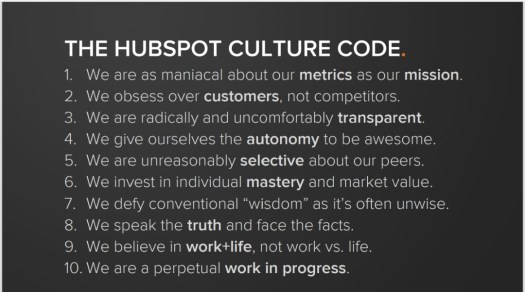
Communicate your culture widely. In 2009, Reed Hastings, famously published a 125-page powerpoint on Netflix’s culture that has been viewed over 10M times. Its refreshingly direct tone struck a chord by focusing on values and performance over rules and controls. It set a culture that enabled their meteoritic growth. The HubSpot Culture Code and the Valve New Employee Handbook emulate this open approach to transparently communicating culture.
“Simple, clear purpose and principles give rise to complex, intelligent behavior. Complex rules and regulations give rise to simple, stupid behavior.” —Dee Ward Hock, Founder of Visa
Put Culture into Action. Ultimately, culture is not the words you write on the wall or share in a handout, but the actions you take as a business. This means that leaders’ actions set the tone. Live those principles you want your team to embrace. Culture isn’t a static set of ideals, but a dynamic outcome from consistent actions, decisions, and behaviors that the business practices:
- Prioritize cultural fit in hiring: Invest time to find individuals who are not only high performers but also a strong culture fit. Communicate your culture clearly to potential hires to attract those who self-select to your principles. Likewise, ensure people continue to embody your culture. HubSpot states that cultural debt is crushingly worse than financial or technical debt. They screen candidates closely and shed mistakes quickly. Netflix uses the “Keeper Test”: Would you fight to keep this person if they wanted to resign? If not, let them go now.
- Recognize and reward the right behaviors: Ensure that promotions, bonuses, and recognition systems reinforce behaviors that matter most and align with your business values. Netflix and HubSpot explicitly state that their actual company values are shown by who gets recruited, rewarded, promoted, or released. HubSpot uses its HEART awards to recognize those who “live by their values every day and make us proud to work here.” Google-X, which values innovation, uses a rarely awarded “Audacious Award” to encourage risk-taking and offers those who shut down any project extra paid time off and a bonus.
- Empower your team: Minimize unnecessary controls and trust the judgment of employees who fit your culture. Your culture should set guidelines for building informal relationships and creating ways to resolve conflicts among subordinates, bosses, peers, and external players such as suppliers, regulatory authorities, and customers. Create a culture that guides good decisions, then address exceptions as they arise. HubSpot says, “Solve for the customer” and “Use good judgment.” At Netflix, everyone is expected to make big decisions without waiting for executive approval. If mistakes happen, they serve as learning opportunities rather than reasons for punishment.
- Create lore, rituals, and traditions. Enshrine stories and recurring practices that build cohesion and strengthen a sense of belonging and understanding of culture principles. Netflix’s “culture onboarding” ensures new hires are immersed in their values from the start. Stories of HubSpot’s founders’ early coding and regular reshuffling of everyone’s desks contribute to their team culture and sense of fun. These consistent actions and shared stories become part of the company’s identity and serve as ongoing reminders of what’s important.
Embrace iteration: Culture is not reserved for certain groups and is not written in stone. Resist the temptation to impose a top-down culture. Culture consists of living relationships working toward a common mission, built by collective actions and shared principles. Have quarterly culture reviews: What’s working? What’s outdated? Publicly share and discuss failures to create learning. Generate reflection and conversation, allowing the team to co-create a shared path. Shah suggests uncovering and tracking the ‘bugs’ in your culture code and he shares responsibility for fixes. Their culture deck has been updated at least 30 times. Great culture is always changing and evolving, requiring continuous adaptation and response.
Culture isn’t built overnight—it’s a deliberate, ongoing effort. Start with one or two small changes and scale up. The goal isn’t to copy Netflix or HubSpot but to adapt principles to fit your unique business.
Get a jump start on communicating your culture using HubSpot’s culture code template.
How are you building the culture you love?
-
A Leaders Guide to AI

AI is growing fast. A recent McKinsey Study shows that adoption spiked in 2024 with a 50% increase in businesses using AI in at least one function. And adoption is accelerating:
- 98% currently use AI-enabled tools in some capacity.
- 40% specifically use generative AI applications like chatbots and image creation tools—double the number from the previous year.
- 79% regularly use or experiment with AI.
- 83% that have implemented AI report tangible benefits, such as improved efficiency and operational effectiveness.
Yet, most businesses are not fully taking full advantage of the possible benefits. According to Chris Tamm, a recent Vistage speaker on AI for our mountain group and CEO at Cast Services, AI can provide 2x to 100x efficiency in specific tasks and can position you for accelerated differentiation from competitors. Now is the time to take bold action.
AI success, like much business success, starts by fostering a culture of continuous learning and experimentation. Get key players involved and knowledgeable about AI. Make it business-driven. Start by acknowledging, “AI is not an IT project… It’s a business project.”
Here’s a list of actions to start today to drive AI adoption:
- Invest 15 minutes/week actively working with a new AI tool: Gain hands-on experience with AI to understand its capabilities and limitations. Allow yourself and your team to stay updated and involved with AI. Some places to start include:
Try ChatGPT to plan a trip (bonus: use the Expedia plug-in)
Upload a resume or Excel sheet to Gemini and ask questions
Try Gamma.app to create a PowerPoint presentation
- Teach team members the basics of AI: Training is crucial for ensuring safe, responsible, and effective AI use. Training programs should cover technical skills, privacy and legal compliance, ethical considerations, and best practices with case studies.
- Review the AI Policy Primer document with leadership: This helps inform all about AI’s implications to guide conversations around policy. It offers an overview and deeper dive into the nuances of AI and automation.
- Update company policies: Revise customer and vendor agreements and employee policies to address AI-related issues such as: what public AI tools can be used and how, ethical considerations, data privacy compliance and protection protocols, AI literacy and training, transparency and accountability mechanisms, intellectual property management, security protocols for AI systems, cyber-insurance, and continuous policy review and adaptation.
- Create a ‘passphrase’: In an age where AI can generate convincing fake content, it’s important to establish a security protocol within your family and business to verify the authenticity of communications or content that can be used for nefarious purposes. Consider something like, “Does this impact ‘global expansion?’” with a response that must mention a specific non-obvious country like ‘Naru’.
- Discuss initial project selection with your organization: Involve cross-functional stakeholders to identify suitable AI automation projects that align with organizational goals.
- Pick 1-3 small projects to scope and move forward: Starting with small, manageable projects allows teams to understand new applications of AI tools and frees them up to do more critical work.
For the last two bullets, Chris Tamm offers a non-traditional assessment approach. He suggests businesses start by exploring the hopes and fears that stakeholders have around AI automation. Are they excited about not having to do menial tasks? Do they worry they will lose people? What are concerns about the impact on customers? Discuss mitigation methods like:
Human-in-the-Middle (HIM) indicates a system where human oversight and control are present in an AI-driven process, especially in critical decision-making steps.
Human-Enhanced-Response (HER) refers to AI improving or augmenting the human response with suggestions or alternatives.
With these as guidelines for moving forward, ideate about where AI could fulfill the hopes and deliver value. For each function, analyze current processes to find areas for AI and automation. Focus on identifying specific use cases that can provide tangible benefits.
Tamm says, “Most great use cases are not packaged solutions.” Think beyond the capabilities of tools to understand how AI can improve your specific business practices. Encourage operational employees to think creatively about the “WHAT” (strategic goals) without worrying initially about the “HOW” (technical implementation.) Examples include:
- Document review, summarization, and data extraction
- Support chatbots
- Sales call grading and data extraction
- Automating integration between systems
- Research and long-form content writing
- Email handling and follow-up
For each idea, discuss openly the associated business and people risks. Prioritize those that are most promising. Then scope the top 1-3 projects. Get appropriate technical help to estimate feasibility, cost, and return.
Then, get started. Early adopters gain a significant edge in efficiency, innovation, and market responsiveness.
Benefits Include:
Increased Efficiency: Automate repetitive tasks to free up people for more strategic activities. Time not spent on administrative tasks can allow focus on more value-added activities like connecting with customers.
Cost Savings: Reduce operational costs through streamlined processes and optimized resource allocation. One real estate team saved $8k/month versus a $1.5k/month cost.
Improved Accuracy: AI can reduce errors and improve the quality of output. Radiologists using AI correctly diagnosed 92% of the time, compared to 77.5% by physicians alone.
Better Decision-Making: AI enhances decision-making through data-driven insights and predictive analytics.
Enhanced Scalability: AI facilitates scalable solutions, allowing your business to grow without being limited by human resource constraints.
Competitive Edge: Leverage AI for innovation and improved customer experiences to stay ahead of your competition.
By taking initial steps now, you can responsibly integrate AI automation into your business, driving growth, efficiency, and a more innovative future. How will you begin to capture the benefits of AI automation?
Jon Strickler, Vistage Chair & Executive Team Coach
Adventure humbly. Live boldly.
Find me at: 720 323 0793, jon.strickler@VistageChair.com, Twitter: @HorizonLineGp, LinkedIn: www.linkedin.com/in/jonst, Website: HorizonLineGroup.com
-
Good Goal Setting
There’s been a lot of debate about how to best set goals for a business. SMART suggests they should be Achievable. Stretch suggests they should be motivational. BHAG suggests they should be inspirational. So, what’s the right approach? Eric Kish, spoke at our last Vistage meeting and I believe he has cracked the code. In his presentation, book, and blog, he proposes a three-tiered system that includes a Threshold, Target, and Stretch goal. Let’s look at how and why it works.
Stretch goals have a mixed track record. Motorola famously reduced product development time by tenfold in the 1990s after mandating stretch goals. But when too ambitious or unrealistic, they have demotivated and overwhelmed people. They caused ethical issues at Wells Fargo, and led to failure at Yahoo. SMART goals meanwhile suggest that goals should be Attainable. These can fail to challenge teams to perform above minimal levels.
A three-tiered goal system balances the need for challenge and attainability. It includes goals set at a:
- Threshold: The minimum acceptable level of performance that must be achieved. These goals should be achievable 85% of the time. It is the point below which the performance is considered unacceptable.
- Target: The realistic and committed level of performance that is expected to be achieved. These goals should be achievable 50-60% of the time. Up to this point, performance is considered satisfactory.
- Stretch: The exceptional and ambitious level of performance that is aimed to be achieved. These goals are achievable about 10-15% of the time. Any performance above Target is considered outstanding.
Why include the three tiers? Kish’s system is based on a behavioral psychology concept known as anchoring. When buyers are presented with only two choices, say an economy ($10) brand and a standard ($20) brand, they will most often anchor on the economy brand and choose it. However, when also given a premium ($40) option, they more often anchor on and choose the standard brand. So, by including the Stretch goal, the idea is to have employees anchor on the Target goal and be more likely to be motivated to achieve it.
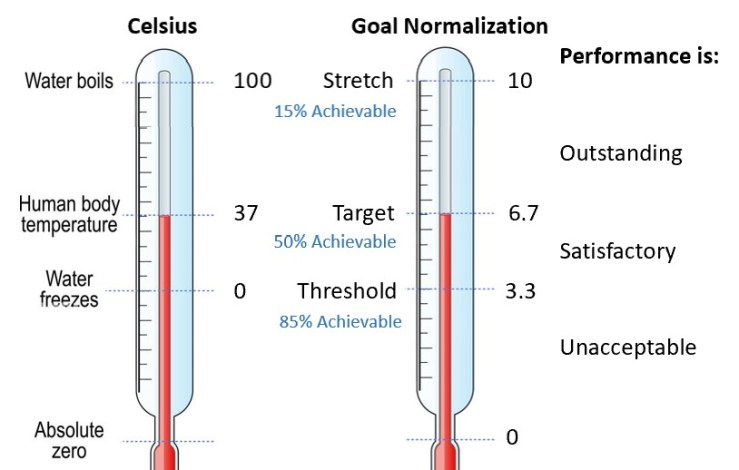
The other beauty of the system is that it allows for a common scale and nomenclature across all business metrics. This makes it easy to compare performance across all metrics and know the metric’s health regardless of the absolute measure. The different goals are analogous to how the temperature scale is set:
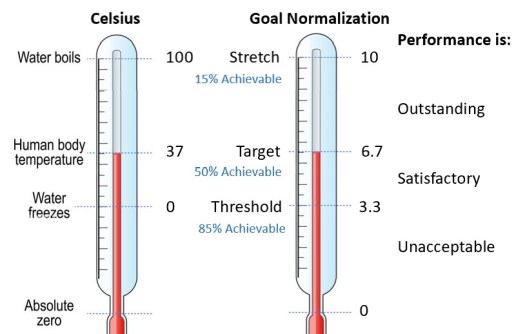
A metric that performs at the Threshold goal is normalized to 3.3. Everything below this is ‘Unacceptable.’ The Target is normalized to 6.7. Between a normalized score of 3.3 and 6.7, performance is ‘Satisfactory’. The closer to 6.7, the closer we are to Target. The Stretch goal is normalized to 10; any metric at or above 6.7 is considered ‘Outstanding’ performance and we can tell how close we are to the Stretch goal by how close we are to 10. Above 10 and we have exceeded even the Stretch goal.
These normalized scales can also be used to calculate performance bonuses. This practice has been used in finance for many years, and these normalized metrics give structure to allow for a level playing field for any organization.
Setting goals can be contentious and hotly debated. Properly set goals can motivate and challenge. Poorly set goals can demoralize. How can a three-tiered approach help your business?
To learn more, see Kish’s articles, The Tricky Job of Setting Targets and Metrics? Anything can be Measured. You can also learn more about how to set the different goals at Best Practices in Performance Goal-Setting.
Please follow, share, comment, and like. Message me if I can serve in any way.
May you find adventure, joy, passion, and freedom in all your pursuits.
-
What Chief Executives Do

Being a CEO or business owner isn’t about making big decisions from a corner office. It’s about setting the vision and building a business that thrives with or without you. Whether you own a mom-and-pop, found a startup, or are CEO of a Fortune 500 company, the job boils down to these few core responsibilities.
1. Set and Communicate the Vision
Great leaders ensure their companies operate with a clear sense of purpose. A CEO’s job is to define that purpose, set long-term direction, and communicate it relentlessly. Setting a direction means embracing new ideas, adapting to an evolving business context, and identifying patterns from a broad range of inputs. It involves broad-based thinking and a willingness to take calculated risks. The output is a compelling vision and roadmap that describe why the business exists and what it should become. They focus efforts on the most critical activities.
2. Create a High Performing Culture
CEOs build values that guide action, align work, and motivate people. They ensure the business operates according to its values. They align work so that people across all levels work toward the same future and feel empowered to help drive the vision forward. It requires creating a clear vision, building informal relationships, and creating ways to resolve conflicts among subordinates, bosses, peers, and external players such as suppliers, regulatory authorities, and customers. They motivate people and energize their teams by making goals personally relevant, involving others in decisions, providing constructive feedback, and consistently recognizing and rewarding the right behaviors. When employees understand their purpose, know how they contribute to the vision, and feel valued and empowered, their culture allows them to push through challenges and contribute at a high level.
3. Build Key Relationships
CEOs are the face of the business. Whether talking to investors, partners, customers, regulators, or employees, they represent the business to the world. Strong leaders inspire confidence, tell compelling stories, and build relationships that help the company grow and accomplish its vision.
4. Ensure Great Execution
CEOs must ensure that priorities are clear, teams are aligned, and obstacles are removed. Great CEOs spend significant time recruiting, coaching, and fostering a culture of accountability and high performance. They act as the ultimate problem-solver and arbitrator, ensuring the best results by having the right leadership team members who have the resources and skills needed to deliver success.
5. Ensure Longevity
CEOs set financial goals, ensure regulatory compliance, and manage risk and oversight to support the vision and ensure business longevity. No matter how great your vision, cash flow is king. They must know their numbers well enough to ensure healthy revenue streams and raise capital when needed.
6. Scale Yourself
The best CEOs recognize that their role evolves as the company grows. What worked at 10 employees won’t work at 100, and what works at 1,000 requires an entirely new approach. Responsibilities can be delegated, but final accountability in these areas stays with the CEO. Great leaders embrace disciplined thought and action, constantly improving themselves and others to meet the needs of the business.
If you’re a chief executive—or aspiring to be one—focus on these core responsibilities, and you’ll set yourself and your company up for long-term success.
How would you modify this list?
Explore more in these related articles: Build in Leadership and Management, and A Closer Look at Leading and Managing.
Adventure humbly while living boldly.
Jon Strickler, Vistage Chair & Executive Team Coach
Find me at: 720 323 0793, jon.strickler@VistageChair.com, Twitter: @HorizonLineGp, LinkedIn: www.linkedin.com/in/jonst, Website: HorizonLineGroup.com

About Me
The sky is not completely dark at night. Were the sky absolutely dark, one would not be able to see the silhouette of an object against the sky.
Follow Me On
Subscribe To My Newsletter
Subscribe for new travel stories and exclusive content.
 Horizon Line Group