

Hello, I’m Veronica
The sky is not completely dark at night. Were the sky absolutely dark, one would not be able to see the silhouette of an object against the sky.


-
Mastering the Space Between Stimulus and Response

Life’s complexities often overwhelm us, as if external forces control our experiences. However, while we can’t control everything that happens, we have absolute power over our thoughts and actions. This shift in perspective is crucial for navigating healthy mindsets, creating systems that build the right actions, and finding peace amidst life’s many stresses.
“Between stimulus and response, there is a space. In that space is our power to choose our response. In our response lies our growth and our freedom.” —Viktor Frankl
These words by holocaust survivor and author of ‘Man’s Search for Meaning,’ penned in 1945, may be the most powerful self-help sentences ever written. In their simplest form they say that regardless of external factors, we control only two things: our thoughts and our actions. We cannot control what happens in our lives, but we can always control what we think and do. We choose based on our thoughts and depending on the actions of our response, we grow our mental freedom and ultimately the meaning and happiness we derive.
What you control:
You may be thinking, “Surely, I control other things in my life. What about things like making my sales goals at work? It’s important, and I will do whatever is needed to meet the goal?” Just because you work hard doesn’t mean you control the result. With the right attitude (thoughts), you do the work (actions) to best sell to prospects. This will influence the outcome. But you cannot control things like the timing and selection preferences of others who make buying decisions. The final result is not within your control.
Other things you may be concerned about fall outside of any influence. No amount of effort can affect things like the weather. You cannot change the past and people can act as they wish. Most of us who are not Federal Reserve Chairs or Elon Musk will not influence stocks or the economy.
Cultivating ‘Space’: Tools for a Healthier Mindset
In the ensuing 80 years, many scholars have attempted to explain what best should occupy the ‘space’ Frankl identifies. Throughout the years they have suggested we adopt tools that use:
Internal Locus of Control, Julian Rotter, 1954 —Creates the power to act through belief in having control of your fate, over the belief that external forces drive your life.
Self-efficacy, Albert Bandura, 1970s —Emphasizes that it’s not just about having control over our thoughts and environment, but also about believing in our capacity to influence circumstances through sustained effort, regardless of setbacks or obstacles.
Ladder of Inference, Chris Argyris, 1974 —Makes explicit and creates awareness of how we add judgment and story to the available facts and data that influence our actions.
Be Proactive, Stephen Covey, 1989 —Focusing on what we can influence instead of being victims to things outside of our control empowers us to choose our response to any situation.
Radical Acceptance, Marsha Linehan, 1990 —Fully accepting reality as it is without judgment or resistance allows for letting go of the emotional struggle from fighting against things we cannot control and responding with more clarity.
Emotional Intelligence, Daniel Goleman, 1995 —Understanding and managing emotions through better self-awareness, self-regulation, empathy, and social skills allows for more constructive responses.
Mindfulness, Dahli Lama, 1998 —Becoming more aware of our thoughts and emotions, enables us to choose responses based on compassion and kindness and create more positive and fulfilling interactions.
Growth Mindset, Carol Dweck, 2006 —Adopting a growth mindset where we believe that our abilities can be developed through effort and learning, encourages taking on challenges, remaining resilient, and achieving greater success.
Grit, Angela Duckworth, 2016 —Sustained effort through passion, practice, purpose, and hope, rather than talent alone, is key to overcoming obstacles and achieving long-term goals.
Extreme Ownership, Jocko Willink, 2020 —Taking full responsibility for team results, learning from failures, and proactively seeking solutions, even when others or external factors influence the outcome, generate the best results.
Focus Energy on What You Control
As the serenity prayer suggests, we should all have “… the serenity to accept the things we cannot change, the courage to change the things we can, and the wisdom to know the difference.”
Frankl’s quote clarifies that we can and should make space to control our thoughts and resulting actions. Use this control to find meaning in both success and challenging circumstances and to take responsibility for creating a life that contributes based on your unique abilities and interests. With this focus, create more impact in the world. Master your inner world so that your actions create a ripple effect that extends outwards.
Make better use of the space between stimulus and response by:
- Acknowledging innate limitations and focusing your energy on what you can control (thoughts and actions)
Thoughts
- Choose to respond to challenges with a healthy mindset using one or more of the tools developed over the last 80 years that work best for you
- Move quickly from thoughts about “why is this happening” to “what can I do about this” to allow for clearer thinking and more effective problem-solving
- Find meaning for yourself to create your unique positive drive toward results
- Create themes and commitments for you and your business that prevent reactive actions
Actions
- Be intentional about the actions you take
- Build and grow skills to increase chances of success
- Make plans and be prepared to best work toward goals
- Adopt habits, routines, and systems that create actions aligned with your goals, values, vision, and purpose
By using healthy mindsets to master our thoughts and actions, we empower ourselves to navigate life with greater clarity, purpose, and peace of mind. We live happier, more productive, more meaningful lives. What occupies your space between stimulus and response?
May you adventure humbly while living boldly in the New Year.
-
Maximizing Your Happiness Math

Understanding and practicing what brings happiness is the path to living a richer, more fulfilling life. Yet, many misunderstand how to create it in their lives. We can chase possessions, approval, and leisure. Or we neglect health and relationships in the failed pursuit of happiness.
To better understand how to build real happiness, let’s explore various happiness equations, highlight common themes, and extract practical tips for intentionally building happiness.
Why Happiness is Important
Before digging into how to be happier, let’s consider why happiness is important. Like all self-care, it’s not a selfish act. The Dalai Lama goes as far as to argue that “the purpose of life is to be happy.” It is not a fleeting emotion but a fundamental aspiration that guides our actions and choices. It’s If you need more reasons to prioritize happiness, it is also essential for:
Health and well-being: The Harvard Study of Adult Development, one of the longest-running studies on happiness, suggests that people who describe themselves as happy tend to have fewer health problems, a lower risk of depression, and longer lives
Resilience: By focusing on love and enjoyment rather than fear and doubt, we increase our resilience and ability to navigate life’s inevitable ups and downs, overcome obstacles and achieve our goals.
Contributing to a better society: Individual happiness can have a ripple effect, creating a more positive and harmonious society. As the 14th Dalai Lama explains, “If a person is happier, his or her family is happier; if families are happy, neighborhoods and nations will be happy.“
Defining Happiness
This year, I read Mo Gawdat’s book with the title Solve for Happy. In it, he presents the first happiness equation below. It got me exploring how others define happiness. As I researched other relevant discussions on happiness, some authors had their own equations. For others, it was easy to create equations. I found equations to be a way to simplify a complex topic, show similarities, and encourage analytical thinking about the interplay of elements influencing happiness.
It’s important to consider these equations as concepts rather than precise calculations:
- Happiness ≥ Events of your life – Expectations of how life should be. Mo Gawdat
- Happiness = Self-Knowledge + Good Habits. Gretchen Rubin
- Happiness = Meaning + Work + Positive Relationships. Shawn Achor
- Happiness = Meaning + Pleasure. Tal Ben-Shahar
- Happiness = Meaning + Accomplishment + Positive Emotion + Engagement + Relationships. Interpretation of Martin Seligman
- Happiness = Meaning + Enjoyment + Satisfaction. Arthur Brooks & Oprah Winfrey
- Happiness = Purpose + Discipline + Gratitude. Andy Frisella
- Happiness = Yearning + Trust. Martha Beck
- Happiness = Compassion * Calm Mind. Interpretation of The 14th Dalai Lama
- Happiness = [Alignment + Contentment] * Control. Interpretation of Rangan Chatterjee
The 1st equation argues that it’s not just about what happens to us, but how those events measure up against our preconceived notions of how they should have happened. It emphasizes the importance of managing our expectations and cultivating acceptance of life’s events. While Gawdat emphasizes that happiness is our default state, he seems to focus on how not to be sad rather than on what contributes to happiness.
Equation 2 takes a “to thy own self be true” approach that counters the 1st equation. It simplistically states that knowing what brings you joy and building habits that deliver those things is what brings happiness.
The next few equations (3-7) expand on the idea that happiness stems from being able to deliver on the Self-Knowledge of what we find important and joyful as in equation 2. The most common new element is Purpose or Meaning. Most have an element of Discipline, Work, or Accomplishment (like Good Habits in equations 2) describing how to deliver it. Some equations add the related elements of Enjoyment, Pleasure, and Positive Emotion. Relationships, Engagement, and Gratitude/Satisfaction round out the list of elements that bring happiness.
Equation 8 takes a more forward-looking approach. It expresses that happiness comes from surrendering to the possibility that what we yearn for is attainable, even if we don’t yet see the path clearly. This aligns with Beck’s concept of letting go of fear and doubt to enable our desired outcomes to manifest through love and integrity.
“If you want others to be happy, practice compassion. If you want to be happy, practice compassion.” – The 14th Dalai Lama
In equation 9, The Dalai Lama takes a somewhat different and simplistic interpretation. He suggests that “the key to happiness is peace of mind” which comes from cultivating “kindness and warm-heartedness towards others”. He emphasizes that compassion is the source of happiness so Compassion and Calm Mind reinforce each other.
Common Themes
Equation 10 captures common themes that run across the equations:
- Alignment creates integrity and congruence between what you believe in and how you spend your time. It combines the ideas of Self-knowledge with Accomplishment reducing internal conflict and fostering a sense of Meaning/Purpose and authenticity. This also ties to the need for positive Relationships, Emotions, and Enjoyment with people, things, and actions that align with your values.
- Contentment involves accepting and appreciating your present circumstances, rather than constantly striving for more. It combines the ideas of Satisfaction and Gratitude for what you have with fulfillment in the present moment. It also ties to the Dalai Lama’s emphasis on cultivating a Calm Mind and inner peace.
- Control allows for agency in making meaningful decisions, managing reactions, not being overwhelmed by external pressures, and taking appropriate action. When you feel in Control, you can surrender to the possibility of achieving your desires and act with integrity to achieve them. Control puts a positive slant on the broadest theme: that happiness comes from inner mindsets and positive action.
“Happiness does not depend on what you have or who you are. It solely relies on what you think.” -The 14th Dalai Lama
It’s worth noting what is absent:
Status, titles, praise, things, money, comfort, and leisure are lacking from all equations. There is no room for ego, greed, or sloth in any of the happiness equations. There is an element of Pleasure, and you might derive it from some possessions. But happiness is not gained by acquiring more in a never-ending game of trying to be enough, have enough, or relax enough.
There is also no element of self-sacrifice. Creating Meaning and Purpose do not require ignoring health or relationships. Instead, Compassion (including self-compassion,) a Calm Mind, and strong Relationships are all elements that add to happiness. Self-care builds the foundation for happiness.
Be Intentional About Happiness
From a study of the equations and the associated explanations, I take away the following practices as ways to be intentional in building more happiness:
Work on Meaningful Goals: The most common element across equations suggests the need to derive Meaning and Purpose from your desires and actions. Spend priority time on what aligns with your values and passions in service to something larger than yourself. Stop doing activities that don’t feel meaningful.
Build Capabilities: The equations emphasize the need to be able to achieve your meaningful goals. Build and strengthen habits, routines, discipline, learning, and self-control to build a sense of agency and an ability to deliver on goals.
Make Joy a Priority: Allocate regular time for the activities that bring you Pleasure and Positive Emotions. Engage in 15 minutes of enjoyable physical activity daily, like walking or gardening. Spend quality time with family and friends, as strong relationships are crucial for joy and health.
Perform Random Acts of Kindness: Perform small and large acts of kindness and show genuine compassion and concern for fellow beings. Say hi to strangers like you mean it. Send positive messages that boost your mood and theirs while strengthening connections.
Focus on Internal Factors: All the equations emphasize the importance of inner work. True happiness stems from within and is built through integrity, self-awareness, realistic expectations, and a calm mind. These can be bolstered by mindfulness exercises, gratitude journaling, practicing presence, and building emotional intelligence.
Examine the elements across equations to uncover areas in your life that need attention. What resonates with you and how can you start working to include more of it in your day-to-day to grow your happiness?
Glossary of Happiness Equation Elements
- Acceptance: Embracing the reality of the present moment without resistance or judgment, fostering peace of mind.
- Accomplishment: Pursuing and achieving goals.
- Alignment: Ensuring that one’s inner values, beliefs, and purpose are in integrity with everyday actions, leading to a sense of authenticity.
- Calm mind: An active state of awareness and presence that allows facing reality with equanimity and wisdom. The Dahli Lama argues that cultivating compassion leads to mental comfort, which is the true source of happiness.
- Compassion: An active concern for the well-being of others.
- Contentment: A state of peaceful acceptance of one’s decisions, accomplishments, and life.
- Control: A sense of having agency in making one’s decisions.
- Discipline: The ability to consistently control one’s actions and follow through on commitments made to oneself.
- Engagement: Being deeply involved in activities that use your strengths.
- Enjoyment:
- Gratitude ~ Satisfaction: The state of being thankful and appreciative for what one has, fostering contentment.
- Meaning ~ Purpose: A driving force that provides motivation, significance, and direction in life, giving meaning to actions often by serving a larger cause.
- Mindfulness: Paying attention to the present moment without judgment, fostering self-awareness and emotional regulation.
- Positive Emotion: Experiencing joy, gratitude, and other positive emotions.
- Pleasure: Feeling enjoyment or satisfaction from engaging in activities or experiences that bring positive sensations or emotions.
- Relationships, Positive: Building strong, supportive connections with others.
- Self-Compassion: Treating oneself with kindness, understanding, and forgiveness, promoting well-being and resilience.
- Self-Knowledge: Knowing the foundation of our own values, interests, purpose, and temperament.
- Trust: Allowing in the possibility of a future reality; normally based on the reliability, truth, ability, and care of someone or something.
- Work: Engaging in productive and fulfilling tasks that contribute to personal and professional growth.
- Yearning: A strong emotional pull towards a particular goal, experience, or person, often accompanied by wistfulness or melancholy.
-
Integrity in Leadership and Life

Consistently living in integrity is key to lasting happiness and success. Ultimately it delivers better results as leaders and in life. It requires more than moral codes; it’s about aligning your life with your true self. Suffering comes from living in conflict with our core self, but is avoidable by making choices aligned with who we truly are. It requires introspection and difficult changes to our lives. Let’s explore how to journey toward integrity.
What is Integrity
According to the Oxford Dictionary, integrity is both: 1. Honesty: The quality of being truthful and having strong moral principles that you refuse to change, and 2. Wholeness: The quality of being whole, complete, and aligned.
Living in integrity goes by many names and definitions as indicated by some of the many books on the topic:
- True North: Bill George defines it as ‘the internal compass that guides you successfully through life.’
- Whole Hearts: part of Brené Brown’s subtitle to Dare to Lead defines it as ‘choosing courage over comfort; choosing what’s right over what’s fun, fast, or easy; and practicing your values, not just professing them.’
- Authentic Happiness: Martin Seligman says it is ‘characterized by a regular pattern of behavior consistent with one’s espoused values, moral convictions, and the genuine presentation of oneself to others.’
- The Way of Integrity: Martha Beck defines it as ‘being in harmony with oneself.’
Integrity means aligning your actions with your inner values, strengths, passions, and purpose. It requires being true to yourself and others, even when it is difficult. The root ‘Integer’ suggests it is about being “one thing, whole and undivided.”
Why is it Important
“Peace is your home, integrity is the way to it, and everything you long for will meet you there.” – Martha Beck
Integrity is a path to a better living with benefits that extend across personal, and professional domains. It improves:
- Happiness and Well-being: Living authentically reduces internal conflict and distress. It creates a sense of wholeness, peace, and inner harmony.
- Self-Respect and Confidence: As we act in ways that reflect our authentic self, we build trust in our judgment. We learn the importance of self-compassion in navigating and acknowledging our mistakes and setbacks without losing sight of our inherent worth.
- Relationships and Connection: We build transparency and trust when we are genuine and act according to our values. This allows for deeper and more meaningful connections, as others can rely on who we are.
- Stress and Anxiety: Living out of alignment feels disconnected, frustrated, overwhelmed, exhausted, lost, and unfulfilled. By contrast, aligning actions with our inner values reduces stress and anxiety as we live without friction.
- Fulfillment: Integrity builds a sense of purpose and meaning. This purposeful living contributes to a sense of satisfaction and a feeling that our life has direction and significance.
- Leadership Effectiveness: When leaders consistently follow their values, they create trust, respect, and credibility that inspires followers. It also motivates us and builds our ability to do good work and perform at our highest levels.
How to Live with Integrity
Living in integrity is a challenging endeavor for several reasons:
- We may not know our true selves. We can experience misalignment because we don’t know or trust ourselves, our values, or what we want from life. Without a committed understanding, making choices that align with them is hard.
- External pressures and expectations lead us astray. Societal expectations, a need to please others, comparing ourselves to others, and fear of judgment can lead to choices that contradict our true selves. We find ourselves believing in things that aren’t truly important. We conform to norms or pursue goals that don’t resonate with our authentic selves.
- We feel trapped by past commitments. We take on too many things because of beliefs about what we should accomplish or promises made. We create a story, feel bound by it, and sacrifice important values and other priorities to keep it.
- Uncomfortable emotions and difficult choices betray us. It can be scary, painful, and hard to acknowledge past mistakes, let go of unhealthy patterns, and make changes that disrupt our comfort zones.
- It requires consistent effort. It is not a one-time act, but an ongoing practice of aligning actions and values. This continuous effort is demanding, requiring constant vigilance and a willingness to course-correct often.
Martha Beck proposes a four-step process using Dante’s Devine Comedy as an allegory for the journey to lasting integrity:
- Recognition (The Dark Woods of Error and Mount Delectable): Recognize the disorientation and unhappiness caused by living out of integrity. Easy fixes appear to offer a path out, but ultimately only reveal the false allure of superficial desires, our pride and ego that prevent us from admitting vulnerabilities, and problems from choices made out of fear rather than love.
- Investigation (Descending the Inferno): Confronting internal forces that prevent integrity requires courage for deep self-examination to understand our meaning-making systems: mind, body, soul, and heart. We must confront and understand the sources of inner turmoil as represented by the Inferno’s eight levels. Among the traps are desire, greed, anger, pride, envy, violence, and lying. With this understanding and the resulting guardrails, we can work toward real integrity.
- Commitment (Ascending Purgatory): Examine every aspect of our life with a commitment to living authentically. Climb higher by aligning our external life with newfound inner clarity and making choices that actualize our true self. Implement incremental changes to live in integrity.
- Action (Living in Paradise): Continuously align actions to harmonize inner and outer worlds. Beck describes this as “effortless being,” where life flows naturally and we are fully engaged in the present to experience peace and joy. Taking care of ourself and living in integrity allows for more meaningful support to those around us. Maslow came to call this ‘Transcendence.’
Tools and Techniques
This approach takes time and focused practice using strategies to understand and grow integrity:
- Self-awareness: Deeply understand your true self. Define values, strengths, passions, and purpose. Complete a value and visioning exercise to make them explicit. Continuously refer to them to ensure they guide decisions and actions.
- Mindfulness: Cultivate awareness of thoughts and feelings. Notice when caught in the Dark Woods or attempting to climb Mount Delectable. Learn to benefit from emotions that indicate when integrity is missing.
- Journaling: Reflect on your experiences and identify areas needing more integrity. Journaling helps to clarify your true self, understand needed alignment, and express gratitude for what works.
- Compassion: Be kind to yourself and others and recognize that growth takes time. It requires forgiveness for mistakes of the past and along the way.
- Ownership: Own your actions and their consequences. Being a victim doesn’t allow us to adjust our actions to align with our integrity.
- Set boundaries: Adjust or stop activities that don’t align with your values and embrace those that do, regardless of expectations.
- Stay Consistent: Integrity isn’t a one-time act; it’s a way of living. Be truthful to yourself and others in your words and actions so that they always match your true self, even when it’s uncomfortable.
What is one area of your life where you might be struggling with integrity? Maybe it’s in a relationship, work related, or in another priority. What is one small step you can take today to move toward greater integrity; a step toward a happier and more fulfilling you?
Jon Strickler, Vistage Chair & Executive Coach
Find me at: 720 323 0793, jon.strickler@VistageChair.com, Twitter: @HorizonLineGp, LinkedIn: www.linkedin.com/in/jonst, Website: HorizonLineGroup.com
-
Strategic Planning Answers the Right Questions

Strategy answers all the questions of “why, where, how, what, when, and who.” When you construct the answers to these questions from the top down, you create a coherent business strategy.
Planning that comes from this top-down approach is strategic planning. It leads to a program of initiatives that delivers success. Your employees and customers understand why you exist and how your actions support it. Planning that comes from less integrated approaches can lead to disjointed action. It’s just planning.
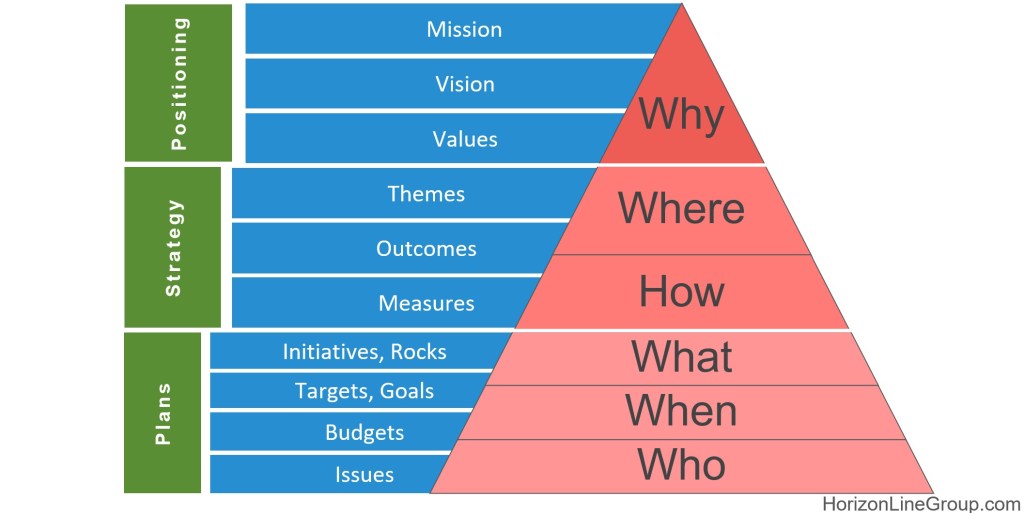
Let’s explore how to answer these questions in a top-down hierarchy through positioning, strategy, and plans to align efforts, track progress, and achieve vision with clarity and purpose.
People don’t buy WHAT you do, they buy WHY you do it. – Simon Sinek
Positioning: Answering “Why?”
Positioning is the foundation of any strategic plan. It answers “why the business exits” by defining:
- Mission: The enduring purpose of the organization. It explains why the company exists and what it aims to achieve.
- Vision: The aspirational goal of the organization. It paints a picture of what the company will become and how it will be viewed by the world when the mission is fully achieved.
- Values: Principles and beliefs that guide the business’ operations, actions, and decisions. They establish the company’s culture and ethical standards.
Together, these elements provide a clear sense of purpose and direction, ensuring that everyone in the business and their customers understand why it does what it does.
Strategy: Answering “Where and How?”
Next, strategy sits in the middle to answer the questions of “where to play” and “how to win.” This creates a coherent framework for moving the business toward its positioning. Strategy connects why you exist with what you do based on assumptions and answers to these questions.
You cannot fully control strategy. Strategy makes assumptions about customers and the context that influences your business. Who are your customers? What do they want? How will you reach them? How do your offerings differ from or complement competitors? Which competencies are needed? What trends are important? The answers create assumptions to be tested by a strategy that informs planning and allows for monitoring of results. Strategy creates coherent action that makes sense to employees and customers.
This involves defining:
- Themes: The broad areas of focus that drive the business’ efforts. They represent the strategic priorities that advance the mission and vision over the next about 3 years. At a minimum, themes answer what differentiators you offer, how you go to market, and how you make money.
- Outcomes: These are the specific results that the organization aims to achieve within each theme. They describe success.
- Measures: The metrics used to track progress towards the outcomes. They ensure that the organization can objectively assess the accuracy of its assumptions and make necessary adjustments.
By defining these, strategy informs a roadmap for achieving the organization’s vision, outlining where to focus efforts and how to achieve success. The answers ensure that everyone in the business and their customers understand ‘where’ and ‘how’ it does what it does.
Plans: Answering “What, When, and Who?”
Armed with your best answers to the ‘strategy’ questions, you next align plans and actions. Plans lay out the practical questions of “what, when, and who.” You can control planning, so it’s tempting to start here. But, resist the urge since planning will not be aligned unless it has answers to the questions above it to create needed alignment. Planning questions should be answered annually by creating focused:
- Initiatives: These are the specific projects that have defined scope and timeframe and actions that will be undertaken to achieve the strategic themes and deliver the desired outcomes.
- Targets: These are the specific objectives that the organization aims to achieve through the initiatives usually set for about a year out. They should tie to Measure where possible and can also be more subjective.
- Budgets: These outline the people, financial, and other scarce resources allocated to each initiative within the planning horizon (normally annually.)
And then at least quarterly by detailing:
- Rocks: The major priorities or milestones that need to be accomplished by the end of each planning period (normally quarterly.)
- Goals: The objectives that define success for the rocks.
- Issues: The challenges and obstacles that need to be addressed to ensure successful execution of the plans. Defining and resolving issues allows teams to make steady progress.
Plans define and periodically refine these to provide a detailed blueprint for action, ensuring that the organization knows ‘what’ needs to be done, ‘who’ will do it, and ‘when.’
Leaders can mistakenly use ‘goals’ as a replacement for strategy. Goals do not create strategy on their own. They are important at each layer to clarify and allow measurement of the essential strategic questions. Vision is a long-term goal that describes how you will be viewed if you achieve your mission. Outcomes, measures, targets and goals are all ways to describe success for their associated levels and timeframes.
StrategyOS is a framework to keep these questions current so that you maximize success. In previous newsletters, we covered implementing strategy transformation using iteration to validate and improve strategy and creating people practices needed for good strategic planning.
How does your business answer the basic questions of “why,” “where to play, and how to win,” and “what, when, and who?”
Let me know how I can help your business answer these questions as you set up for success in 2025. Jon Strickler | 720 323 0793 | Schedule a Call | Strategy Workshops
Stay humble, adventurous, and bold!
-
Strategy Needs Context
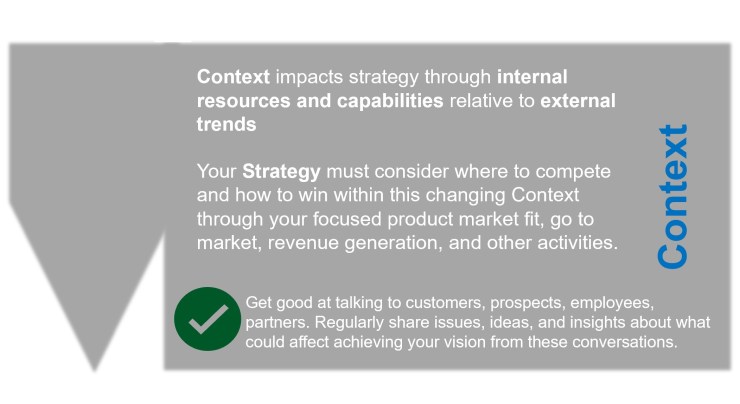
Evaluating context helps businesses ensure their strategies stay aligned with the current environment and customer expectations. Let’s learn more about Context and three ways to institutionalize keeping it aligned with your strategy.

What is Context
Context refers to the specific environment, circumstances, and factors that can impact a business’s ability to achieve its Vision. The impact could add positive or negative momentum. Aligning strategy with the Context that underlays your business model accelerates success. To continue to have a good strategy, your business model must stay coherent with this Context.
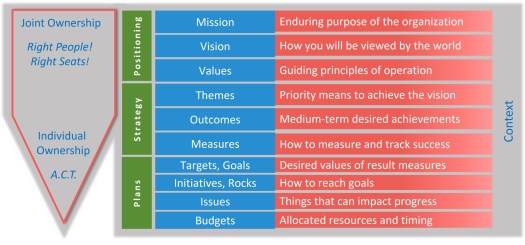
The components of your Business Model run on top of relevant Context Your Positioning and Strategy must continue to update and refine where you will compete and how you will win within the evolving Context. Understanding Context helps you formulate and adjust ideas about what must be true for your strategy to succeed and to reach your vision. From this understanding, you create alignment between what your business does and what will best succeed in your Context. It allows for creating focused product market fit, go-to-market, revenue generation, and other Themes of your strategy.
This understanding feeds into Leadership Team meetings and the Adapt and Grow phase of StrategyOS to resolve issues and make necessary changes to the business model that runs on top of Context.
Assessing Context
Assessing Context is an activity that strategy practitioners make complicated. Some of the many ways to evaluate context include: SWoT analysis, 5-forces, competitive positioning, customer segmentation, value chain analysis, adjacent markets, best practices, and internal gap analysis! While these add understanding, they also add time delays and complexity. And they are difficult to keep current and relevant.
There are 3 easier ways to routinely integrate Context with Strategy:
- Listen to customers and employees
- Allow space to work “on” the business
- Council meetings
The most important thing leaders can do to support this step is to listen to customers, employees, and other stakeholders. Support your reps on sales calls. Conduct customer surveys and focus groups. Create formal and informal A/B testing. Check your support desk and other customer-facing processes that define how the world sees your business. Understand customer needs and ensure they see you how you want to be seen.
Similarly, find ways to get feedback from your employees. Tactics include: open office hours, ACT meetings, suggestion boxes, walking around, and team-level council meetings (discussed below.)
The next most impactful thing leaders can do is to allow time to work “on” the business away from the day-to-day. Many leaders I know schedule weekly blocks for this “thinking time.” The best leaders schedule longer blocks of time monthly and schedule full day or longer blocks each quarter and annually. Wickman (pg 214) calls these Clarity Breaks. This is not time to catch up on work tasks. Instead be alone, away from work, with a notepad and no distractions. Focus on important questions like Positioning, Context, priorities, people, processes, products, nagging issues, emerging trends, and how you structure your own time and work. You can start with written questions from the week, or focus on what comes to you. The outcome should be ideas that can lead to expanded opportunities, accelerated success, and expanded relevance.
In his book, One Hour Strategy, Jeroen Kraaijenbrink suggests that everyone works on strategy from their level and their perspective. Executive leaders should spend at least 1 hour per day, managers should spend 1 hour per week. He organizes times of reflection around three strategy and context questions (the 3Qs):
- Q1. Relevance: Do we still have the right strategy?
- Q2. Progress: Did we make the right progress?
- Q3. Mood: Is everyone still on board?
From these different perspectives, the goal is to uncover issues, gain insights, and generate innovative ideas (the 3I’s):
- I1. Issues: Any problem, bottleneck, or mistake identified
- I2. Insights: Any fact, observation, or experience learned
- I3. Ideas: Any solution, improvement, opportunity, or innovation identified
Peer groups and advisory boards are another way to create time to work “on” the business. Ideally, these groups bring diverse perspectives, take a long-term view, meet regularly, and have the best interests of the leader and the business as their agenda.
Council meetings ensure your company stays in touch with its Positioning and that it stays relevant with evolving changes and trends in the Context in which it operates. These meetings combine the idea of listening to customers and employees with a formal agenda focused on working “on” the business. Where other rhythm meetings are focused on execution, these meetings are focused on strategy (for details see Great Council.)
Cascading Council meetings through all levels of the business ensures good employee input from those who are closest to your customers. It allows everyone in the business to spend at least 1 hour per month considering strategy and the business Context that impacts strategy.
To learn more, jump into how to set up council meetings and how to adapt and grow as you evaluate Context. As you work to integrate Context into Strategy, check it against the green flags for coherence.
What practices do you use to stay in touch with your business Context?
Please, comment, subscribe, and connect if you found this useful.
Live bolder each day!


About Me
The sky is not completely dark at night. Were the sky absolutely dark, one would not be able to see the silhouette of an object against the sky.
Follow Me On
Subscribe To My Newsletter
Subscribe for new travel stories and exclusive content.
 Horizon Line Group