
Hello, I’m Veronica
The sky is not completely dark at night. Were the sky absolutely dark, one would not be able to see the silhouette of an object against the sky.


-
A Winning Position
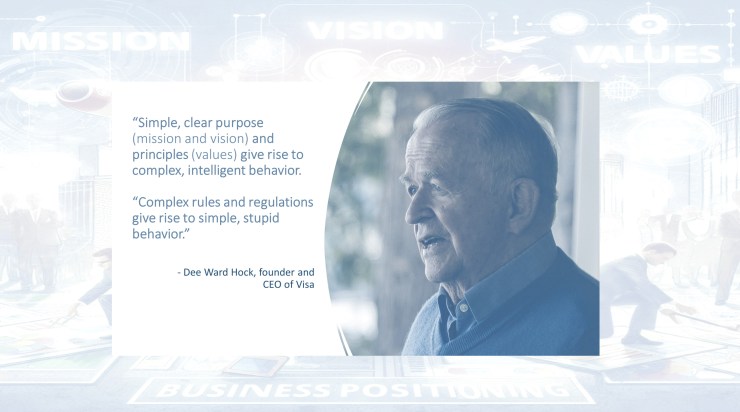
Your business Positioning frames all other strategic choices you’ll make. I’ve seen some businesses make the mistake of creating aspirational statements and proclaiming them to be their ‘strategy.’ Others ignore positioning or fail to give it enough deliberate thought and debate to create a basis for differentiated coherent action. The best recognize that giving Positioning proper attention allows for better success and congruency of action across teams and time.
This week, I’ll explore Positioning. Then, next week, we’ll dig deeper into Council meetings that give Positioning and other strategy elements life.
What is Positioning
In StrategyOS, we use the term Positioning to group together the terms and elements of our business model that are ten plus years out and should endure time, technology and people in the organization. They define why the business exists.
– Mission: Why you are in business; the enduring purpose of the business
– Vision: How you will be viewed long term; your BHAG
– Values: Guiding principles for decisions and actions
These guide strategic choices and help to give direction when there is uncertainty. They help guide and energize people and streamline evaluation of choices to create focus. Define something worth doing that you are passionate about. Make that your mission. Create a vision to define success and inspire working on that mission. Add values as guiding principles to help navigate the path.
When you get Positioning right, you can carve the components in stone to endure beyond anyone’s tenure in the company. While staying simple, they need to create a unique value proposition that allows the business to excel and endure over time.
In Good to Great, Jim Collins suggests doing this by focusing on what he calls getting the ‘Hedge Hog Concept’ finely tuned. His Hedge Hog Concept is closely related to the concept of Ikigai meaning ‘a reason for being.’ It links passion, unique capabilities, and financial returns in your strategy.
In Collins’ words:
“The key is to understand what your organization can be the best in the world at, and equally important what it cannot be the best at—not what it ‘wants’ to be the best at. The Hedgehog Concept is not a goal, strategy, or intention; it is an understanding.”
This understanding adds meaning to the business model Positioning and ensures the right focus when creating priority Themes. To do this well, you will need some level of analysis to understand your unique business Context. Some start with a SWoT analysis to highlight important ideas. Others are guided by input from customers, employees, and partners. The understanding is created by asking the right questions, debating the answers, trying out resulting decisions, and ruthlessly evaluating their impact. This leads to a focused understanding to create the Positioning needed to guide other elements of a good strategy.
To expand on his hedgehog concept and create the right focus, I suggest an understanding that addresses all the questions proposed by Lafley and Martin in Play to Win. They add two questions to the three from the Hedgehog Concept:
- What is your winning aspiration? What is our businesses’ mission or passion. What vision or high-level goals guide decisions.
- Where will you play? What geographies, product categories, customers segments, channels, verticals.
- How will you win? What is our value proposition. What drives our economic engine and financial returns.
- What capabilities must be in place? What can we be the best in the world at doing. What is our unique competitive advantage. How will we take advantage and grow the unique capabilities of our people, processes, knowledge, and resources to win.
- What management systems are required? How will we implement systems, structures, and measures (including #StrategyOS) to support our choices.
Creating Positioning
You may already have some elements of positioning statements documented for your company. If they serve you well, you may not need to modify them extensively. But, most businesses that are just starting to implement a StrategyOS will need to start new or want to revisit them to ensure they are solid touchstones for at least the next 10 years and ideally indefinitely.
Create a Positioning that takes advantage of your unique understanding from the hedgehog questions and analysis. Ensure your Positioning allows for a strategy that meets all the green flags discussed in our last newsletter.
If you are stuck, look to other companies, brands, and people for inspiration. Here are a few examples:
Create an initial documented statement for each Positioning element. This is best done in a working session (Leadership Council Meeting) that allows key leaders and influencers in your company to give input. Your team may benefit from outside facilitation to ensure structure and balanced debate. Regardless, group input will produce a better result than any individual can create.
Use your Positioning to guide shorter-term Themes and Plans. Work backward from your enduring Mission and long-term Vision to the near-term using Values as your guide. This creates confidence about what is the best next action that moves your business toward ultimate success.
Test drive your positioning for a quarter and revisit whether it is serving the intent at ongoing Council Meetings and the next quarterly meeting (see Rhythm meetings.) Check again against the green flags of strategy. When you have a couple of quarters with no changes, it is time to start making these statements the cornerstones on which to build other elements of your winning strategy.
-
Green Flags of Strategy

In my work, I regularly encounter businesses that believe they have a great strategy. They may have set long-term financial targets or other lofty goals. Some have inspiring visions for the impact they will make. Some have a curated list of priorities that will lead them to success. Some set OKRs and track metrics that will show when they have met their objectives. But often they are missing key elements.
Great strategies require multiple elements working together. Let’s explore the green flags that signal a robust and effective strategy—one that has the elements needed to deliver success.
A great strategy:
💚1. Motivates People: Inspire Action and Energy
Your strategy gives you, your employees, partners, and customers energy to work toward something important to achieve.
Define something worth doing. Make that your mission. Create a vision that inspires working on that mission. Add values as guiding principles to help navigate the path. Understand that these are primarily to help guide and energize people. Positioning is the start to defining strategy, but not an end in itself.
💚2. Is Different: Chart a Unique Path
Your strategy guides you to a place that is worthwhile when you arrive there by uniquely creating value.
Michael Porter famously proposed the essence of strategy lies in choosing a unique and valuable position rooted in activities that are difficult to imitate. The book Blue Ocean argues that creating and capturing uncontested market space rather than competing head-to-head is critical. Relative to current offerings, decide what you will start and stop doing and what to emphasize and deemphasize to create a new market where demand is high, and competition is low to null.
💚3. Rides Waves: Diagnose Trends and Challenges
Your strategy has a diagnosis of key trends and challenges in your relevant business context with a hypothesis of what can propel you toward success or that you must crash through for success.
Diagnosis of business context is the start of strategy work. It creates an understanding of what is happening that is relevant to success. It allows for formulating ideas and hypotheses about specific things that can help or hinder your success. And importantly, it must find the causes that, when addressed, will lead to success. What trends propel you forward? Which hinder progress if not solved? What causes them? Which can you make progress on today? Five forces, SWoT, and customer feedback are some tools that assist with this diagnosis. But good, actionable hypotheses are needed for riding waves to great success.
💚4. Solves Problems: Tackle the Hard Stuff
Your strategy solves what makes success hard to achieve.
Work on the most important thing you can solve that moves towards your inspiring vision. Strategy is about solving the hard problem, issue, challenge, or opportunity uncovered in the diagnosis. It needs to implement policies and actions that move toward resolving them in ways directed by the best hypothesis for the underlying cause. Track and resolve other issues as they arise.
💚5. Uses Power: Leverage Your Advantage
Your strategy creates leverage using some advantage and continues to develop that advantage.
Discover and use strengths that create asymmetries from a distinct competitive advantage that can propel success and endure over time. Examples include unique skills or reputation your people or brand possess; being first with unique approaches or intellectual property; access to networks or relationships; or owning resources like data or raw materials.
💚6. Creates Focus: Choose a Few Critical Priorities
Your strategy focuses on only a few critical policies and/or actions that deliver the greatest impact.
A great strategy involves making trade-offs among activities to find the few key actions that should be executed. One CEO I worked with had a list of 17 strategic priorities. I was able to have him deprioritize only 3. They failed to find traction and were sold out of PE in an acquisition that failed to recoup investment. Steve Jobs, by contrast, allowed only three priorities to be discussed in strategy meetings at Apple and required choosing one by the end.
💚7. Stays Coherent: Align Policies and Actions
Your strategy outlines aligned, coherent policies and actions that work together to solve the problem.
Great strategies solve the and manage fit across all company activities over a sustained period. At their core, strategies are coherent action plans. Sequence actions appropriately. Recognize proper timing and avoid actions that are not aligned, cause friction with each other, or don’t address the real problem uncovered in diagnosis. Don’t do things that fight each other or are self-contradictory. For example, I’ve seen companies that want to pursue both growth and profit simultaneously which are usually at odds. Ensure your near-term actions support longer-term Themes.
💚8. Generates Cash: Ensure Longevity
Your strategy generates long-term value and has the cash needed to be fully executed or is well financed.
Cash flow is the pulse of a business. Ensure you have a plan with the financial viability to not bleed out on the path to success. Find ways to preserve cash flow especially as you grow. Or have a fundable business model with actions to raise needed cash. Have an end state that creates strong value for everyone in your business ecosystem.
💚9. Continuously Adapts: Improve as You Go
Your strategy is flexible with regular checkpoints and interim goals to adapt for what is and is not working.
Test and adjust regularly to ensure that the hypothetical waves you ride are moving you toward success. Milestones, goals, and metrics do not define strategy in themselves, but they enable routine tracking of progress toward important outcomes defined by the strategy’s coherent actions. Execute a meeting rhythm that creates time to continuously adjust with both incremental and disruptive improvements.
💚10. Aligns Interests: Work as a Team
Your strategy is supported by leadership and key contributors who first prioritize overall business outcomes.
Strategies fail when any individual or department prioritizes their success over that of the overall business. In the words of Patrick Lencioni, team success requires Trust, Healthy Debate, Commitment, Accountability, and Service to the overall vision and mission of the business. Ensure your strategy is created to overcome his 5 disfunctions. Use A.C.T. to ensure alignment across the business.
How does your strategy compare against the 10 green flags listed here? How can you improve your strategy to have more green flags? Let me know if I can help plant more strategy green flags.
Stay humble and adventurous!
-
You’re Fired, I Love You

The most challenging and important decisions leaders face are deciding who to hire and fire. Deciding if and how to fire someone is especially fraught with emotional, ethical, and practical considerations, and it’s essential to apply a blend of empathy and objectivity. In the last issue, we explored how to get the right people in the right seats in a way that sets up the best chances for success. In this issue, we’ll explore some of the considerations for leaders when they get an inkling that a people change is needed.
When to terminate
“Letting go of an employee is not a failure; it’s an opportunity for growth and improvement for both the individual and the organization.” — Tony Hsieh, Founder of Zappos
When there are obvious reasons for termination, firing decisions can be more straightforward. Some commonly accepted “easy” reasons for termination are attendance issues, theft, sharing confidential information, sexual harassment, violence, threats, damaging property, or falsifying records. In these cases, document them and move swiftly holding to the ideas in the next section.
Harder is when the reasons are less obvious. Even with good hiring, onboarding, and development practices, you can make mistakes. Or people and the business can change. The question of whether to fire someone is not just about performance metrics or the “easy” violations listed above; it’s also about fit and future potential. Leaders must reflect on the company’s direction and the composition of their ideal team.
“Letting the wrong people hang around is unfair to all the right people, as they inevitably find themselves compensating for the inadequacies of the wrong people. Worse, it can drive away the best people.” — Jim Collins, Good to Great
These reasons are harder to recognize and to admit they need to be addressed. Leaders should ask themselves:
- Does the person align with the vision and culture of the organization? Do they make it a better place to work and contribute to the long-term goals?
- If the employee were to resign, would there be a determined effort to retain them? Netflix formalizes this into a “Keeper Test.” Employees failing this test are “offered a generous severance, giving them time to find a new company.”
- Is the person still enthusiastic about the company? To help ensure everyone has the motivation to stay and contribute, Zappos offered employees $2,000 on day one and beyond if they leave.
- Do I feel the need to tightly manage them? As Collins says: “The moment you feel the need to tightly manage someone, you’ve made a hiring mistake. The best people don’t need to be managed. Guided, taught, led -yes. But not tightly managed.”
When you get a tingle that things are not right, it’s time to dig deeper. Regularly evaluate candidates using the same criteria you used for hiring. These evaluations should be done at least annually, but allow for more frequent evaluations to avoid letting the wrong people “hang around.” Regularly and as needed check that you still have the right person and that they are in the right role.

First, evaluate whether they are the right person. Do they still align with culture? This evaluation checks against your mission, vision, and values. If there are any failures, it is possible that a person does not understand them well. In this case, point out where they failed. If you immediately see improvement, then they likely share a belief system that aligns and no further action is needed. If not, or if there is a long trend of poor performance, there is not a culture fit and you have the wrong person. The wrong person cannot be rehabbed or find success in another role. Most companies use a 3 strikes role before terminating the wrong people; I suggest that is one or two too many chances.
If you have the right person, the next evaluation is for the right role. This evaluation is against role GWC and Accountabilities:
- If they don’t Get it: train them, put them in a position that they do get, or let them go.
- If they don’t Want it: put them in a position that they truly want for the right reasons, or let them go.
- If they don’t have the Capacity or fail to meet accountabilities: put them on a performance improvement plan to learn needed capacity, free up time, or let them go.
Note that it can be advantageous to keep the right person if changes can be made. A crucial action in this process is to share evaluations as feedback. The need for improvement and possible outcomes should never be a surprise.
As part of everyone’s development, use regular 1-to-1 meetings to have an open dialogue about performance. Use them to understand the root causes of underperformance and whether the employee takes accountability for their actions. If the right person is coachable and shows a genuine desire to grow, a performance plan with measures of success may be a viable alternative to termination. Documentation is important in the event termination is eventually required.
However, if you have the wrong person, or if there’s a clear lack of willingness or ability to adapt to the right role, swift action is appropriate.
How to Terminate
“To let people languish in uncertainty, stealing precious time in their lives that they could use to move on to something else when in the end they aren’t going to make it anyway – that would be ruthless. To deal with it right up front and let people get on with their lives – that is rigorous.” — Jim Collins, Good to Great
Once you decide to fire someone, do it promptly. It can be easy to be concerned for your own feelings and the fear of consequences even when you know the right answer. Not acting is against the best interests of the person and the company. They are most likely unhappy with their current situation. Others are likely impacted by their actions.
“Great leaders make tough ‘people decisions’ and are tender in implementing them.” — Brene Brown, Dare to Lead
Commit to moving forward with courage, generosity, and kindness, and allow for as much dignity as possible. Find the best outcome for all. Employees trust you with their career when they join; make sure to keep that trust throughout the termination process. Be sure to put your ego and fears aside. It’s not about protecting yourself or creating an excuse for broader problems. Engage both your head and your heart throughout.
Here are strategies:
- Legal Compliance: Familiarize yourself with relevant employment laws and company policies to ensure that the process is conducted legally and ethically. Legal requirements vary greatly depending on our location and other factors. Check with an expert if needed.
- Preparation: Plan the process. Consider logistical details such as timing, location, and who will be present during the conversation. Plan any actions that need to be done during the conversation. Sometimes it is important to limit the person’s access to company resources in preparation for, during, or immediately after the conversation.
- Communicate Clearly: Start directly with the topic. Ensure that the reasons for termination are stated clearly and with respect. Provide constructive feedback and be transparent about the decision-making process. Make sure to communicate it as resolved. Allow for questions of understanding, not alternative possibilities. Focus on relevant facts and not any issues or concerns you have.
- Offer Generous Support: Help them land on their feet with a new role that better fits them. Offer support resources such as severance, career counseling, and willingness to act as a reference, make referrals, and help land new employment.
- Be Humane: Approach the conversation with empathy and compassion. Regardless of behavior, they likely have reasons. Be kind. Understand that termination is almost always emotionally challenging. Act in ways that allow the exit to be as graceful and with as much dignity as possible. Give them choices on how to proceed when possible.
- Next Steps: Give explicit clarity on the next steps. Give directions for any remaining pay due, completing needed paperwork, and out-processing. State any boundaries around access to others and company resources. Decide what will happen when they leave the conversation. Decide how to notify colleagues.
- Internal Communication: Communicate the termination to other team members professionally and respectfully. Emphasize confidentiality and the importance of maintaining a positive work environment.
- Learning and Improvement: After the termination, conduct an exit interview and reflect on the experience. Consider what lessons can be learned to improve future processes. You may find ways to prevent similar situations or to more quickly identify issues in the future.
Be especially aware of the impact of decisions on remaining team members. Clear communication and support are vital to maintaining trust and morale in the team after any termination. After firing someone, you may find relief, or you may find deep regret or fear from other team members. Be prepared to address different reactions from different people.
The decision to fire an employee should never be taken lightly. It requires a thoughtful and strategic approach, considering the well-being of both the individual and the business. Leaders must balance compassion with the hard realities, always acting in the best interest of the company’s culture and vision.
What insights and guidance can you share on the right way to approach firing? What lessons have you learned?
If you find this valuable, please click on the subscribe link below and share with your network.
May you find Passion, Joy, and Freedom in all life’s adventures.
-
Right People, Right Seats

The most challenging and important decisions leaders face are deciding who to hire and fire. They are decisions that can significantly impact both the individual concerned and your business. The process is fraught with emotional, ethical, and practical considerations, and it’s essential to apply a blend of empathy and objectivity. In this issue, we’ll explore how to get the right people in the right seats in a way that sets up the best chances for success. In the next issue, we’ll explore some of the considerations for leaders when they get an inkling that a people change is needed.
Hire for fit
“Hire slow, fire fast.” — Jason Fried, Co-founder of Basecamp
If you never want to terminate an employee, start with a great process to hire, and develop people. Whether someone joins your team or not can be one of the most impactful decisions on their and your business’s future. Often leaders fail to create enough time and process for both parties to reach a good decision. Show respect for candidates’ time and move quickly, by building a streamlined process that allows a good evaluation of both fit with the company culture and fit for the role they will play.
The check for fit with culture should be through. You can train skills, but the fit is more ingrained. Harnish in Scaling Up reminds us that cultures can and should be like immune systems that spit out even capable people who don’t align. So, screen first to get the “right team on the bus” (Collins, Good to Great) even before we know where we want to drive it. Check for fit by ensuring alignment with your strategy and values.
Check for strategy alignment against your business mission and vision. Help candidates see how their role fits with this larger purpose of the company and ensure they are enthusiastic about helping to create your future vision. A simple question like ‘why do you want to work with us’ can uncover the difference between someone seeking a job for personal security and those who are motivated to have a part in creating the future your mission envisions.
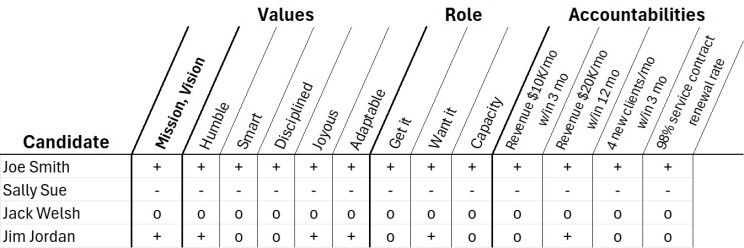
Values alignment is a fundamental screen for deciding whether people are right. People who do not embody the company values create distractions by not getting along well with others, and making decisions that do not best support the vision. Value checks also ensure people can deliver the brand promises like customer service, or quality. Evaluate for Values; people either believe in the values in a way that adds value (+), subtracts from value (-) or is neutral (o). You should evaluate to ensure candidates are strong in all core values.
Next, check Wickman’s (Traction) criteria for fit with a particular role. He suggests the acronym GWC that stands for “Get it, Want it, Capacity to do it.” If any of these are a no, you have the wrong person. Each component represents:
- Get it: This refers to whether the individual understands the role’s responsibilities, objectives, and contributions. Create a mission for the role that supports the overall business mission and check for understanding. Can they explain why the job is important? Do they understand the day-to-day tasks while also seeing the big picture? They should have a clear grasp of what is required to be successful without the need to be told what is important.
- Want it: This pertains to whether the individual is motivated and enthusiastic about fulfilling the role. They should have a genuine desire to perform the tasks and responsibilities associated with the position. Explore what parts of the role excite them and why they want to do the work.
- Capacity to do it: This assesses whether the individual has the necessary skills, knowledge, time, and emotional intelligence to effectively carry out the role. Current skills are less important than the ability to build on experience and learn what is needed to deliver the right outcomes. You might also be able to create time for a candidate that otherwise has the capacity.
Finally, move the check for Capacity from qualitative to quantitative by defining a handful of specific and measurable outcomes that a role needs to accomplish in the next one to three years. This is different than a job description that lists what people will be doing (coaching sales reps, writing code, building relationships.) Instead, create a few key measurable accountabilities you want from the role within a timeframe that is reasonable. Use the hiring process to uncover whether capabilities, interests, and history suggest they can deliver these outcomes.
Make your hiring process as experiential as possible. This will give you opportunities to see candidates outside of a typical hiring interview to gain insights and perspectives. Candidates should also appreciate the chance to learn more about the potential future culture and role they would be joining. Add evaluation steps that:
- Incorporate work assignments: Have candidates complete a typical piece of work or check relevant work samples.
- Design team-based assessments: At George Group, we had candidates work together to create and deliver a mock presentation. It allowed us to evaluate their problem-solving skills along with soft skills and cultural fit.
- Create opportunities for interaction outside the workplace: Take candidates to coffee, meals, and other events where less formal interactions can further evaluate fit.
- Check references: Previous employers and co-workers can give good insights that otherwise are difficult to obtain. In the interest of time and respect for candidates’ privacy, some make offers that are contingent on satisfactorily completing these checks.
Have everyone involved in the hiring process evaluate candidates against your criteria. Come to a consensus around each category for each candidate. The goal is not necessarily to hire the best candidate. The goal is to hire only qualified candidates who meet all your criteria and who are excited about the culture and role at the compensation you can afford to pay.
Collins’ (Good to Great) first practical discipline related to hiring people and building a great business is: “When in doubt, don’t hire. Keep searching until you find the right fit. If needed, limit your growth based on your ability to attract enough of the right people.”
Set up Success
Once you hire, set everyone up for success starting on their first day. Do this by creating proper onboarding and continuing to develop people.
Onboarding new employees is a critical step not just for paperwork completion, but also for easing anxiety, fostering a sense of belonging, and setting the stage for long-term success. Here are some ways to enhance your onboarding process:
- Celebration: A warm welcome can make all the difference. Consider a welcome package or a team lunch to celebrate their arrival. Zappos is known for its celebratory culture, making new hires feel like part of the team from day one.
- Integrate Culture: Understanding company culture should be easy. Create a culture book or have a ‘culture day’ to immerse new employees in the company’s history, values, and mission. HubSpot and Netflix have famously published culture decks that create clear expectations around their norms and traditions. (I encourage all to study: The HubSpot Culture Code)
- Training: Role-specific training is essential. Use a mix of hands-on, peer-to-peer, and formal training sessions to cover all necessary skills and processes. When I worked at Accenture, all new hires attended formal training at a former college they had repurposed for their internal training. The two-week program built skills, jumpstarted networking, and immersed new hires in the culture.
- Tools: Ensure new hires have everything they need to succeed. From a place to work to laptops and access to software and knowledge bases, having the right tools from the start makes a big difference.
- Accountability: Set clear, measurable goals with expected timeframes to help new hires understand responsibilities and accelerate growth. This can be done by agreeing to goals and rocks each quarter. Or you can be more formalized like the Ovative Group which delivers customized 30/60/90-day onboarding plans to set expectations and milestones.
- Dehassle: Facilitate easy integration a transition to work as normal. Organize meet-and-greets, AMAs with senior leaders, and other programs to help new hires integrate smoothly into working on their team. Microsoft is known for pairing new hires with an onboarding buddy while they acclimate. Thrive is known for putting well-being at the center of its onboarding to help prevent burnout before it starts.
These are only the first steps in setting up success. Create ongoing support programs. All employees should get regular check-ins with their manager starting with onboarding. These include recurring 1-to-1 lightweight and ACT meetings that cover Accountability, Coaching, and Transparency to ensure a focus on career progression and professional development. An early start ensures any issues are uncovered and addressed before they hamper satisfaction and performance.
Beyond this, the best companies create tailored career development plans and access to: emerging leaders programs, industry and peer groups, apprentice certifications, webinars, and other continuing development.
Some formalize these elements with dedicated teams that deliver the outcomes. Many rush through them without giving them the thought and focus they deserve. When you consider all the effort that is needed to find the right person and the costs if you need to find a replacement, it only makes sense to take enough time to ensure everyone is set up for success. Don’t skimp on any of these points. Make them a priority. Err on the side of too much over too little.
By focusing on these elements, you can create a recruiting and onboarding experience that is welcoming for candidates and excites them to join, contribute, and thrive in their new roles. Remember, successful hiring, onboarding, and development lead to engaged employees and a stronger business.
Share in the comments any practices that help you hire the right people? How do you ensure they are fully engaged when they start working? What might you improve?
If you find this valuable, please click on the subscribe link below and share with others.
I hope you find Passion, Joy, and Freedom in all life’s adventures.
-
Rhythm to Go the Distance
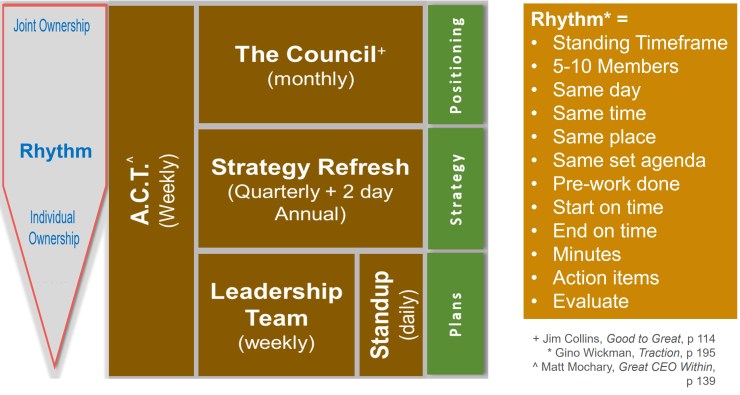
When used correctly, every day is a day that runs on your StrategyOS. Recurring meetings reserve time to focus on Values and Mission at each level of strategy to make regular progress toward your Vision. Let’s explore how they work to create a rhythm that delivers long-term success.
Rhythm ensures everyone’s energy can be sustained over the long timeframes needed to reach important goals. It creates a cadence that renews focus with appropriate touch points to stay coordinated and accountable.
Rhythm meetings have a different beat to create coordinated action across your business model layers depending on the timeframe of the topic.
Execution is created by following these fundamentals to create recurring meetings:
- Standing recurring timeframe
- 5-10 standing members
- Same day, time, place
- Same set agenda
- Pre-work done
- Start and end on time
- Minutes
- Action items
- Evaluate
These points help ensure all meetings get the attention and participation that is required to deliver value. These deliver strong results along with perfect meeting practices that include executing to the right agenda and good time management.

There are five key meetings businesses need to get good at executing. They are listed in the diagram above and discussed below. These standing meetings focus on the key sections of your Business Model to their right.
They focus on increasing strategy levels as you go up. Starting from the most tactical, they are:
1. Standup meetings to ensure daily coordination and commitment at a team level. Agile development teams are familiar with a 15-minute standup meeting to keep progress moving. These meetings are a check-in that gives each team member a chance to say:
- What they worked on yesterday (since last meeting)
- What they will do today (by next meeting)
- If anything is blocking their progress
This creates coordination, accountability, and commitment among team members and ensures continued progress. It is important to stick strictly to the agenda, time box the meeting, and uncover blocking issues. You can plan time to address issues but do not take time to solve them during the meeting. This ensures maximum value in minimum time from all members.
Some teams may find they only need to meet 2 or 3 times a week. And not all teams will benefit from a daily standup. But, you should include it in your team’s routine if you are moving fast and coordination between members is critical to overall success.
2. Leadership Team meetings keep focus, and accountability, and remove barriers to success frequently. This meeting can be held at any leadership level, but the executive team should be the first to adopt it. The main focus is delivering the Goals and Rocks developed at the most recent quarterly planning. Most executive teams will meet weekly for 1.5 hours. See the writeup on Leadership Team Meetings for details.
Ensure the scorecard is up to date and distributed prior to the meeting. Written updates for the Rocks Standup portion and to-dos also help expedite team productivity.
The first part of this meeting is similar to a standup meeting in that it is designed to coordinate progress and surface issues. Scorecard review and company highlights start this activity. It then borrows from a standup meeting for coordinating more closely around quarterly Rocks.
Unlike a standup, this meeting reserves a large block of time for the team to work together to solve priority Issues and remove barriers.
3. Strategy Refreshes are quarterly meetings taking from half to two days to focus on ensuring the near- and medium-term strategy elements are still relevant and are on track to be delivered. See the writeup for recurring strategy refresh meetings for details.
These reviews are your chance to work on the business model as a leadership team. People are programmed in a way that makes it difficult for them to stay on plan for much past 3 months without a need to refocus on priorities. Quarterly reviews create the checkup, resetting, and refresh that ensures efforts stay aligned and are making progress toward your annual plan and overall business model.
Once a year, these expand into an annual refresh. Most companies hold their Annual strategy refresh as an offsite that is free of distractions. This is dedicated time for the executive team to revisit Themes and priorities across a full year.
4. The Council meetings help ensure your business stays in touch with its Positioning and that it stays relevant with evolving changes and trends in the Context in which it operates. They are normally scheduled monthly for one hour. Where other rhythm meetings are focused on execution, these meetings are focused on strategy and the business model itself.
In Jim Collin’s Good to Great, he suggests the Council focuses on understanding and tuning what the business can be the best in the world at doing. He explains the Council’s job as exploring this understanding by asking the right questions, debating the answers, trying out resulting decisions, and ruthlessly evaluating their impact.
Each level in the organization should schedule Council meetings to create a strategy dialogue that discusses what they believe could affect shared business model elements. These meetings check across all Themes to ensure continued:
- Relevance: Do we still have the right business model?
- Progress: Are we making the right progress?
- Mood: Is everyone still onboard?
The output of these meetings is action items specific to each team with individual ownership to make incremental improvements to how they deliver business model Positioning elements and their part of Strategy and Plan elements. Learning is shared with the leadership team to help them understand any impacts on the business model or the need for adjustment to Positioning or Themes. This feeds into the Adapt and Grow phase of StrategyOS.
5. ACT meetings help teams and individuals continue to grow and deliver results. These meetings are one-to-ones between employees and their managers. They should happen weekly for 15 min to an hour at all levels of the organization. See the write-up about how ACT helps create great cultures for details. These meetings incorporate the following elements into recurring discussions:
- Accountability is declaring a destination (vision, objectives, results, measures); the action steps to get there (to-dos, rocks, initiatives); and whether those action steps were taken (and eventually the destination achieved).
- Coaching is declaring the current health of the entity (individual, team, department, company), both the good and the not good; and with the not good, what the issue is in detail and a proposed solution. (This is where reports can make requests for help from their manager.)
- Transparency is declaring (to a person’s manager, peers, and reports) feedback to people on what they are doing, using the following framework: Like: “These are the specific actions that I like that you are doing.” Wish that: “These are the specific actions that I wish you would do differently.
In addition to standing one-to-one meetings, you should add the ACT elements to other rhythm meetings.
Which meetings do you currently schedule? Which would you add or improve? If you need to prioritize, I suggest starting with Strategy Refresh and Leadership Team Meetings. How well do these accomplish the objectives of your business?
Please leave a comment to share how you use rhythm to drive your business. Subscribe to our newsletter if you’d like to see other ideas to help deliver success. Message me if I can answer any questions or help accelerate your leadership.
Follow your Passion, find Joy in your work, and create Freedom to pursue all life’s adventures.



About Me
The sky is not completely dark at night. Were the sky absolutely dark, one would not be able to see the silhouette of an object against the sky.
Follow Me On
Subscribe To My Newsletter
Subscribe for new travel stories and exclusive content.
 Horizon Line Group