
Hello, I’m Veronica
The sky is not completely dark at night. Were the sky absolutely dark, one would not be able to see the silhouette of an object against the sky.


-
Adapt and Grow Phase Keeps Strategy Relevant
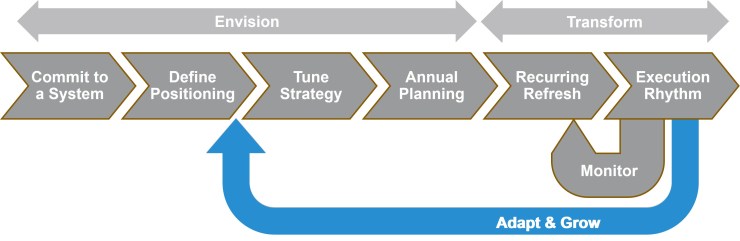
This edition investigates the Adapt and Grow phase of #StrategyOS. It investigates the purpose of the phase, how to evaluate what is needed to stay relevant and thrive, and how to implement changes when they are needed.
Purpose
This phase of StrategyOS focuses on creating the feedback loop that all complex systems need to be successful. The overall goal is to evaluate what parts of your strategy are working. Add to or modify what accelerates obtaining your vision and stop or reduce anything that does not work or creates friction.

This adaptive approach to strategy takes the pressure off of getting started and allows for accelerating the flywheel of your business model. According to Jim Collins, just like with a mechanical flywheel, these small wins accumulate over time, add momentum, and align your entire organization around delivering your Positioning.
To do this, leaders need to monitor the environment or Context in which their business competes to ensure Positioning, Strategy and the resulting Themes remain effective and adapt to changing trends that impact how you operate.
As a reminder, Context underlays our business model and impacts strategy through internal resources and capabilities relative to external trends.

Your strategy must continue to update and refine how you will compete to win within an evolving Context through your product market fit, go-to-market activities, and other Themes.
Assessing Context
Assessing Context is an activity where strategy practitioners make their work seem complicated. Some of the many ways created to evaluate context include: SWoT analysis, 5-forces, competitive positioning, customer segmentation, value chain analysis, adjacent markets, best practices, and internal gap analysis! While these can add understanding, they can also add confusion, time delays, and complexity.
There are 3 easier ways to assess context:
- Listen to Customers and Employees
- Allow for breaks to work “on” the business
- Council meetings
The most important thing leaders can do to support this step is to listen to customers and employees. Support reps on sales calls. Conduct customer surveys. Check your support desk and other customer-facing processes that define your business to the world. Understand their needs and ensure customers see you how you want to be seen.
Similarly, find ways to get feedback from your employees. Additional tactics include: open office hours, suggestion boxes, management by walking around, and team-level council meetings (discussed below.)
The next most impactful thing leaders should do is to schedule time to work “on” the business away from the day-to-day “in” the business work. Many leaders I know schedule weekly blocks for this “thinking time.” The best leaders schedule longer blocks of time monthly and schedule full day or longer blocks each quarter and annually. Wickman (pg 214) calls these Clarity Breaks. This is not time to catch up on work tasks. Instead be alone, away from work, with a notepad, and no distractions. Focus on important questions like Positioning, Context, priorities, people, processes, products, nagging issues, emerging trends, and how you structure your own time and work. You can start with written questions from the week, or focus on what comes to you. The outcome should be ideas that can lead to expanded opportunities, accelerated success, and more relevance.
Peer groups and advisory boards are another way to create time to work “on” the business. Ideally, these groups bring diverse perspectives, take a long-term view, meet regularly, and have the best interests of the leader and the business as their only agenda.
Further, in his book, One Hour Strategy, Jeroen Kraaijenbrink suggests that everyone works on strategy at their own level and from their own perspective. Executive leaders should spend at least 1 hour per day, managers should spend 1 hour per week, and all team members should spend 1 hour per month considering strategy. These times of reflection should consider three questions:
- Q1. Relevance: Do we still have the right strategy?
- Q2. Progress: Did we make the right progress?
- Q3. Mood: Is everyone still on board?
From these different perspectives, the goal is to uncover the most important of 3I’s:
- I1. Issues: Any problem, bottleneck, or mistake that you have identified
- I2. Insights: Any fact, observation, or experience that you learned
- I3. Ideas: Any solution, improvement, or innovation that you identified
Council meetings help ensure your company stays in touch with its Positioning and that it stays relevant with evolving changes and trends in the Context in which it operates. These meetings combine the idea of listening to customers and employees with a formal agenda focused on working “on” the business. Where other rhythm meetings are focused on execution, this meeting is focused on strategy and the business model itself. (See Great Council)
Staying Relevant
Action items from customers, employees, clarity breaks, and council meetings should be documented, further developed, and solved using your problem solving approach at the appropriate rhythm meeting.
Many of the action items can be added as Issues for your Leadership Team meetings and solved and implemented quickly. Or, they can be larger Issues to work on at the next Recurring Refresh or Annual Planning meeting. The most important insights create a learning loop that feeds back into Define Positioning or Tune Strategy. In early stage companies, it can create a pivot causing major changes to create a pivot in Positioning. Or, more typically in established companies, it impacts the understanding of Positioning and helps Tune Strategy by creating new Themes and re-envisioning needed focus.
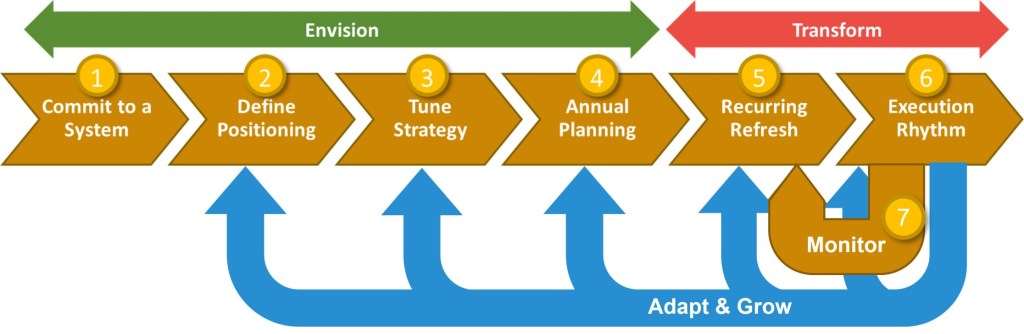
Solve and implement changes with your Leadership Team (Step 6), Or at your next Refresh (Step 5) or Annual Planning meeting (Step 4), or Create new Themes or change their priorities (Step 3), or Execute a pivot (Step 2) How does your business ensure strategy stays relevant? How do you apply any insights generated to reach your vision? What questions do you have?
Please feel free to reach out if I can help you build more rigor to accelerate your business flywheel.
May you find Passion, Joy, and Freedom in all life’s adventures.
-
Create Powerful Business Measures

Creating the right business measures allows companies to translate their Positioning/vision and Strategy into actionable goals. I’ve written before about creating a scorecard for your business. This article elaborates on why the right measures are critical to success and outlines the steps for creating your own scorecard with the right measures to powerfully drive success.
Why Keep Score?
Scorecards are not a just a list of Measures that you think are important. Done correctly, they:
- Clarify Vision and Strategy: Ensure everyone is aligned by crystallizing the mission, vision, and strategic priorities (Themes) of the business to foster a unified understanding of vision and focused action across all levels of the business.
- Business Health: Create a quick, objective way to know whether current execution is delivering expected results, so you know whether additional focus from leadership is needed.
- Strategic Adaptability: Enable understanding of business progress to accelerate adaption to opportunities, changing market conditions, and emerging trends.
- Objective Decision Making: Identify trends, areas of needed improvement, and create other actionable insights that allow adding resources and fixing issues to accelerate success.
- Communication and Alignment: Serve as a common language to ensure that everyone knows how to translate strategy to execution with the right priorities, progress, and synergy.
- Performance Evaluation and Accountability: Foster a culture of accountability and continuous improvement and offer an objective, transparent way to reward good performance.
How to Create Powerful Measures
The steps are:
- Clarify Business Positioning and Themes
- Identify possible Measures for each Theme
- Define each Measure
- Select the best for your scorecard
- Set good Target goals
- Track and tune progress at Leadership Team Meetings
- Integrate outcomes and refine
1: Creating good Measures for your scorecard starts with clarifying your business Positioning (Mission, Vision, and strategic Themes and Objectives. This clarity is crucial as it sets the foundation for the scorecard. The outcome of this exercise is your Shared Business Model captured on Your Vision Cheat Sheet including your strategic Themes. (see links for details)
2: Next, identify key Measures (Some call these KPIs or key results) that align with the strategic Themes. These Measures demonstrate how effective the company is at achieving key business Outcomes related to the Themes that deliver your strategy and vision.
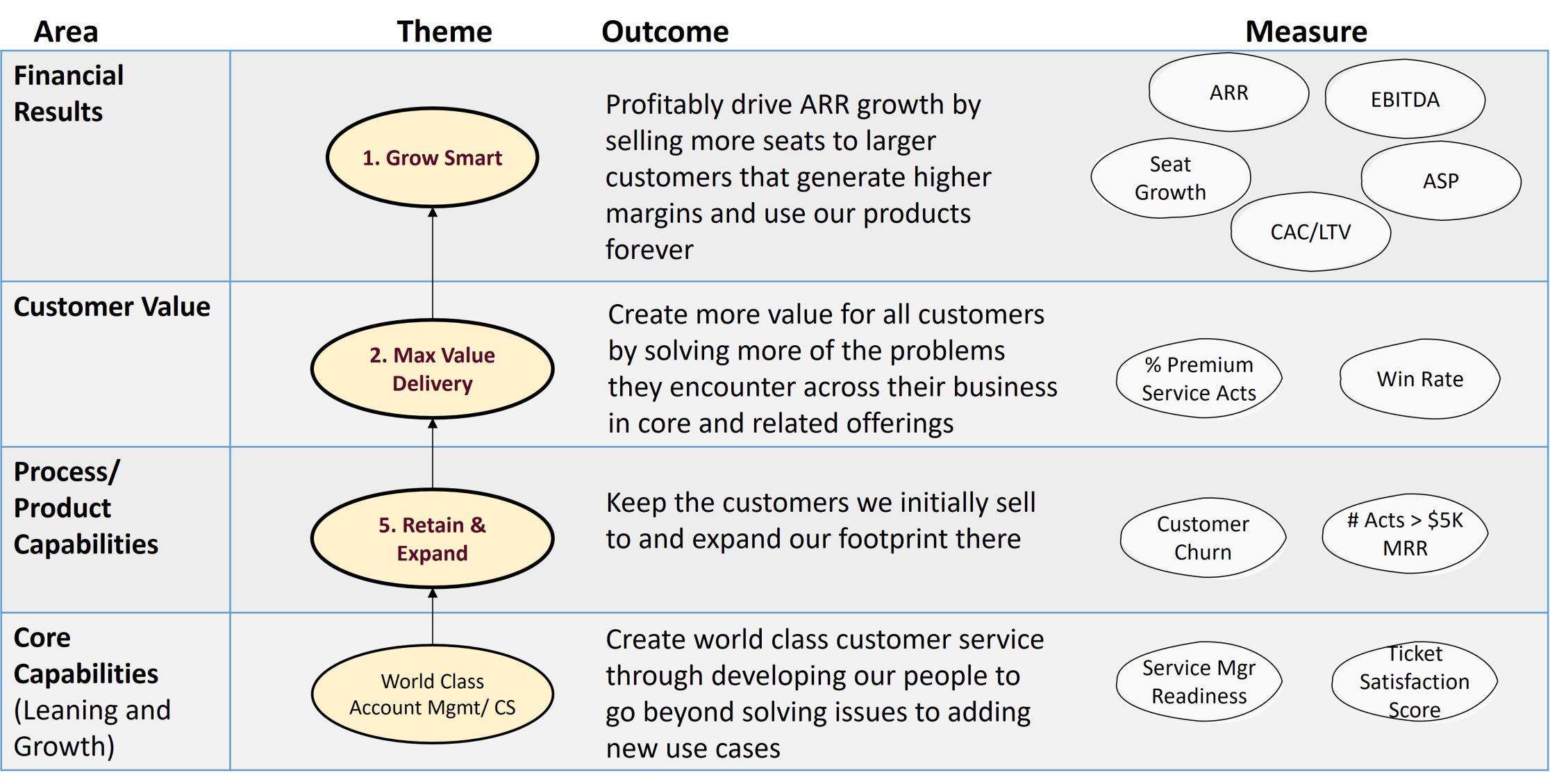
For each Theme, give at least one descriptive Outcome and objective Measure that will indicate reaching the destination. This process helps make the Theme more concrete and allows the right focus of resources to reach the Theme. Themes’ Outcomes may be less tangible than specific measures in your strategic planning horizon. But it should always be possible to determine whether you are making progress and whether the Theme is eventually achieved or not.
Work your way up a strategy map from each core capability to create one or two Measures that can track whether you are making progress toward delivering the objective of that Theme. This bottoms up approach helps to identify leading and diagnostic indicators for your strategy. As you work up from additional Themes, you should find that fewer and fewer new metrics are added toward the top.
3: To ensure usefulness and shared understanding of each Measure, make their definition explicit. Spell out the following attributes for any proposed Measure:
- Name
- How it supports a strategic Theme
- Definition with formula and source of data
- Frequency of reporting
- Who will use it and the value they expect
- Who will collect data and report it
- The cost to produce it
- Any potential unintended consequences from its use
4: Once all Measures are defined, check to ensure it serves the intended purpose well and adds value beyond the cost and unintended consequences. Create a review process with your leadership team to ensure they will get value before adding any Measure. Keep it as simple as possible. Not every measure should make the cut and fewer measures are often more valuable.
5: Set Targets for each Measure to provide direction and benchmarks for success. Use the good goal setting approach to set and get agreement for TTS goals with a number for:
- Threshold (achievable with 85-90% confidence)
- Target (achievable about 50-60% of the time)
- Stretch (10-20% achievable)
6: After establishing these Targets, ensure that the scorecard is not just a measurement tool but also a management system that fosters continuous improvement. Create, update, and review your scorecard regularly. Reviewing them is an agenda item in your Leadership Team Meetings. Take actions that deliver your Targets:
- Create initiatives to drive goal achievement
- Identify and correct issues that are uncovered
- Review the why section above and take other actions to achieve those outcomes
7: Finally, periodically use a critical eye to adapt the scorecard to keep it relevant and aligned with the evolving business context. Raise issues any time you feel like a need is not being met. Your periodic strategy refresh meetings are a good time for these adaptations, especially if priorities or Themes change.
This outlines the why and how of creating a scorecard. The right metrics bridge the gap between strategy and execution, providing a roadmap for success. The scorecard becomes a living gage that guides the company’s strategic actions and decisions, ensuring that all efforts are aligned with the long-term vision of the business.
See related articles about: Envisioning Positioning, Vision Cheat Sheet, Creating Themes, Keeping Score, and Setting TTS Goals.
How will you ensure the Measures that track your business deliver powerful value?
Leave a comment to help others find this and subscribe if you found this article useful.
May you find Passion, Joy and Freedom in all your Adventures.
-
Get People in the Right Seats with Working Genius
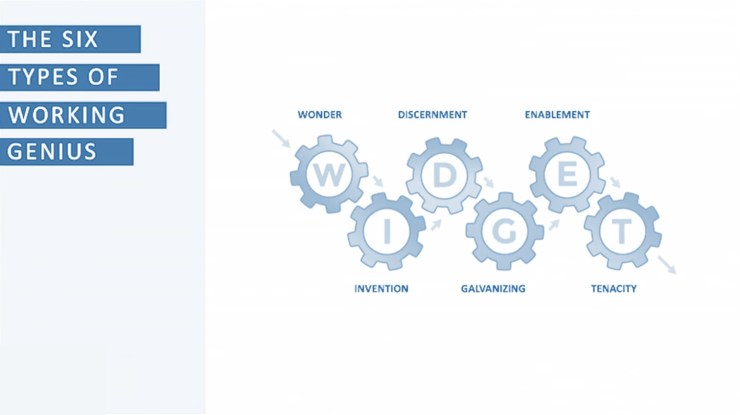
Patrick Lencioni’s book “The 6 Types of Working Genius” offers a easy-to-use use framework to discover people’s natural strengths and work preferences. In this context, “work” encompasses all types of personal and professional tasks, from job-related duties to everyday chores and volunteering.
It helps to answer: why some people love their work and others dread it; why some tasks energize you and others drain you; and why some teams collaborate seamlessly and others struggle to get things done? Let’s dive into the key points.

The 6 Types of Working Genius are six different ways of thinking and working that are essential for success in any endeavor. They are:
- Wonder: Perceiving opportunities and possibilities
- Invention: Creating and generating new ideas and solutions
- Discernment: Evaluating and assessing the validity and value of ideas and solutions
- Galvanizing: Mobilizing and rallying people to take action on ideas and solutions
- Enablement: Supporting and facilitating the work of others
- Tenacity: Seeing things through to completion and ensuring quality
Each of us has two types of working genius that we are naturally gifted at and enjoy doing, two types that we can do but don’t bring us joy or energy, and two types that we find frustrating and draining. Knowing your own profile and the profiles of your team members can help you:
- Align work with everyone’s strengths: Focus people’s jobs on the tasks and roles that leverage their genius and avoid or delegate the ones that don’t.
- Appreciate and value diversity: Recognize and respect the different contributions and perspectives of others, and avoid judging or dismissing them based on your own preferences.
- Get better results: Ensure that all six types of working genius are represented and utilized in your teams and projects, and avoid gaps or imbalances that can lead to failure or mediocrity.
If your types of working genius are Wonder and Invention, it means that you love to explore new possibilities and generate novel ideas, but need others to help evaluate, implement, and finish them. So, if that’s me, I might enjoy writing this newsletter and sharing insights, but need to rely on an editor, and web designer to keep it running, and need readers to give feedback, support, and encouragement.
To discover your working genius, you can take a 10-minute online assessment at WorkingGenius.com. You can also read more about the model and its applications in Lencioni’s latest book, The 6 Types of Working Genius: A Better Way to Understand Your Gifts, Your Frustrations, and Your Team.
What are your types of working genius? How do they affect your work and your team? I’d love to hear other ideas of how to get people in the right seats and the benefits you see from it?
May you find joy, passion, and freedom in all your adventures.
-
Envision Phase Creates Focus
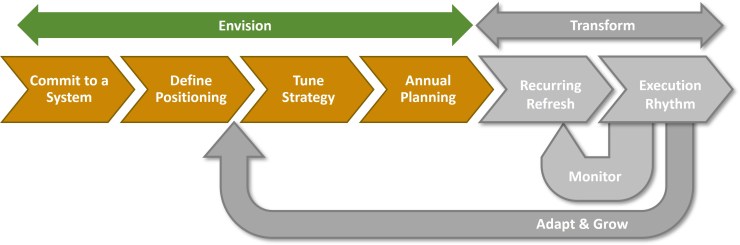
This article gives an overview of #StrategyOS and then describes the approach used in our Strategy Choices Workshops to Envision your business future. It’s a little longer than most to allow for a good overview of how to get started with StrategyOS and create a focused Positioning, Strategy, and Plan for the coming years.

Strategy OS has 3 key activities:
- Envision: Define the enduring properties of the business and how they will be achieved in the medium and near term. This is where to start with StrategyOS and the focus of this article.
- Transform: Execute the strategy on a daily, weekly, and quarterly cadence to create changes that make progress toward the company’s strategy and positioning. This phase delivers business success as shared here.
- Adapt and Grow: Review progress regularly to assess success and improvement priorities and to understand what thematic changes are needed to grow and stay relevant. It includes an (at least) annual refresh of the Envision elements and practices to stay attuned to your business Context.
Definitions:
Before we dig into Envision, it is helpful to review a few definitions. Your StrategyOS must have a defined Business Model on which it works to implement, grow, and improve. The Business Model is first created in this Envision phase and consists of the following elements:

On the right side of the above diagram is the hierarchical list of elements that define your Business Model. As we go down the list, we are getting more near-term and more detailed.

- Positioning terms are the elements that are ten-plus years out and should endure time, technology, and people in the organization. They define why the business exists.
- Strategy terms are two to five years out and create a picture of how to build toward your vision within a timeframe that can be reasonably imagined.
- Plans are made annually and quarterly to guide what to do to achieve the Strategy through daily, weekly, and quarterly actions.
All of this projects on a shadow of the Context that impacts strategy through internal resources and capabilities relative to external trends like customer needs, competitive positioning, and social and regulatory limitations. Your strategy must define how you will compete to win within this Context through your product market fit, go-to-market activities, and resulting business processes and policies. More on this in the Go To Market Theme when we Tune Strategy.
The left funnel is the People Practices of the Business Model which I’ve previously detailed here.
Overall Approach:
When first starting to practice StrategyOS, I work with leaders across the business to define their Business Model in a Strategy Choices Workshop. This is a series of work sessions that allows leaders and influencers in your business to give input and share ideas. It produces a better result than any individual can create and builds needed buy-in through the process. If you’re working to self-implement, I suggest adopting this workshop approach. Some best practices are:
- Ensure ownership and commitment from the CEO or owner. He or she will have selected their strategy operating system in Step 1 and started sharing the approach with workshop members.
- Schedule in advance to allow pre-work and to clear calendars for the effort that is free from distractions.
- Allow 1.5 to 3 days to work through the Envision Steps with the workshop team.
- Develop the business model elements through group exercises like brainstorming, nominal group technique, and voting to generate collaboration and build consensus.
- Build time into the agenda to allow for transfer of information to the Business Model Worksheet and Score Card for review and wordsmithing.
- Allow time after the workshop to refine outputs and continue to execute StrategyOS.
A typical agenda for the workshop looks like this:
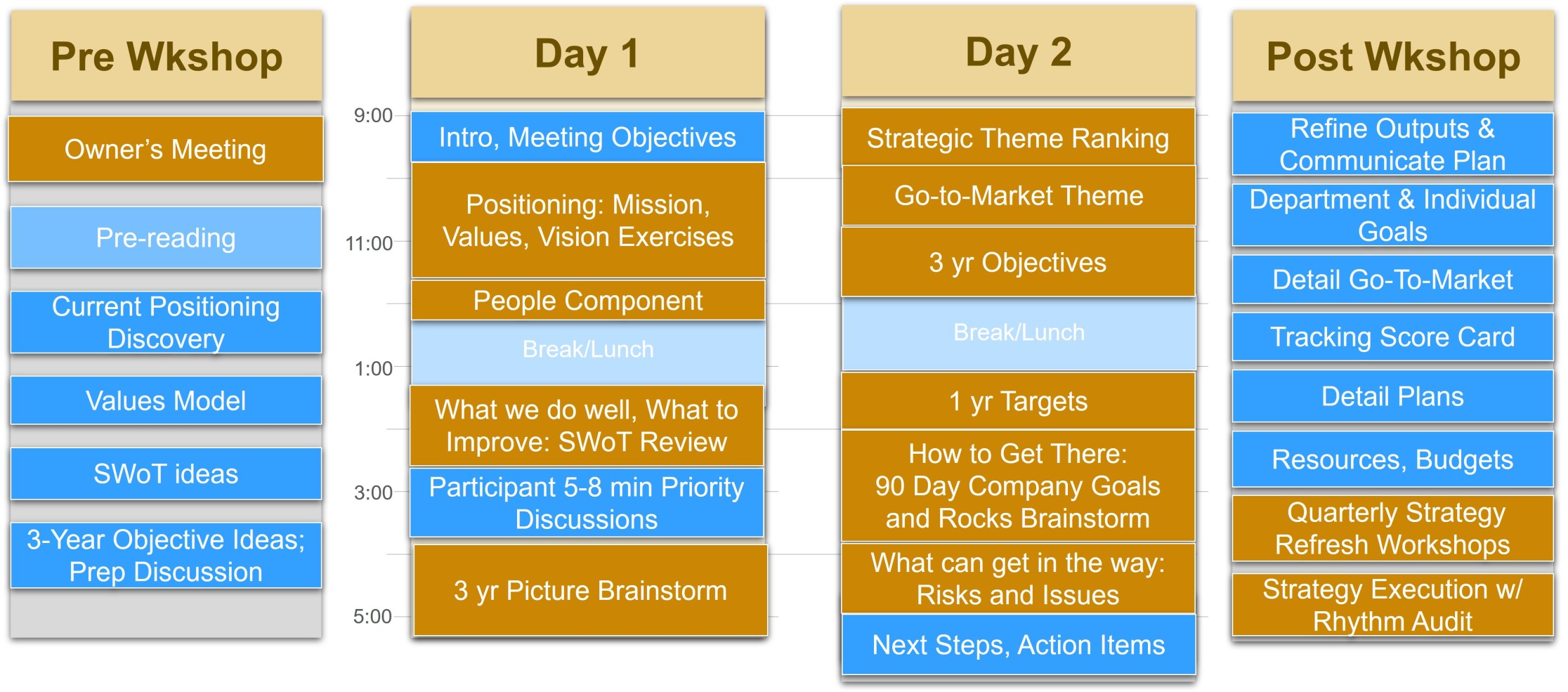
Following the Strategy Choices Workshop, I work with the leadership team to ensure they get good at the Transform phase. Daily and weekly progress on your business model is necessary to ensure priorities are a regular focus of the management team and that progress is not overshadowed by the daily running of the business. Through a Strategy Execution with Rhythm Audit leaders get insight and practice on how to establish a StrategyOS execution rhythm on a daily and weekly cycle. We then focus on running effective Leadership Team Team meetings and implementing the other 8 fundamental practices of StrategyOS.
Further support can come from Strategy Refresh Workshops to get practice on the regular checkups and renewals needed. In this workshop, teams review their progress from the last quarter, set new Rocks and Goals for the upcoming quarter, and work on important decisions and Issues to accelerate results. The annual workshop adds a review and refresh of strategy elements and annual planning.
Envision Phase Steps:
1. Commit to a System:
Much like in AA, the first steps to success are to admit you have a need and to accept that there are systems that have delivered the results you are looking to achieve. The strategic operating system that you choose must be made explicit to create buy-in, a common process, language and tools, and shared accountability to make the system work.
The idea of strategy as an operating system that links planning with execution and feedback is not new. The concepts have been developed and repackaged over the years by many academics, practitioners, and writers. Each has a little different focus and different terms, but share common elements. The most important factor to success is to create one that works for your business and people.
StrategyOS as presented here is borrowed and blended from tested ideas that fit most businesses that have at least a few employees and some customers. I typically modify it depending on company maturity and size as you might do for your business. Or, you might pick another author’s “pre-packaged” system. Popular options that are built into StrategyOS include:
- EOS from Gino Wickman’s Traction is a fairly lightweight way to add a common system.
- Mochary Method from The Great CEO Within documents an approach especially for companies that are starting to scale.
- Lean Strategy from Erik Reis’ The Lean Startup book revolutionized MVP and pivots as a path for startup success.
- Strategy Canvas from Kim & Mauborgne’s Blue Ocean Strategy offers differentiation ideas.
- Balanced Score Card from Kaplan & Norton’s book by the same name offers structure for mature companies.
Pick a system or modify one to fit your special needs. Agree to diligently follow it (at least among your executive team.) Publicly commit to it as your strategy operating system. Share it across the organization to create a common process, language, and tools. Follow it to communicate and hold each other accountable to an ongoing strategy process.
2. Define Positioning:
Positioning includes the business model elements that should be rock solid: Mission (sometimes called Purpose), Values, and Vision. These guide key choices and help to give direction when uncertainty arises. When you get them right, you can carve them in stone to endure beyond anyone’s tenure in the business.
You may already have positioning statements documented for your business. If they serve you well, you may not need to modify them. But, most businesses that are just starting to implement StrategyOS want to revisit them to ensure they are solid touchstones for at least the next 10 years and ideally indefinitely. If you are just getting started or stuck, look to other companies, brands, and people for inspiration. Here are a few examples:
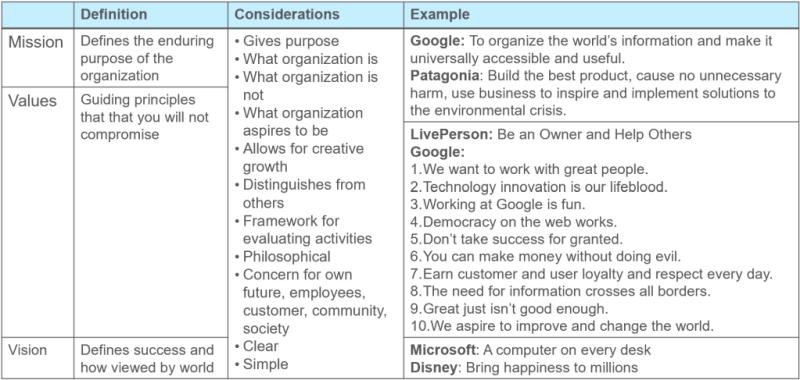
To start, make sure you have a documented statement for each Positioning element as you start to implement your Strategy OS. Create your Values, Mission, and Vision in working sessions that allow key leaders and influencers in your company to give input. Document these in your Business Model Cheat Sheet. Test drive your positioning for a quarter and revisit whether it is serving the intent at the next quarterly meeting (Transform phase’s Execution Rhythm.)
When you have a couple of quarters with no changes, it is time to start making these statements the cornerstones on which StrategyOS is built and run. Publish them widely. Refer to them when evaluating all other components of your strategy and your people. Point to them for decision guidance.
3. Tune Strategy:
Strategy in this context refers to the dictionary.com definition: “a plan of action or policy designed to achieve a major or overall aim.” In this case, the overall aim is to achieve the Positioning created in the previous step.
A useful construct in creating your strategy is to organize around the major Themes that advance your Positioning. Themes are broader than plans or programs in that they offer guidance about what is needed without limiting possible plans of action or timeframes. They are destination statements describing in detail what the business looks like at some future date from a variety of perspectives. Since it is difficult to envision a clear future much further out than about 3 years, use this as your timeframe to create destination statements describing your major next achievements. Make these statements challenging and motivational but within the realm of possible outcomes.

These destination statements come from assessing how you can best use your business talents and unique capabilities to win given the business’ Context. SWoT analysis, competitive positioning, customer segmentation, adjacent markets, best practices, 5-forces, value chain, and internal gap analysis are some of the many ways to generate Theme ideas. Even more important than these approaches, get really good at talking to customers, employees, and partners. Regularly share issues, ideas, and insights about what can drive success or hamper achieving the vision from these conversations.
From the universe of possible destinations, group, prioritize, and focus on the top 3 to 5 (no more than 7) that can have the largest impact on success. Give them short titles that become your Themes.
Once you have your priority Themes, ensure they are well understood by giving each at least one descriptive Outcome and a Measure that demonstrates attainment of that Outcome at the end of the planning horizon (similar to OKRs, but start with a longer time horizon.) This process helps make the Theme more concrete and allows the right focus of resources needed to achieve the Theme. Be flexible; as the example suggests, some Themes’ Outcomes may be less tangible than specific measures in this planning horizon. But it should always be easy to determine whether the Outcome was achieved or not.
Every Strategy must include two specific Themes: Your “Go to Market” and “Financial” themes.
The Go to Market or marketing Theme is how you will sell and win business within your Context. If you need a structure, borrow from what is described by Wickman (pg 55-65.) The elements are summarized with examples below:

The Financial theme defines your revenue model and includes at least two associated Outcomes: revenue and net margin with associated Targets. As you learn key drivers of your financial results add them as leading Measures to give early indication of success. Elevate these measures to the Financial Theme and give them Outcomes and Targets matching your strategy time frame. Finally, you must ensure the company never runs out of funds to operate. Cash management and fundraising are essential parts of the Financial theme, especially for early stage companies.
Add these Themes, Outcomes, and Measure elements to your Business Model Cheat Sheet.
4. Annual Planning:
Annual planning, as the name suggests, involves envisioning the company one year out and setting Targets and Initiatives for the next 12 months. This step works much like the exercise in step 3, but the timeframe is narrowed to one year and more detail is added to create clarity of focus for the next year about key results that will work toward the strategy Outcomes.
Stay lightweight. Planning can be as simple as creating Initiatives and Targets for each Theme created in Step 3. From a brainstormed list of possibilities, group, prioritize, and focus on the top few Initiatives and Targets that can have the largest impact on success. Assign primary owners and give them a Budget that includes people and dollar allocations.
The outputs from Annual planning should be tracked regularly on the business’ Score Card. Themes are good for organizing your Targets. Have two or three of the most important metrics that show performance for each theme along with associated Targets and Goals grouped by Theme.
Create Goals and Rocks for the next quarter in the Strategy Choices and Annual Planning workshops (even though they are technically a Transform Step) so that you’re ready to start with Execution Rhythm the next week. Add quarterly Goals and Rocks related to each Theme to the scorecard. Showing Rocks color-coded indicates whether or not they are on track. Often reaching a Goal requires having a Rock complete. Each Rock and Goal has an owner. Each person on your executive team should own 1 to 4 in total. These are then refreshed in Quarterly (or more frequent) Recurring Refresh meetings.
All plans come with risks and uncertainties. Creating plans is a good time to raise known or possible Issues that could impact your ability to deliver them. The Issues list is a key tool for decision making, barrier removal, and problem solving. You might solve some high priority issues in your annual planning. Most Issues are managed by keeping a priority list that is worked on during Execution Rhythm meetings as discussed in the Transform phase.
What questions do you have about getting started? How well will the efforts in this year’s plan support your long-term vision? How prepared are you and your team to implement your plan at the start of the New Year?
Please feel free to reach out if I can help you build more rigor around delivering business success. I can also share exercises for your team to use to develop Envision elements for your business.
May you find Passion, Joy, and Freedom in all life’s adventures.
-
Build in Leadership and Management

In my last post, I suggested that both leadership and management were important skills needed for businesses to build success. I explored the differences and how to build the skills for both.
In this edition, I investigate why businesses need both functions and and different people for each and how to build both into your business structure.
Almost since their founding, organizations have seen the need for two types of leaders. One that focuses on leading itself. Another that focuses on managing. Many terms have been used:
- Leader = CEO = Entrepreneur = Why-Types = Visionary
- Manager = COO = Operator = How-Types = Integrator
One of the strongest ideas to come out of EOS is the concept that organizations should have the functions of Visionary and Integrator in their organizations. While this concept is not new, Gino Wickman has brought the concept mainstream in his book “Traction” and detailed it in “Rocket Fuel.” I’ll use these terms as the functions needed at the top of any business.
Wickman argues that companies that embrace both roles and understand how they best work together will grow faster and have higher profitability, more cohesiveness, freedom, fun, and a better culture. So, what are the differences and how do they best collaborate?
Visionaries
These leaders focus on what is often described as business leadership. The work involves recognizing, preparing for, and delivering change in uncertainty. Normally, this delivers growth or at least, prevents obsolescence. It creates the transformation needed to take advantage of market, technology, or other systemic shifts.
Visionaries are often founders. Their key strengths are:
- Setting Vision = 10 yr+
- Creating culture
- Alignment
- Motivating
- Growing Relationships (key vendors and customers, partnerships, potential acquisitions)
Integrators
These leaders focus on managing complexity. Good Integrators bring consistency and order that delivers better quality, value, and profits.
Integrators can be founders, but normally are more operationally focused and take fewer risks. Their key strengths are:
- Executing Strategy = 2-5 yrs
- Managing Operations
- Ensuring Profitability and Quality
- Developing People, Processes, and Systems
Comparing and Contrasting*:
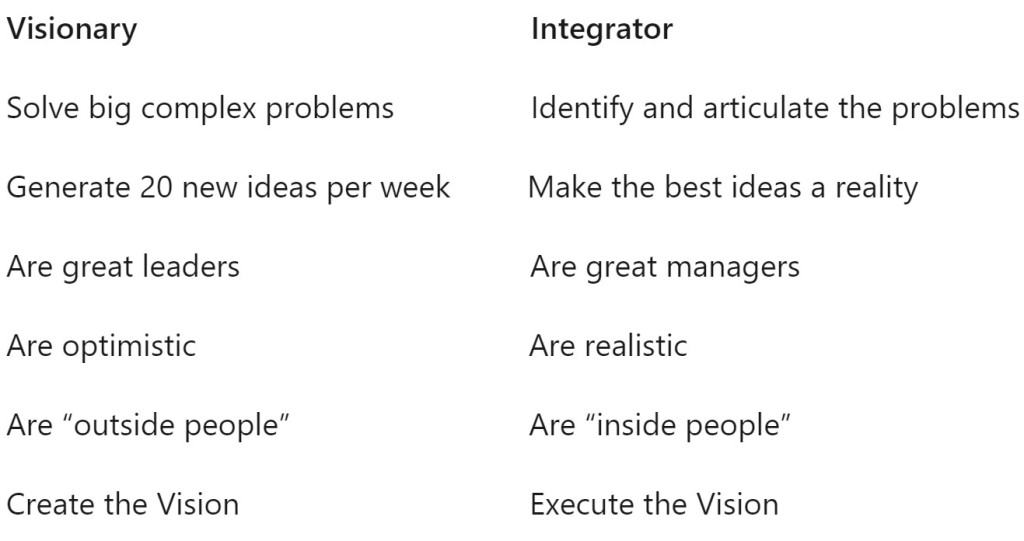
*Wickman, Gino; Winters, Mark C.. Rocket Fuel (p. 67). BenBella Books.
Working Together
Working together starts with understanding the different strengths and weaknesses each type of person brings. Ensure the visionary and integrator functions are filled with people who have an innate desire and ability to fill each position.
It then involves creating understanding and alignment between the two functions. This requires consistent work to continue to stay coordinated and aligned. Wickman suggests 3 tools to keep visionaries and integrators working together:
- The “Accountability Chart”
- The Same Page Meetings
- The 5 Rules
An Accountability Chart is a fancy org chart with roles listed for each function. Or, you can use an AOR = area of responsibility list as Matt Mochary suggests in “The Great CEO Within”: Create a document that lists all of the company’s functions, the areas of responsibilities for the function, and the directly responsible individual (DRI) for each responsibility.
The first step for coordinating visionaries and integrators is to have them agree to and document the roles/areas of responsibilities that each will fill in their respective functions. Be clear that there are no overlaps.
A visionary function’s five most common roles/responsibilities are typically:
- New ideas/R&D
- Creative problem solving
- Major external relationships
- Culture
- Selling big deals
The Integrator function’s five roles/responsibilities might be:
- Leading, Managing, and holding people Accountable
- Executing the business plan/P&L results
- Integrating major functions
- Resolving cross-functional issues
- Communication across the organization
Next, Same Page Meetings keep visionaries and integrators aligned. They should happen at least monthly and can take 2 to 4 hours or more. The objective should be to ensure agreement and alignment before the meeting is over. I suggest an agenda with these topics:
- Check in – Personal, Business, and Role Effectiveness assessment and highlights.
- A.C.T. to raise any issues that need to be addressed. Decide who should own each issue or if you should collectively address any.
– Accountability: Follow up on any action items from past meetings. Share key project milestones and deliverable status that are important to both.
– Coaching: Assess the state of the business. Share the good and not good about the state of the business. Areas to cover include RPM =
o Relevance: Do we still have the right business model?
o Progress: Are we making the right progress?
o Mood: Is everyone still onboard?– Transparency: Share both ways – Like: “These are the specific actions that I like that you are doing.” Wish that: “These are the specific actions that I wish you would do differently.” Follow good feedback protocol.
- Issue Resolution: Prioritize any issues raised above and any that are brought to the meeting by either person. Work all high priority issues to resolution using an appropriate problem-solving approach. Ensure ownership and timeframe for resolving the resulting action items.
The 5 Rules are developed by Wickman to keep the relationship between visionaries and integrators on track. They are mostly self-explanatory. You can explore details on pg. 105 of “Rocket Fuel”:
- Stay on the Same Page
- No End Runs – always defer roles/responsibilities back to the right function
- The Integrator Is the Tie Breaker – except in very, very rare circumstances
- You Are an Employee When Working “in” the Business – no special privileges
- Maintain Mutual Respect – always
Does your business have people for both visionary and integrator functions? Should it? How do you stay coordinated and aligned between the functions?
Please connect, share, comment, like, and reach out if I can answer any questions or serve in any way.
May you find Passion, Joy, and Freedom in all your pursuits.

About Me
The sky is not completely dark at night. Were the sky absolutely dark, one would not be able to see the silhouette of an object against the sky.
Follow Me On
Subscribe To My Newsletter
Subscribe for new travel stories and exclusive content.
 Horizon Line Group