

Hello, I’m Veronica
The sky is not completely dark at night. Were the sky absolutely dark, one would not be able to see the silhouette of an object against the sky.


-
Lead and Manage
There has been a lot of debate, about the value of leadership versus management. In researching this article, I found many comparisons that disparage managers (fixed mindset, authoritative, detached) in order to reinforce qualities of good leadership (open mindset, empowering, inspirational.)
These arguments have been outdated for a long time. I prefer the perspective from the article “What Leaders Really Do,” first published in 1990 by Harvard Business School professor John Kotter. He proposes that management and leadership are different but complementary. Both are needed in balance for business and personal success. Let’s dig in.
Kotter suggests many companies are ‘over managed and under led,’ but the opposite extreme is no better. When it comes to preparing people for executive jobs, companies should try to develop ‘leader-managers.’ When companies understand the differences between leadership and management, they can value and groom people to embrace both.
Management is about coping with complexity. Good management brings consistency and order that delivers better quality and profits. It values incremental improvement.
Leadership, by contrast, is about recognizing, preparing for, and delivering change in uncertainty. It values the transformation needed to take advantage of market, technological, and other systemic shifts.
Kotter highlights 3 key differences:
- Management = Planning and Budgeting; Leadership = Setting a Direction
- Management = Organizing and Staffing; Leadership = Aligning
- Management = Controlling and Problem Solving; Leadership = Motivating
Because they are less understood, let’s define each leadership characteristic.
Setting a direction is about embracing new ideas and adapting to evolving circumstances. Leaders gather a broad range of data and look for patterns and relationships that help explain things. It involves exhaustive, broad-based thinking and the ability to take risks. The output is not plans, but vision and strategies. These describe a business, product, or culture in terms of what it should become over the long term and a feasible way to achieve this outcome. They create constraints for the planning process and focus planning on the most important activities.
Aligning has the objective of getting people moving toward a common outcome. It is a communications challenge rather than an organizational design problem. It is about getting many people to understand, support, and work toward your vision of an alternative future, regardless of management structure or formal reporting relationships. It involves creating informal relationships with and between anyone who can help implement the vision and strategies or who might block them. Leaders must create ways to empower and resolve conflicts with subordinates, bosses, peers, staff across the organization, and external suppliers, regulatory authorities, and customers so that they understand and act to implement the vision.
Motivating is about energizing people to overcome obstacles they will inevitably face as they work toward the future vision. This is done by “satisfying basic human needs for achievement, a sense of belonging, recognition, self-esteem, a feeling of control over one’s life, and the ability to live up to one’s ideals. Such feelings touch us deeply and elicit a powerful response.” Tactics to do this include making messaging relevant to each individual; involving others in decisions; creating constructive feedback mechanisms; and modeling, recognizing, and rewarding the right behaviors.
So, how can businesses create a culture with people who are leader-managers? Kotter emphasizes a few key approaches:
- Give emerging talent early opportunities to practice leadership. Create challenging opportunities for relatively young employees.
- Create development plans that include training and developing both management and leadership skills. Review these regularly and provide feedback and coaching.
- Recognize and reward senior executives who successfully develop leaders. “When told that future promotions will depend to some degree on their ability to nurture leaders, even people who say that leadership cannot be developed somehow find ways to do it.”
How do you prepare for what’s next while maximizing the returns from current initiatives, products, and services? Can you see how #StrategyOS integrates both?
Please connect, share, comment, like, and reach out. Message me if I can answer any questions or serve in any way.
May you find Passion, Joy, and Freedom in all your pursuits.
-
Identify and Fix Growth Mindset Failures to Win
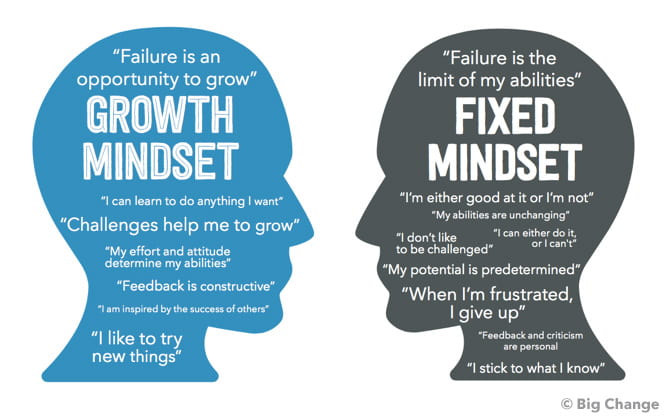
If you have not already, you should read Carol Dweck’s book Mindset: The New Psychology of Success. According to her, we embrace either a fixed or growth mindset. Shifting to a growth mindset is one of the most useful things we can do to challenge ourselves and others.
What’s the Difference
People with a fixed mindset believe that their intelligence, talent, and abilities are set. They see failure as highlighting their inabilities.
People with a growth mindset believe that they can improve through hard work and effort. They like new challenges and learn from their mistakes.
Research has shown that people with a growth mindset tend to be more successful, happy, and resilient in school, work, and life. Benefits include:
- Increased resilience in the face of challenges.
- Greater willingness to take risks.
- Greater satisfaction with life.
- Improved performance.
How do they get these results? People working from a growth mindset are more likely to:
- Be motivated by the mastery and growth they see in themselves and others.
- Seek out and work with people that challenge them in many areas.
- Seek out and challenge themselves to take on new things.
- Believe that they can accomplish anything they set their mind to.
- See mistakes and failures as opportunities to learn and grow.
- Celebrate success to reinforce that goals are achievable.
- Be open to feedback and critique.
- Persist in the face of setbacks.
- Make joy-based decisions that align with their values.
People with a fixed mindset are likely to do the opposite of the above. Fear is the opposite of joy for the last bullet. They see challenges as threatening because failure will show their limits. They need to prove that they’re worthy, even if it means taking shortcuts or avoiding challenges.
Everyone has Limiting Beliefs
I read the book and decided that the evidence suggests I work from the growth mindset Dweck describes. I’m destined to be successful and can move on. Wrong! Even the most enlightened and self-reflective among us have fixed mindset thoughts.
My big breakthrough and what many miss is that, although I normally tend toward a growth mindset, there are times and areas where a fixed mindset sneaks in.
For example, I often tell myself I’m not a people person. With this fixed mindset, I shy away from some social situations with the idea that people might not like the introverted me.
Looking at this with a growth mindset reframes the idea to accepting that the more I do it, the better I get and the fear is likely unfounded. Starting with joy and a growth mindset, I can recognize that I have unique experiences and I am inquisitive and listen well to add value to most social interactions.
Sometimes I catch my inner voice sabotaging my growth mindset. There are lots of subtle ways this happens. Be on the lookout. If you hear yourself saying these or related things, you are probably allowing a fixed mindset to creep in:
- I’m not good at that one thing
- I’m an imposter
- I don’t know where to start
- It’s too hard
- I might fail
- I’m not as good as them
- I don’t know where to start
- What if I’m wrong
- There’s not enough time
- I need to know more before I start
- There must be an easier way
- Someone/something else got in the way
- I’ll feel awkward
- I’m too young/too old
- I’m not creative/outgoing/serious enough
- I don’t have a choice
- I’ll never be able to do that
- It’s not worth trying
- I might look silly
- People might not like/accept me
So, stay alert. Know that it can affect you and be prepared to take action. Here’s a process to overcome limiting mindsets:
- Be aware of what a fixed mindset looks and feels like and be diligent to notice when it impacts decisions and behaviors. Encourage others to help point it out.
- Identify and acknowledge when any version of fixed mindset or fear grips you. Give it a name. Be specific. This has a dramatic effect on taming the impact and moving forward.
- Challenge any negative thoughts. Accept that you don’t want to fail, etc, but you don’t NEED to avoid the unwanted outcome. With a growth mindset, you will learn and get better from any setbacks. Review the bullets above about working from a growth mindset. Ask what you would do without fear, working from a growth mindset.
- Take action in that direction. Focus on the process of learning and improving rather than only the outcome. Accept that you will make mistakes and learn along the way.
- Notice and celebrate when you meet a goal you set from the resulting bold action. Use successes to reinforce that growth and achievement are possible with the right mindset.
Matt Mochary challenges the CEOs he coaches to shift from a fixed mindset and fear-based decisions by making a bet. He bets that doing the opposite will turn out great. He says he has never lost when he has challenged someone who was deciding while working from these limiting mindsets to do the opposite.
Once you do this a few times, you only need to be reminded of the destructive mindset you are working from to drive better decisions and actions.
Don’t be complacent. Everyone has destructive thoughts that can cause them to operate with a fixed, fear-based mindset. Learn to identify when it happens and shift to a growth mindset to accomplish whatever you want.
Please connect, share, comment, like, and reach out. Message me if I can answer any questions or serve in any way.
May you find Passion, Joy, and Freedom in all your pursuits.
-
Breath Work to Work Better
I’ve found a lot of benefit that carries into my professional pursuits lately from breathwork. The biggest has been reduced stress. In this article, I’ll dig into some of the other benefits and show how you can borrow from what I’ve learned to reap those benefits for yourself. Read to the end for a quick breath related reset you can use in most any situation.
I was talking to a colleague recently and we shared how breathwork related meditations had made us more productive and helped us perform better at work. The better performance came from a few benefits of the practice:
- Reduced stress and anxiety: As I mentioned, it is a great way to reduce stress and anxiety by calming nerves and promoting relaxation.
- Increased focus and concentration: With less stress, my attention span expands and helps me to calm my mind and focus on the task at hand.
- Enhanced communication: It helps me to be more present and engaged in conversations. I listen more effectively and respond more thoughtfully with less emotion.
- Improved creativity: It allows me to relax and let go of mental blocks to access a more creative state of mind.
I’ve found two practices particularly useful. A long form, breathing into all the chakra energy centers as an evening or morning practice. (I also sometimes use this practice when I wake up and cannot get back to sleep easily.) And a short from STOP practice when I need a quick reset during the day.
The long form chakra breathing takes me about 10 minutes per cycle to complete. I try to do three cycles in a session, but even one cycle has many benefits. Or try a shorter cycle with one or two breaths at each center to warm up or expedite the exercise.
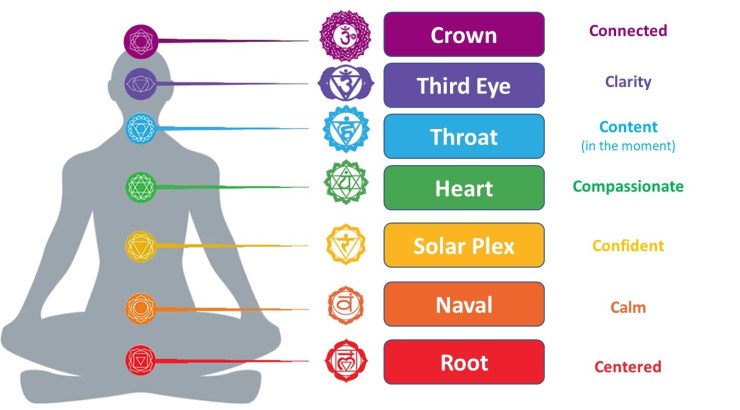
Look at the headline picture for this article as I explain my process. I usually do this laying down.

- Start at the Root Chakra. Take a deep breath while focusing on this energy center. Draw the breath in with your belly and expand your ribs to completely fill your lungs. Repeat to yourself the word to its right, “Centered,” during each breath. Do this three times fairly rapidly.
- Continue to work up the chart, three breaths for each chakra. Repeat to yourself the word to the right of each chakra as you go. I’ve created all “C” words to make it easier to remember. You might find that a different word resonates better for you. I sometimes use multiple related words (eg: 1. Centered = secure = grounded; 2. Calm = peaceful = equanimous; 3. Confident = fearless = passionate; 4. Compassionate = loving = empathetic; 5. Content = present = understood; 6. Clarity = mindful = wise; 7. Connected = purposeful = spiritual.)
- As you work your way up, the chakras become higher energy and my breathing usually accelerates some and it is more challenging to stay focused. Stay relaxed, take full breaths, but go with what feels right for you.
- When you finish at the Crown Chakra, after 21 breaths, take one more deep breath to fill all the energy centers from bottom to top. Let your breath out slowly and pause at the end. Be still without breathing for as long as is comfortable. Just let go with no movement.
- When you need to breath again, take one more deep breath, tighten your pelvic floor, and direct the breath with gentle pressure to whatever energy center you want to focus on for moving forward. After a few moments, release the breath and let any anxiety you have go with it through that chakra.
- Take a few normal breaths and start over for as many cycles as you like.
The STOP technique is much faster when you don’t have time for a more comprehensive practice, but need a reset to better move forward with your day. It was created by Jon Kabat-Zinn, a professor emeritus of medicine at the University of Massachusetts Medical School, as a simple practice that can be used in almost any situation.
The acronym STOP stands for:
- Stop: Take a moment to pause and become aware of your current state of mind and body.
- Take a breath: Take a few deep breaths to calm your body and mind. I usually start with belly breathing into the heart chakra.
- Observe: Notice any thoughts or feelings that are arising; let go of un-useful ones.
- Proceed: Choose how you want to proceed and move forward with that purpose as you release your final breath.
Use the STOP technique in a variety of situations, such as when you are feeling stressed, anxious, or angry. Also use it when you are making a decision or facing a difficult challenge.
Find what works for you. My colleague uses a chanting practice for his breath meditation. Others find simpler counting techniques like box breathing (inhale for count of 4, hold for a count of 4, exhale for a count of 4, rest for a count of 4, repeat) are helpful. Google or ask Bard about breathwork exercises for other ideas that can best deliver the benefits for you.
Please connect, share, comment, like, and reach out. Message me if I can answer any questions or help address a specific need you have.
May you find Passion, Joy, and Freedom in all your pursuits.
-
Recurring Refresh Quarterly Meeting

At least a quarterly recurring refresh is critical keep your leadership team on track and working toward long-term results. 90 days is about as long as people can stay focused without getting off track. It’s just how people are wired. Let’s look at how this practice works to renew focus.
Businesses that use StrategyOS renew commitments on at least a 90-day cycle. As part of this cycle, the leadership team meets for a full day to review, refocus, set priorities, and solve the most important issues.
The recurring refresh meeting includes the following agenda items. It plans about 6.5 hours of focused work time allowing for a working lunch and breaks:
1. Transition warm-up (10 minutes)
Each team member shares:
- Their best news,
- What is and is not working, and
- Expectations for the meeting.
This helps to get everyone engaged and on the same page and identifies any key issues.
2. Review of the previous quarter (30 minutes)
The team reviews the Scorecard along with the Rocks that were set for the previous quarter. They discuss what went well and what didn’t, and learn from any shortcomings. Capture key issues that the review raises.
3. Review of the Business Model Cheat sheet (40 minutes)
Make sure everyone is on the same page about the company’s vision. Refine as needed with particular attention to Themes that may need updated. Capture Issues, Ideas and Insights about whether teams feel confident that each Theme still has good:
- Relevance: Do we still have the right business model?
- Progress: Are we moving at the right pace?
- Mood: Is everyone still onboard?
4. Establish next quarter’s Rocks (100 minutes)
The team lists all the items that must get done in the next quarter. They decide which items to combine, kill, or keep, and assign ownership to each. Each team member should have 1 to about 3 priority Rocks for the next quarter.
5. Review quarter’s focus area (40 min)
Define a specific quarterly focus area for each meeting that ensures the team gives attention to important themes or other destinations outside of more routine operations. This is a chance to define related Initiatives and uncover Issues that may otherwise not get enough attention. Focus areas can include department plans, talent management, budgeting, and with an extra day each year, annual strategic planning.
6. Solve key issues (140 minutes)
The team reviews the Issues List and removes any issues that have been resolved and identifies about 3 priority issues for the quarter. They solve these using the appropriate problem solving approach that identifies root causes, solutions, and action steps.
7. Wrap-up (10 minutes)
The team summarizes, reviews action items and next steps and assigns owners and due dates to any missing them.
8. Rate (10 minutes)
Each team member shares their feedback on the meeting with at least one good and one delta and rates the meeting to help improve the next iteration.
Refer to perfect meeting principles for great meeting practices. Here are some highlights for running a successful refresh meeting:
- Time block to start and end on time. This shows respect for everyone’s time and helps to keep the meeting on track.
- Be prepared. The team should come to the meeting with all the necessary prework and information, such as scorecard metrics, rocks, and issues.
- Be open, honest and engaged. The team should feel comfortable sharing their feedback and discussing any challenges. Schedule enough in advance that members have no other obligations; keep phones away until breaks.
- Be solution-oriented. The focus of the meeting should be on making decisions and finding solutions to problems, not just discussing them.
- Follow up. After the meeting, the team members take action on decisions made. Continue to track progress at weekly Leadership Team Meetings.
The quarterly meeting is an important opportunity for the leadership team to align on goals, address issues, and make sure the business is on track. Use this newsletter to get the most out of your (at least) quarterly recurring refresh meetings.
Follow these tips and agenda items to ensure quarterly meetings are productive and effective. Or, book a workshop to jumpstart your team on #StrategyOS.
Please connect, share, comment, like, and reach out. Message me if I can answer any questions or help address your needs.
May you find Passion, Joy, and Freedom in all your pursuits.
-
Strategy Starts Long-Term
Most teams start planning from where they are to where they want to go. This is backward. Start with and keep in mind the long-term. Then, work back to prioritize the most important next steps that deliver your vision. Let’s look at how it works.
Starting planning with a short-term perspective creates stress and can make it difficult to focus on the big picture. Teams lose motivation and prioritize the wrong actions that don’t work toward your ideal future. So, start long-term to give purpose and meaning to the smaller actions you take.
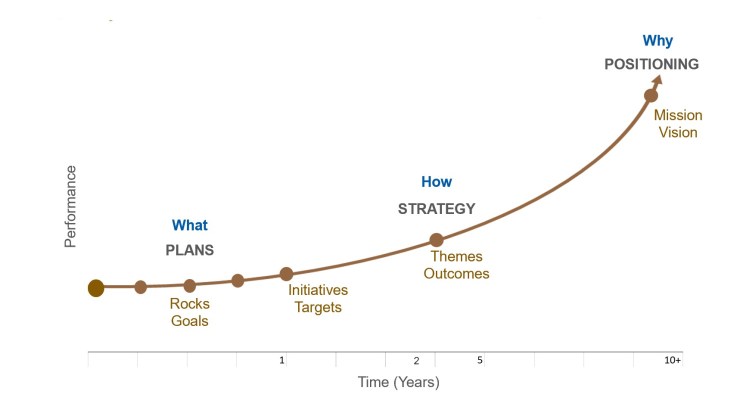
From a 50 thousand foot view, strategic planning is a repetitive process of setting focus along with defining resulting success by working backward from the long-term to the near-term. Using this process creates confidence about what is the best next action that moves your business toward ultimate success.
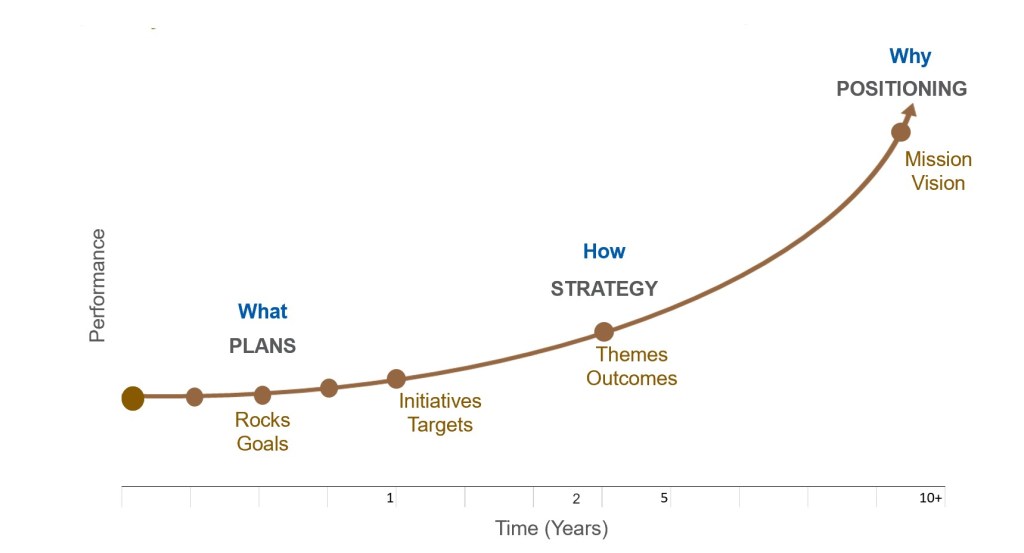
StrategyOS breaks this into three timeframes:
- Positioning elements are ten plus years out set by Vision. They define why the business exists. They give purpose and inspire.
- Strategy elements are two to five years out set by Themes that describe a picture of how to build the vision. They connect the action of nearer-term plans to the long-term vision.
- Plans are made annually and at least quarterly to guide what to do next to best move your strategy forward. Rocks are set at least quarterly as the most important next thing to focus on delivering. They can be stand-alone deliverables, or milestones of longer-running Initiatives or Themes.
Start long-term to clearly define your Positioning. Create a focus and describe a result that are aspirational and unbounded:
- Mission: (a focus) Your business’ reason for being. What you are passionate about, can be the best in the world at, and can deliver an economic return.
- Vision: (a result) How your business will be described when you deliver you mission successfully. Describes how customers feel, the benefit they receive, and the impact you have made. “Vision” is a strong motivational phrase of purpose and is sometimes used in place of “Positioning” to describe the long-term outcome.
Once you define the future, make a clear assessment of where you are today. Evaluate your internal capabilities and the business context that can impact your business, including key trends that can accelerate or deter momentum toward success. Be honest about what you can exploit and what you need to overcome to build toward your vision.
Now you know where you are starting and have a clear picture of where you want to go, but it is too hard to follow a 10+ year path to delivering a vision without guardrails. Determining best actions with only a long-term vision, can be difficult to imagine.
So, pick a time in the future that you can describe with some clarity. This starts to put boundaries around how you will travel toward your vision. It can be between 2 and 5 years depending on how fast your business and industry moves. Most teams use 3 years out to create clear, descriptive pictures of envisioned success from a variety of perspectives. Use at least 4 important perspectives:
- Financial outcomes for stakeholders,
- Customer Value from your products and services or what problem you solve,
- Internal Processes needed to create the value (including sales and delivery,) and
- Unique Capabilities that allow the business to learn and grow.
The most important of these descriptive statements become Themes (a focus) with descriptive titles. Add understanding by giving descriptive Outcomes (a result) with ways to measure progress for each.
strat·e·gy (n): a course of action or policy designed to achieve a major or overall aim. — Oxford Languages
This creates the Strategy that is your focused course of action organized around trackable Themes. Themes define a waypoint on the way to achieving the long-term Positioning.
At this point, you have done two repetitions of creating focus and describing results: once for a 10+ year timeframe and then once for about a 3-year timeframe. Next, planning prioritizes deliverables that drive action. Planning suggests that you repeat the cycle two more times: for a one-year timeframe and for no more than quarterly iteration time-frame.
Annual planning is a norm in business and allows for a good medium-term focus. A quarter is about as long as a team can stay on task without the need to re-assess progress and understand impact of new learning, so iteration planning should happen at least this often.
In each of these planning cycles, as you did for the first two cycles, prioritize what to deliver (a focus), and how to quantify success (a result). In #StrategyOS, for annual planning we call the focus items Initiatives and the results Targets. For quarterly iteration planning, we call the focus items Rocks and the results Goals.
Starting from the long-term ensures that near-term actions are the most important next steps to work on. Keeping Vision and Themes in mind makes sure delivering iterative results stays aligned and leads to ultimate success.
You can find more detail about delivering your strategy in this newsletter on Transform Phase.
Please connect, share, comment, like, and reach out. Message me on LinkedIn if I can answer any questions or help address a specific need you have.
May you find Passion, Joy, and Freedom in all your pursuits.

About Me
The sky is not completely dark at night. Were the sky absolutely dark, one would not be able to see the silhouette of an object against the sky.
Follow Me On
Subscribe To My Newsletter
Subscribe for new travel stories and exclusive content.
 Horizon Line Group