

Hello, I’m Veronica
The sky is not completely dark at night. Were the sky absolutely dark, one would not be able to see the silhouette of an object against the sky.


-
7 Resolutions to win at Business this New Year
As you make personal New Year’s resolutions this year, include adding a strategy process to your business. Resolving to implement a process leads to more success than goal setting alone. Process creates the habits that lead to goal attainment. Resolve to make these 7 habits part of your business processes for increased success this coming year:
1. Commit to a Strategy OS
2. Maintain a Business Model Cheat Sheet
3. Quarterly Strategy Reviews
4. Weekly Leadership Team Meetings
5. Manage Issues
6. Keep a Score Card
7. Schedule Regular Adapt and Sustain Time1. Commit to a Strategy OS:
Healthy organizations view strategy as an ongoing process that allows them to define and execute their mission in a way that grows steadily toward their vision. A strategic operating system links planning with execution and feedback. The system that you choose must be made explicit to create buy-in, a common language, and shared accountability to making the system work.
The diagram below lays out the Strategy Operating System (Strategy OS) I use. It shows how to make strategy creation link to execution and feedback to make progress on a daily basis. It is detailed here.
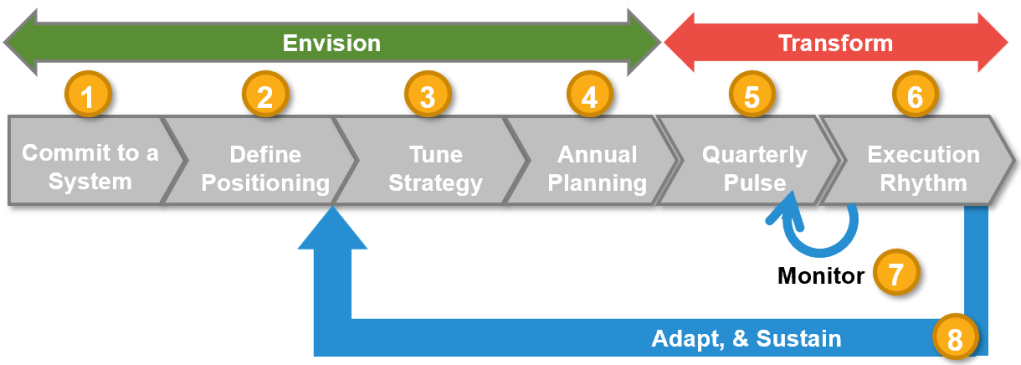
This Strategy OS is borrowed and blended from tested ideas that fit most companies who have at least a few employees and and some customers. I typically modify it depending on company maturity and size as you might do for your company. Or, you might pick another author’s “pre-packaged” system. Most small to medium sized companies will find the EOSTM from Gino Wickman’s Traction is a light weight way to quickly add a common system with minimal overhead. Matt Mochary’s The Great CEO Within documents another approach worth adopting, especially for startups that are starting to get product market fit. Early stage companies may look to Erik Reis’ The Lean Startup or Kim & Mauborgne’s Blue Ocean Strategy for ideas. More mature companies might like structure from Kaplan & Norton’s Balanced Score Card.
The most important factor to success is to pick and commit to following one that works for your company and people.
2. Maintain a Business Model Cheat Sheet
The best Business Models can be communicated in a few words, documented in a couple pages, and managed with a few meetings. Your Business Model should fit on one or two pages. Create a Cheat Sheet (n: a written or graphic aid that can be referred to for help in understanding or remembering something complex) for your Business Model. You can find my editable Business Model Cheat Sheet here.
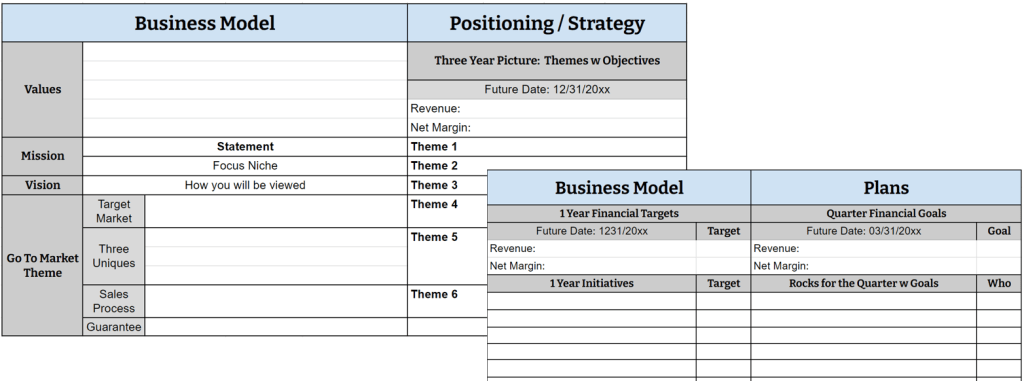
The first page documents your Positioning and Strategy. Positioning includes the busines model elements that should be rock solid: Mission, Values, and Vision. These guide key choices and help to give direction when uncertainty rises. When you get them right, you can carve them in stone to endure beyond anyone’s tenure in the company. Strategy in this context refers to the long-term plan of action or policy designed to achieve the Positioning. Its sets the Themes and Objectives for the next three to five years. Themes are broader than plans or programs in that they offer guidance about what is needed without limiting possible plans of action. They are destination statements describing with details what the business looks like in about three years from a variety of perspectives. The Go-to-Market area documents in more detail the key Theme around how you win business and sell your products and services.
The second page documents Plans to work toward your Vision and deliver Themes. Annual planning, as the name suggests, involves envisioning the company one year out and setting Targets and Initiatives for the next 12 months. Stay light weight. Planning can be as simple as creating Targets and Initiatives for each Theme. Let these feed into your budgeting process for the year. Quarterly plans narrow the timeframe to three months with more focus and detail. Each quarter, create Goals that support the annual Targets, and Rocks that support annual Initiatives. These Plans define key results for the near-term that ensure progress on a daily and quarterly basis is contributing to deliver longer-term Objectives and ultimately your Vision.
3. Conduct Quarterly Strategy Reviews
These reviews are your chance to work on the business model as a leadership team. People are programmed in a way that makes it difficult for them to stay on plan much past 3 months without a need to refocus on priorities. Quarterly Strategy Reviews create the checkup, resetting and refresh that ensures efforts stay aligned and making progress toward your annual plan and overall business model.
At your first meeting and annually, create your cheat sheet and keep it up to date. Reserve one or two full days to work on the Business Model elements with your team.
Other quarterly strategy review meetings should be more focused half day or day long sessions where the timeframe is narrowed to 3 months to create quarterly Goals and Rocks that support annual Initiatives and your Positioning/Strategy. Define key results for the near-term that ensure progress on a daily and quarterly basis is contributing to deliver longer-term Objectives. It should have a standing agenda similar to:
- Review last quarter’s Goals and Rocks (uncover any issues or barriers)
- Review Positioning and Strategy to renew focus
- Establish Goals and Rocks for next quarter
- Review quarter’s focus area to approve related Initiatives and uncover Issues
- Uncover, prioritize and solve important Issues for next quarter
- Wrap-up: Summarize, Review todos, Rate meeting
Agenda item 4 suggests giving a specific focus area for each quarterly meeting that ensures attention on an important theme or other destinations outside of more routine operations by the team. Your annual planning meeting is one of these key focus areas where you renew strategy and adjust for changes in environmental context. Evaluating People and ensuring you have “the right people in the right seats” (Wickman, pg 4) should be another focus area. You can choose to use other quarterly meetings to focus on sales, product, and other major portions of your business model on a quarterly rhythm.
4. Hold Weekly Leadership Team Meetings
A weekly standing meeting with you leadership team keeps focus, accountability, and removes barriers to implementing you Strategy OS on a frequent basis. This meeting can be held at any leadership level, but the executive team should be the first to adopt it. The main focus is delivering the Goals and Rocks each leader committed to at the most recent quarterly planning. Most executive teams will meet once weekly for 1.5 hours using an agenda similar to that suggested by Wickman (pg 190 – he calls these Level 10 meetings) or by Mochary (pg 144.) Ensure the score card is up to date and distributed prior to the meeting. Written updates for the Rocks Standup portion and to-dos also help expedite team productivity. Here is the agenda I use:
- 5 min – Transition: Each member shares something good from the week to help transition to a productive meeting. Be brief.
- 5 min – Score Card Review: This reminds team of Goals and Rocks for the quarter and is a chance to note the good and bad to identify if team is on track for achieving Rocks. Any issues identified go on the list and may be assigned an owner. It is not the time to solve issues (a rule for all agenda items before 5.)
- 5 min – Company Highlights: This is an opportunity to share the good and bad news around key customers, employees, and partners. Anyone can share wins and concerns. Document any issues identified.
- 15 min – Rocks Stand-up Meeting: Each member reviews: Accomplishments, To-Dos for the coming week, and any Blocking Issues for all Rocks they own.
- 50 min – Issues Resolution: Work on the highest priority issues to create solutions and action items
- 10 min – Wrap-up: Summarize, Review todos, Rate meeting
The first part of this meeting is designed to coordinate progress and surface issues. Score card review and company highlights start this activity. It then borrows from a standup meeting for coordinating more closely around quarterly Rocks. Finally, it reserves time to work on priority Issues to resolve them with the key brain trust of the business.
5. Manage Issues (and a resolution process)
Issues can impact success at any level of your Business Model. As such, it is important for teams to rigorously manage and solve Issues at all levels. It starts with uncovering and tracking a prioritized list of Issues. This includes any important decisions or problems that can impact success.
Teams must then have a shared approach for solving Issues that identifies their root cause and first principles that make the them go away in a verifiable way. The Leadership Team meetings reserve time for the leadership team to work together to solve priority Issues and remove barriers. Priority issues can get special attention through focused action items. Adopt an issues solving method from Wickman’s IDS (pg 136,) or Bain’s RAPID, or Deming’s PDCA approach. Or, find another problem solving method your team agrees to follow. Keep it as light weight as possible and only add more structure for the hardest to solve Issues that cannot be modified once an initial decision is made.
Ultimately, one accountable individual must have final say on decision making. If you are the executive leader in your organization and have not specifically delegated an Issue, that individual is you. Once a decision is made, document it and take specific action items to implement and communicate it.
6. Keep a Score Card
Score cards track results to create fast cycles of feedback that help steer daily activities. It ties together all the strategy elements in a way to verify progress and achievement. They should be simple with a matrix of past scores to show trends and a color code of green, yellow, or red relative to goals to help point out needed attention.
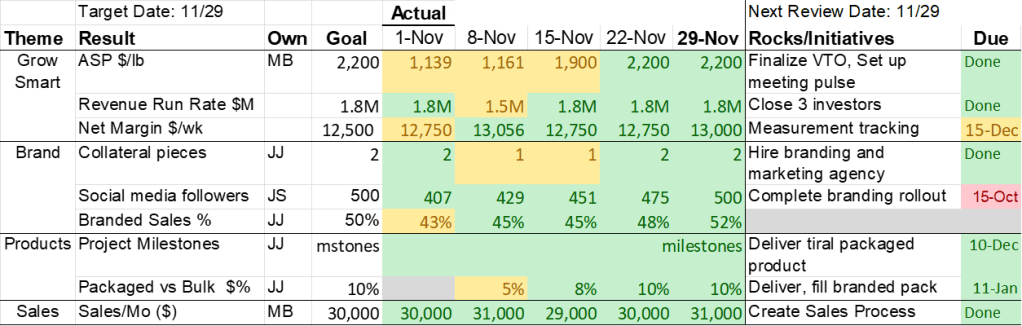
Themes are a good organizing item to group Result measures. I like to also add Rocks related to the Theme to the score card and show them color coded to indicate whether or not they are on track. Often reaching the Goal requires having a Rock complete. Be sure to include leading measures to give early indication of success and key diagnostic measures to help determine if potential trouble areas need more or less focus. Keep a variety of measures on your Score Card to ensure you are covering work that may be needed around non-operational improvements like developing your people, new competencies and the right customers.
Update your Score Card weekly and review it as part of the pre-work for your Leadership Meeting. This ensures you know whether you are getting results from your daily and weekly actions that work toward Goals and Targets. If not, raise Issues that it highlights. Give it extra scrutiny at quarterly meetings to help ensure you are ultimately progressing to deliver the strategy Themes and your longer-term Vision.
7. Schedule Regular Adapt and Sustain Time
These actives focus on creating the feedback loop that all complex systems need to be successful. It starts by monitoring the environment in which your business competes to ensure your Business Model remains relevant. Consider how internal resources and capabilities are impacted by external trends. Your business model must continue to update and refine how you will compete to win within an evolving business environment through your product market fit, go to market activities, and other Themes.
The most important thing leaders can do to support this activity is listening to customers and employees. Support reps on sales calls. Conduct customer surveys. Check you support desk and other customer facing processes that define your business to the world. Understand their needs and ensure customers see you how you want to be seen. Similarly, find ways to get feedback from your employees. Open office hours, suggestion boxes, and management by walking around are tactics.
The next most impactful things leaders should do is to schedule time to work “on” the business away from the day-to-day “in” the business work. Many leaders I know schedule at least one hour per week for this “thinking time.” The best leaders schedule longer blocks of time weekly and schedule full day or longer blocks each quarter. Wickman (pg 214) calls these Clarity Breaks. This is not time to catchup on work tasks. Instead be alone, away from work, with a note pad, and no distractions. Focus on important questions like Positioning, context, priorities, people, processes, products, nagging issues, emerging trends, and how you structure your own time and work. You can start with written questions from the week, or focus on what comes to you. The outcome should be ideas that can lead to expanded opportunities, accelerated success and more relevance.
Many of the ideas from customers, employees, and clarity breaks can be added as Issues for your Leadership Team meetings and implemented quickly. Or, they can be larger Issues to work on at the next Quarterly. The most important insights create a learning loop that feeds back into you Business Model. In early stage companies, it can create a pivot causing major changes in Positioning. Or, more typically in established companies, it impacts the understanding of Positioning and feeds annually into your strategy review to create new Themes and clarify priorities.
That’s it.
If you’re in a hurry to learn more, start with Use a Strategy OS Every Day and What is Strategy. Or, the HorizonLineGroup.com site’s top level navigation is organized by the Strategy OS activities, or you can search on the site for a topic that is of interest to you.
If you feel like having an experienced guide for your Strategy OS journey makes you more comfortable, please reach out. Let’s talk about how I might help you get stated or gain more success. You can contact me through the About page.
-
Iterative Rocks Build Greatness

Many companies lose focus and progress on their strategies because their execution is too long-term and unfocused. Rocks fix this problem.
Steven Covey‘s idea of Rocks is a “First things first” metaphor for prioritizing the most important activities and goals in life. In business, this idea can be applied to achieve greatness by building strategy execution with Rocks. This business context was further developed by Geno Wickman in Traction.

Covey uses an analogy of filling a jar (representing limited time and resources.) Consider that you have a pile of sand (everyday tasks) and rocks (big priorities) to fill the jar. If you put the sand in first, there is not enough room for the rocks. But, if you put the rocks in first, the sand can fill empty space left between them allowing all to fit.
So, if you want to accomplish big things with limited time and resources, prioritize and work first on the big priorities represented by Rocks.
To illustrate, consider a company that has an objective to launch a new product. The Rocks would be the most important priorities for a successful launch, such as developing a marketing plan, and finalizing product design. Sand might be less important issues and tasks, such as responding to emails and attending meetings that do not impact the product launch.
Defining the Rocks gives them focus while allowing the sand to get less attention, get outsourced, or maybe get stopped all together.
Wickman suggests that people are programmed in a way that makes it difficult to stay on plan much past three months without a need to refocus on priorities. Teams should therefore set at most a quarterly pace for delivering new Rocks for their strategy. Most teams find quarterly is the right pace, but startups and other very agile organizations may have shorter monthly or even two week iterations.
Prioritize Rocks on this iterative schedule to create focus and make commitments to the next key milestones that are most important for your Theme objectives. Themes and their Objectives can be longer term, but Rocks allow focus and rhythm on an interval during which people can stay focused.
Each Rock has a goal that defines success. These goals are results that can be binary – like delivering a capability, or can be measurable – like reaching a sales target.
Each Rock has an owner. Each person on your leadership team should own 1 to 4 in total.
Rocks are the units of coordination at Leadership Team meetings. Track progress and resolve issues around Rocks there. Each leader should plan action items, and work daily, and track progress on the Rocks they own to move them forward.
At the end of the quarter (or your iteration cycle if shorter,) ensure each Rock fits the space it was expected to fill by having the leadership team evaluate what was actually delivered against the goal. Celebrate finished Rocks. Unfinished Rocks may have a simple action item remaining to capture or there may be issue that needs problem solved to deliver its results. Carry Rocks over to the next iteration if needed with appropriate changes.
Then, plan the next Rocks that deliver results to get even closer to longer term Theme objectives. The team can be confident that by delivering each Rock they will eventually deliver what is needed to achieve their Objectives and ultimately build their Vision.
One at a time, iteration by iteration, Rocks build the foundation on which to place future Rocks that together build toward Themes and the long term Vision. They deliver great success.
Please subscribe, share, comment, like, and reach out. Schedule time from the About Page or message me on LinkedIn or Twitter if I can answer any questions or help address a specific need you have.
Follow your Passion, find Joy in your work, and create Freedom to pursue all life’s priorities. #StrategyOS
-
The Value of Values

It may not be immediately obvious why values are important to success. My experience has found that values are the cornerstone to organizational success. Here’s why and how to create successful values for your teams.
To some, it can seem like business processes dictate values. This is somewhat true. A waterfall development process, by its nature dictates that planning and control are important values. Agile dictates that adaptation is key. But would an organization that values adaptation even consider a waterfall process? Values should dictate how you work, not the other way around. And process alone does not give insight into how team members are expected to interact and make decisions. Will they collaborate to solve problems among themselves and partners? Can they openly raise issues? How will they involve customers? More in-depth, shared understanding is needed to bring success.
I have seen how the values implemented with a process can make all the difference in ultimate success. As Dee Hock, the founder of Visa once said:
“Simple, clear purpose and principles (values) give rise to complex, intelligent behavior. Complex rules and regulations give rise to simple, stupid behavior.”
Insuring that the values are explicit, clear and agreed to among and across team members allows for better interaction and has a large impact on success. It supports an environment for productive interaction by providing a touch stone to ensure that motivations are healthy and that collaboration is productive throughout any process. It allows for hiring and evaluating employees for qualities that will make them successful in the organization. It allows any process to evolve and deal with complexities that may not have even been considered when originally conceived.
So, where should we look to define values that are central to success? You could create a list to prioritize by:
- Looking internally at values that you believe have made you successful
- Looking at organizations or brands you admire and collect their values for evaluation
- Creating a list of people you admire and make explicit the values that you find attractive
Once you have your list, work with your team to discuss and then prioritize to get to 3-5 (never more than 7) top values. Have the team give an example for each one on the list. Then make a value statement for each. This list is your values. Live with your values for a quarter and re-evaluate it in you next review. If you make changes, give it another quarter. When you get to where you have a couple quarters with no changes, you have a good set that you can call “Our Values.”
Now, it is time to put your values into practice:
- Publish, announce and continuously reference your values
- Build your brand around your values
- Use your values as a guide for evaluating and critiquing important decisions
- Put yourself in your customer’s place and ask if your interactions with them express your values. Change any that miss the mark. Do the same for internal practices.
- Evaluate all employees against your values and set development or exit plans for those not meeting expectations
- Make your values a hiring criteria and pass on anyone not meeting expectations regardless of other qualifications
- Evaluate your customers and focus only on those that share values complementary to yours
If you value your values, your organization will find joy in the work they create together and achieve your team’s vision over the long term.
Here’s an example for how an organization that may want to create values similar to other successful agile companies. In a post called Agile on a Single Page, I suggested agile organizations start with the agile poster from VersionOne, the Agile Manifesto and the Declaration of Interdependence. Finding common ground across these sources is a good starting point for the discussion in organizations that value agility. Mapping affinity from these three sources, I get:
Agile Poster
Agile Manifesto
Declaration of Interdependence
Adaptability
Responding to change over following a plan
Welcome changing requirements, even late in development. Agile processes harness change for the customer’s competitive advantage.
At regular intervals, the team reflects on how to become more effective, then tunes and adjusts its behavior accordingly.
We expect uncertainty and manage for it through iterations, anticipation, and adaptation
We improve effectiveness and reliability through situationally specific strategies, processes and practices
Transparency
Customer collaboration over contract negotiation
Working software over comprehensive documentation
Working software is the primary measure of progress.
We deliver reliable results by engaging customers in frequent interactions and shared ownership
Simplicity
Simplicity–the art of maximizing the amount of work not done–is essential
Unity
Individuals and interactions over processes and tools
Business people and developers must work together daily throughout the project.
The most efficient and effective method of conveying information to and within a development team is face-to-face conversation
We unleash creativity and innovation by recognizing that individuals are the ultimate source of value, and creating an environment where they can make a difference
New Term
Customer Value
Our highest priority is to satisfy the customer through early and continuous delivery of valuable software.
We increase return on investment by making continuous flow of value our focus
Cadence
Deliver working software frequently, from a couple of weeks to a couple of months, with a preference to the shorter timescale.
Agile processes promote sustainable development. The sponsors, developers, and users should be able to maintain a constant pace indefinitely.
Accountability
Build projects around motivated individuals. Give them the environment and support they need, and trust them to get the job done.
The best architectures, requirements, and designs emerge from self-organizing teams.
We boost performance through group accountability for results and shared responsibility for team effectiveness
Quality
Continuous attention to technical excellence and good design enhances agility.
I see utility in giving one or two word labels to the similar concepts and have added them where the agile chart did not apply. Short labels allow complex thoughts to be communicated in a short hand and give teams the ability to quickly call forth values in discussions. There is also a need to spell out in more detail what is meant by these simple terms to promote understanding.
Your organization is not required to have this same set of values and statements. You should modify or enhance these areas to fit unique aspects of your team or organization. With debate, your team might add the need for simple, timely, shared metrics to the Transparency value statement. I might suggest a social aspect to it as well or change the title of Unity to Collaboration.
You may also add to or delete from the initial list you create. Eight is probably too many values, so your team may prioritize to get to the 3 to 5 that are most important. Often others values follow from more fundamental values. The value of “Be an Owner” can, for example, include “Customer Value” and “Accountability.”
The important thing is that values should be stated, understood and agreed to across the organization. They should be documented and referenced and shared regularly.
-
Conscious Leadership in Two Easy Steps
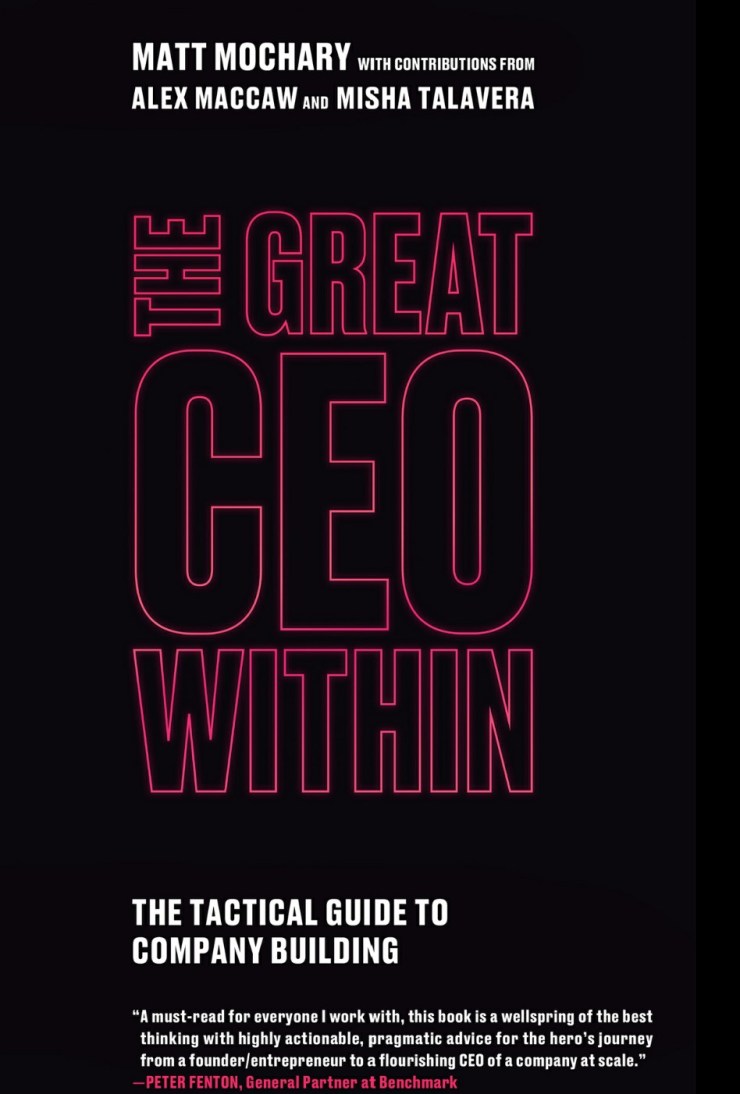

I spent three days reading Matt Monchary’s book The Great CEO Within twice to better understand and document the lessons that made him one of the most sought after coaches in Silicon Valley. Here are the most valuable lessons for you in two short sentences:
- Practice Empathy: “Really imagine yourself in their shoes. If you do this, people will sense it and immediately trust and like you, because they will feel that you care about them and understand their circumstances.”
- Motivate with Joy: “Keep pushing forward with the conscious leadership work quickly to get to a place where you are motivated by joy… Joy is an even better motivator than fear, so your business will thrive. And your life will be amazing!” *
Matt’s book is packed full of practical lessons any leader can put to good use tomorrow. Pick it up to study, practice and reference the other secrets he shares that will give you the tools to be a great leader.
* Mochary, Matt; MacCaw, Alex; Talavera, Misha. The Great CEO Within: The Tactical Guide to Company Building (p. 58). Kindle Edition.
-
Why SWOT Confuses and How to Fix it
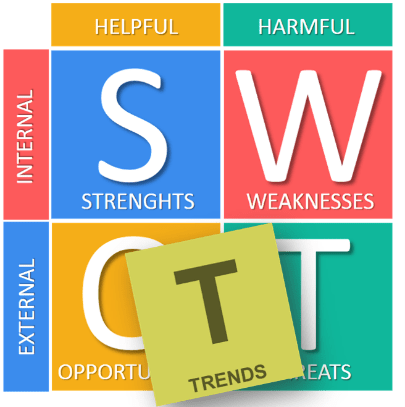
I believe most organizations have difficulty with SWOT analysis primarily because of the implicit assumption that organizations can categorize differently the external factors that impact their business. Factors that are favorable to their business are Opportunities to exploit, while those that may cause problems are Threats to defend against. I prefer to approach the exercise with the perspective that there are only external Trends. Either organizations adapt to important trends or risk disruption that may be fatal to their business.
Before digging into this idea, a quick refresher. According to Wikipedia, SWOT analysis is a strategic planning and management technique used to help a person or organization plan for future success. It is sometimes called situational assessment or situational analysis.
The name is an acronym for the four components the technique examines:
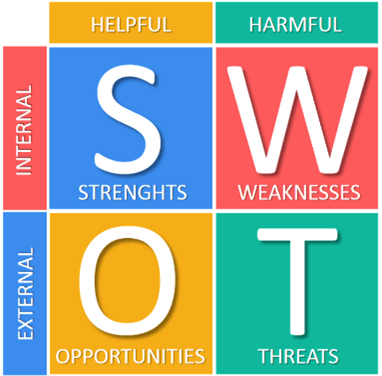
- Strengths: internal characteristics the business does well that give it an advantage over others
- Weaknesses: internal characteristics that place the business at a disadvantage relative to others
- Opportunities: external elements in the environment that the business could exploit to its advantage
- Threats: external elements in the environment that could cause trouble for the business
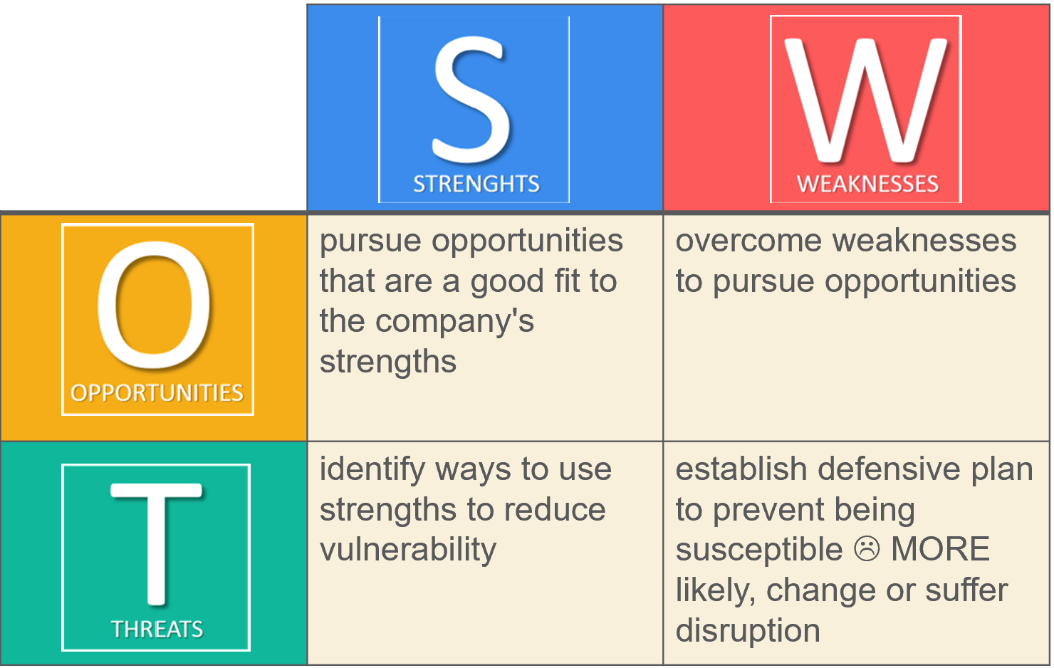
The output of these components is then put into a 4×4 matrix (sometimes called the TOWS matrix) to determine key strategies and initiatives needed at the intersection of the internal and external components. The matrix looks like this:
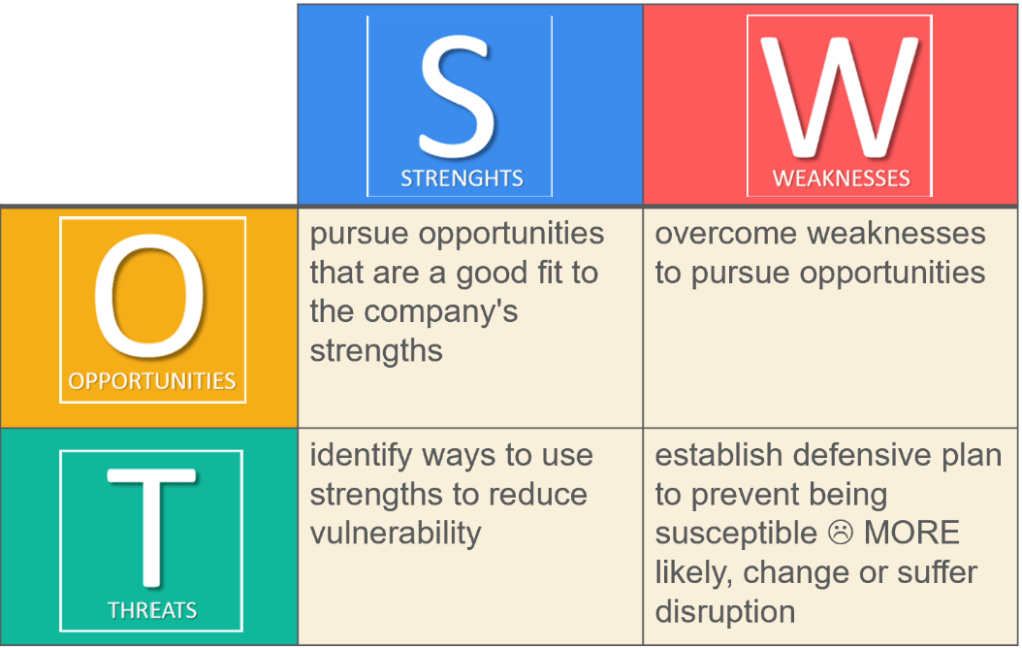
The sad face in the bottom right corner highlights my perceived weakness of the approach. Historically, companies that have tried to defend themselves from external threats suffer disruption. They are still building horse whips for faster buggies when the world wants cars. Or, to be more current, they focus on exploiting a strength like building incremental features for an existing product when their customers are seeking a step change like a different cost structure or new architecture. In the end, items falling into the external threats category likely overcome any defenses the business tries to create.
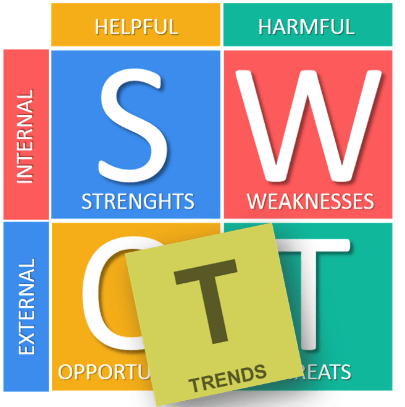
Instead, I have participants in this exercise think about external Trends that may impact their business. It doesn’t matter whether these trends are favorable or troublesome. Because it depends on the reaction from the business, many participants have difficulty categorizing external factors as opportunities or threats initially anyway. Kennedy once declared the word “crisis” was composed of both danger and opportunity.
So, simply list key Trends that are important from changes happening in context categories like your: 1. Competition; 2. Industry Evolution; 3. Social, Cultural, Demographic; 4. Physical Environment; 5. Legal, Politics, Regulatory; 6. Technology; and 7. Economy.
Ideas may come from your: Customers, Competitors, New Entrants, Suppliers, Markets, Channels, Substitute or Complementary Products, Creditors, Regulators, Special Interests, Labor Relations, Community, and your Natural Environment.
The result should be a prioritized list of external Trends happening in the business Context that may impact the business going forward.
These external Trends then lead to a simple matrix to contemplate strategic action when crossed with internal Strengths and Weaknesses:
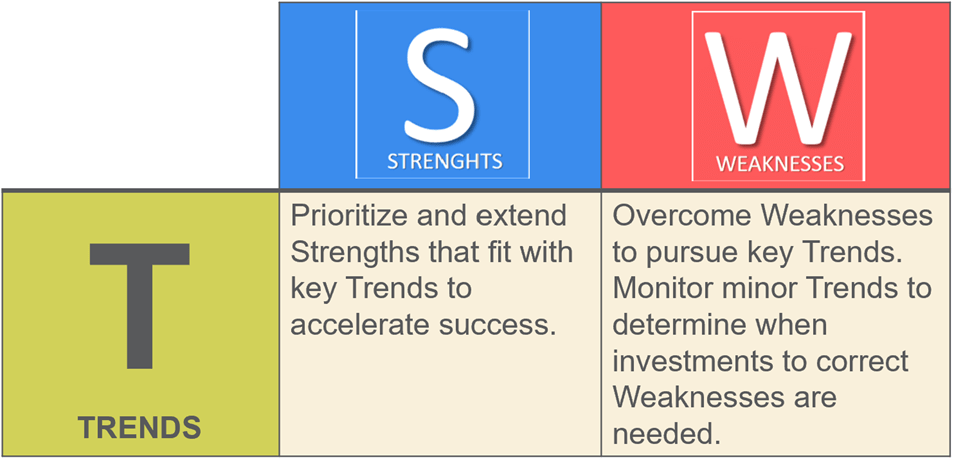
For simplicity’s sake, I still call this swot analysis. I just spell it SW-T or SWoT. My experience is that this approach is simpler, less confusing and leads to better ideas about how to prepare for future success.


About Me
The sky is not completely dark at night. Were the sky absolutely dark, one would not be able to see the silhouette of an object against the sky.
Follow Me On
Subscribe To My Newsletter
Subscribe for new travel stories and exclusive content.
 Horizon Line Group