

Hello, I’m Veronica
The sky is not completely dark at night. Were the sky absolutely dark, one would not be able to see the silhouette of an object against the sky.


-
How Long Does it Take?

This post continues a series of blog posts on Measures by exploring Cycle Time.
Cycle Time is one of my favorite measures. It is at the heart of Lean and forms a basis for improvement that is typically at the center of good customer experience and process agility. In my opinion, any process not tracking this measure cannot be meaningfully improved.
Cycle Time is defined as the total duration for a process to complete. This includes all time from a customer’s perspective to transform inputs to outputs including wait, process, transport, inspect, and other value add and non-value add time.
Cycle Time (CT) is easily measured for any process. You could measure it directly by starting a clock when a work item enters a process and timing until the process is completely finished with an end product. Of course, you’d have to allow for different exception paths that may take longer than the happy path on some repetitions of the process. The neat thing however, is that on average, Cycle Time can be calculated using two other readily available metrics. Cycle time is equal to the work in process (WIP = work that has started the process, but is not yet finished) divided by the capacity (Exits = output of the process over a period of time.) That is:
CT = WIP / Exits.
Consider a bank line. There are 10 people in line in front of you for the teller. You notice that one person is finishing on average every 2 minutes. How long will you wait in line – what is your bank line cycle time? WIP = 10 people in line. Exits = 1 person/2 minutes = 0.5 person /minute.
CT = WIP/Exits = 10 person / (0.5 person/ minutes) = 20 minutes
Want cycle time to improve? Reduce the WIP. If 5 people leave the bank line, you’ll wait half as long. Same process, half the CT. Or, improve the process capacity. With a second teller working, the Exits increase to 1 person/minute and again you wait half the time. Best yet, make the single teller twice as productive. Again, Exits double and CT is cut in half.
These same concepts apply easily to processes improvement. Usually, we can control the WIP in a process. Pull or Kanban systems are set up to do just this. Once the established WIP level is reached, no new inventory enters the process until another item exits. Generally, work should stay in its most unprocessed form until there is demand and capacity for it. Why is this important? When WIP is reduced all kinds of good things happen:
-
- Reduced Investment. WIP represents an investment that has not yet paid off. Reduce WIP, and you reduce the capital needed to run a process. Or, for service processes, think of reducing the investment in unbillable work “laying” around the office.
- Less Waiting. WIP that is waiting to be worked on is potentially wasted. Specifications and demand can change and WIP can get damaged and decay causing rework, excess and waste. Even for items that don’t need preserved, it is helpful to think of WIP has rotting any time it is in a queue.
- Less Storage. If WIP is not in the process, it does not need to be stored on the floor, in warehouses, or in file cabinets and desks.
- Easier Logistics. Unless you’re a long haul railroad, it is easier to schedule and move smaller loads.
- More Focus. If work gets stuck in the process, it is much easier to find the bottle neck or constraint and take corrective actions.
In general, WIP should be reduced to just enough to cover the bottle neck activity. Consider our 3 step loan approval process of: Capture, Approve, Fund. If Approve can process only 10 loans a day while Capture and Fund can do 20 per day, marketing should generate demand for only 10 loans per day to meet a 1 day cycle time. Any more, and the cycle time will increase to over 1 day. Want to be able to handle more loans each day at the same CT – you’ll need to improve capacity (Exits) at the bottleneck. To process 20 loans at 1 day cycle time, you’ll need to double Approval processors or make them twice as efficient (normally using a Lean technique to focus on value add or Six Sigma technique to reduce errors and variability.) The Capture and Fund processors already have that capacity.
Looking at improvement from another perspective, as cycle times are reduced, capacity (Exits) increases proportionally. That is Exits = WIP/CT. A fifty percent reduction in cycle time at the same load means capacity has doubled.
Measure and focus on Cycle Time improvement to maintain customer satisfaction, reduce costs and improve capacity.
-
-
How Many?

When setting process measures, there are four key areas where I start:
- Volume
- Cycle Time
- Efficiency
- Quality
I’ll be exploring these over a series of blog posts on Measures starting with this post on Volume.
Volume seems like a simple measure. At its root, it is concerned with how many. Lets consider a simple a simple loan process and dig in a little deeper.
First, should I measure the number of loans, or the $ value of the loans processed? Is there another weighting factor that affects the process that I should measure?
The loan process has two types of loans. Do I need to measure volume separately for each type or jointly? What if there is different process requirements for each type?
Our process has 3 steps: Capture, Approve, Fund. There is drop-off after each step, so that volume at the first step will be different than subsequent steps. How do I account for this? If there are dependencies, and parallel steps, they may also need to be accounted for. Volume measurement gets more interesting as transactions become longer running. Over what period do I measure? Do I care about:
- The number in each step (how many loans need funded),
- The number that passed through each step (how many loans got approved today and may or may not yet be funded regardless of when we captured the loan), or
- The number that got converted through the process steps (of the loans captured this week, what percent were approved, are funded)
I have multiple processors at each step. Do I want to measure volume separately for each processor, or is jointly OK? What if the processors are more specialized or have different levels of approval authority?
Volume measures can get complex very quickly. So, be sure to understand how volume measures are being used. Depending on what level of visibility is required and how it impacts management or the ability to optimize processing, there can be many dimensions to how volume gets tracked and reported.
-
CU’s Business Process Management Class
Thanks to Dr. Judy Scott and all the thoughtful University of Colorado students who participated in last night’s engaging class discussion around BPM. Good to know that BPM has grown into a graduate course with good critical thinking around the concepts and applicability.
Here is a link to my presentation materials on the Business Value of BPM. I look forward to follow up discussions in the comments below or on the course discussion forum.
-
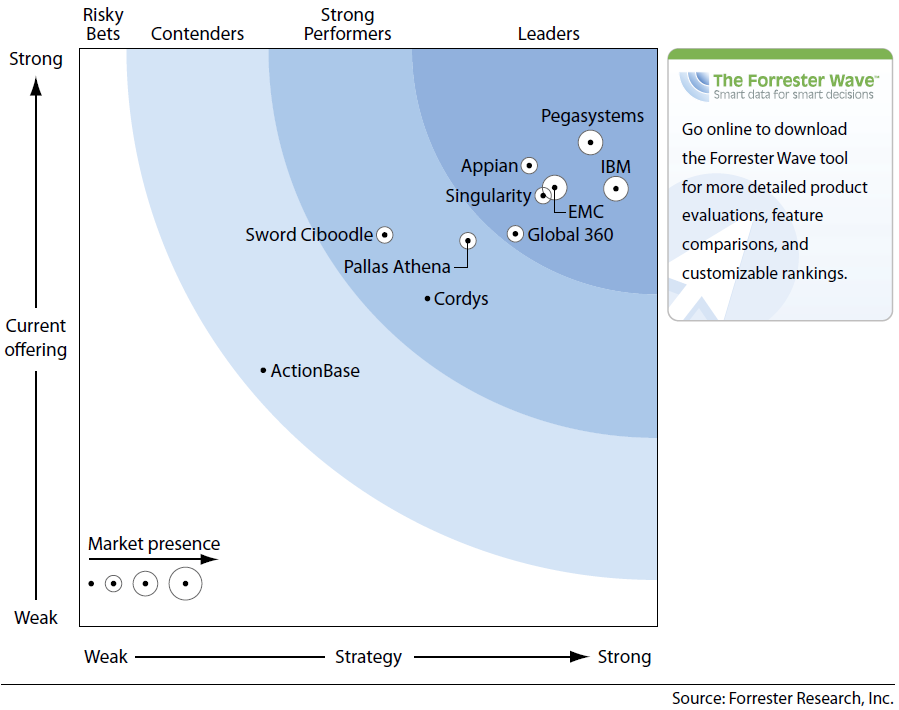
Forrester Waves Dynamic Case Management
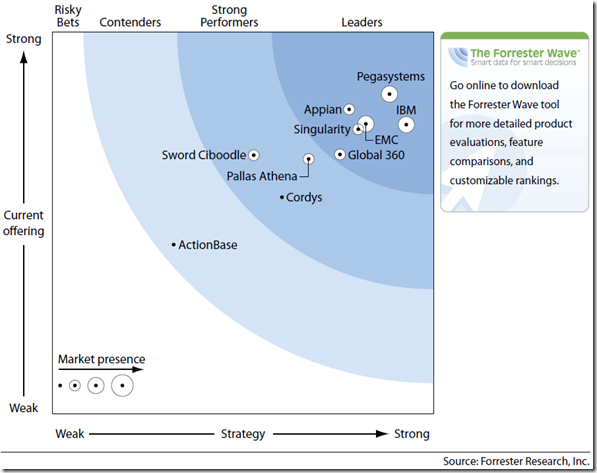
“While BPM products tend to focus on repeatable, structured processes, case management applies to more dynamic, unstructured, ad hoc processes.” And so, a new wave is born in Q1 2011. Forrester now separates DCM from traditional BPM with a separate wave. The usual suspects make up most of the leaders. Some interesting up and comers also make the short list of vendors profiled. Their explanation of Dynamic Case Management is worth a read of the full article.
-
Is Process Improvement Strategically Important?
 What a great blog over at HBR. I agree with most everything Brad Power discusses. In a recent installment he tackles a question often overlooked. The title speaks for itself: When Is Process Improvement Strategically Important? He starts with the assertion that, “Process improvement programs that do not expressly target competitive advantage are doomed to fail.” Agreed. He then goes on to describe when programs have the right target. Among other jewels, he discusses a quad matrix to quantify the importance of process to strategy using focus (efficiency vs. growth) and time-frame (short-term vs. long-term). Hint: The requirement for a long-term focus may be why some organizations discount the strategic importance. Go read the post, then browse the whole blog.


About Me
The sky is not completely dark at night. Were the sky absolutely dark, one would not be able to see the silhouette of an object against the sky.
Follow Me On
Subscribe To My Newsletter
Subscribe for new travel stories and exclusive content.
 Horizon Line Group