

Hello, I’m Veronica
The sky is not completely dark at night. Were the sky absolutely dark, one would not be able to see the silhouette of an object against the sky.


-
What Happened at Lean & Kanban
The Lean & Kanban 2009 conference, wrapped up this week and there has been a lot of buzz about it. I like a summary by email from Dean Leffingwell over at The Agile Executive. Among Dean’s takeaways on the conference are:
I obviously think Lean Software will be big. It will be to the enterprise what Scrum is to teams.
I believe that Kanban (a subset of lean, being used as an agile team method now), will be more readily adopted in 3-5 years than Scrum.
He gives a number of reasons. I won’t list them all, (go read the post) but among them are:
- Easier to adopt at the team level.
- Far less overhead for planning and estimating, and fewer ceremonies (approaching zero in the edge case and with appropriate context).
- Support from industry stalwarts such as Lockheed Martin, who are applying proven lean manufacturing practices to software development for projects like the Joint Strike Fighter.
- Lean optimizes the whole enterprise and gives you tools to reason about the enterprise, from order to shipment, rather than just the team optimization.
I tend to agree in that Lean is the foundation for improvement in a wide variety of areas with software development being just the latest to embrace it with gusto. I differ some in that I have always thought of Agile and Lean as interwoven and perhaps make less of a distinction than Dean between them.
For more conference coverage, read Dean’s blog where he’s posted his full presentation. Or, Leading Agile has live blogged much of the event if you really want to dig into things.
-
Balanced Scorecard Tools
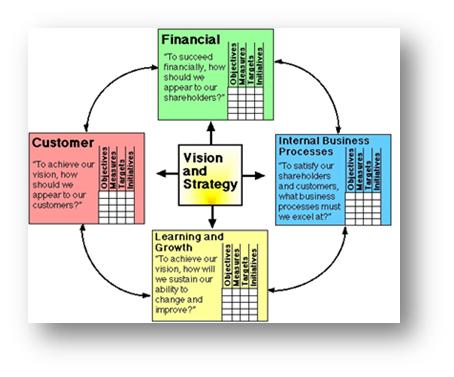 I am a big believer in creating an overall score card for an organization and measuring performance against it. The Balanced Scorecard remains one of the best ways to accomplish that goal for an organization. I recently found a great set of tools from Mark Graham Brown that simplify getting started. I especially like the Excel Templates. You will also find Supplemental Materials => Excel Model | PowerPoint | Case Study | Workshop | Project Plan | White Paper. If you’d like to get a broad overview of the Balanced Scorecard, there is also online training and how to guides (I’ve not looked at these, but expect they match the quality of the other tools.) => online | take exam | pdf | exe file | word. So what are you waiting for, get started on actively managing your company’s strategy today. I’ll share more on how to move beyond excel designs in a later post as I review some promising cloud tools.
-
Denver ABPMP Meets Tomorrow
If you can be in Denver tomorrow, Feb 19 between 4:30pm and 6:00pm, please join us. We are meeting at:
Oracle Building, Denver Tech Center
7700 Technology Way
Denver, COGuest Speaker: Steve Towers
Moments of Truth, Making customer satisfaction work in your favorSteve Towers is the founder of the Business Process Group (www.bpgroup.org) a global business club (originally formed 1992) exchanging ideas and best practice in Business Performance Management, Transformation and Process Improvement.
He leads from the front and works with many of the leading fortune 500 companies as a mentor, coach and sometimes consultant specializing in the implementation of performance improvement, process change and transformation.An inspirational speaker and author of several books including “A Senior Executives guide to BPR”, “In Search of BPM Excellence”, “Thrive! How to Succeed in the Age of the Customer” and recently “Customer Expectation Management – Success without Exception” he is noted for his direct and pragmatic approach. Steve previously worked for Citibank where he led restructuring and business process transformation programs both in the US and Europe.
-
Gartner Says Most Organizations Lack All the Skills Needed to Implement and Optimize Their Business Processes
While this article is not new, its title caught my eye while doing some other research. Quite a bold statement from Gartner. I wonder why there’s not the typical 80% chance by 2010 parenthetical?
I do agree with the extract: “Successful BPM requires an agile iterative approach to process change. Many internal IT organizations and external service providers (ESPs) are still practicing business process re-engineering, using ‘waterfall’ software development methods and calling this ‘BPM’,” said Michele Cantara, research vice president for Gartner. “BPM is intended to empower business stakeholders to work collaboratively with IT to change the solutions supporting business processes. Most ESPs do not possess the governance, modeling and change management skills to effectively foster this collaboration.”
Quite an endorsement for Agile from Gartner! You can read the article here to find 11 less agile steps that Cantara recommends to help determine how organizations should source BPM skills.
-
The Process Center of Excellence
A final post in a series addressing some of the lessons and take aways from experience in establishing Centers of Excellence.
Every organization knows they have a responsibility to optimize financial resources. I don’t know of a business that does not have a CFO or the equivalent and appropriate staff. Most also have acknowledged the importance of their information resources and have a CIO or CTO organization. Most also realize that they need to effectively manage their human resources and have established a Human Resources department.
With processes being perhaps the most critical resource an organization develops, I wonder why most are less enthusiastic about optimizing processes and appointing a chief process officer. This officer would lead a Process CoE that focuses on two critical activities within the business:
- Optimize and Continuously Improve Existing Processes
- Create New Capabilities
Some organizations have addressed the first of these using six sigma and lean. I applaud Motorola and others that have embraced this as a practice, ideology and goal within their organizations. The structures and concepts of lean six sigma fully address the first activity. Motorola credits six sigma with delivering at least $16 billion in savings between 1987 and 2001.
But, it only addresses half of the requirement of a Process CoE. Motorola, as a case study, has demonstrated an extraordinarily difficult time adapting to changes in their business model and producing next generation products and capabilities. Witness the recent woes and impacts from the 3G cellular transition. This, I believe, is from their lack of focus on the second critical Process CoE activity, creating new capabilities. Despite the DMADV methodology within six sigma, few shops actively nurture capability development as an activity. This leaves them unable to successfully transition to the next strategy, market, or product.
Creating new capabilities first requires an organization to recognize that a new capability is required. This takes strong outward facing skills not honed in six sigma. It also requires the ability to create new partnerships, attract new customers, enable new value chains and master new processes, tools, skills and technologies. None of these are Master Black Belt competencies. I am currently working with an organization that is building an new internal capability, and I can say it is nearly as difficult a work as a start-up organization faces. (I say ‘nearly’ only because they have some existing structures that can be borrowed and fewer capital constraints than startups where I have worked.)
My vision of a Process CoE would expand on the six sigma foundation to nurture both of these critical activities. At the core of the center would be strong analytic problem solvers that would improve existing processes and design new ones. We would borrow heavily from IT, HR and other speciality resources when needed. Around them would be project, program and change managers that would stitch together the complex dependencies that would ensure readiness for working differently. And, sitting on top of that would be visionaries moderated only by an enterprise prioritization and resource allocation process. These visionaries would focus on expanding use of the organization’s core competencies and pushing leaders to explore new opportunities and relationships to keep the business relevant for an ever changing world. A truly agile enterprise would be the result.

About Me
The sky is not completely dark at night. Were the sky absolutely dark, one would not be able to see the silhouette of an object against the sky.
Follow Me On
Subscribe To My Newsletter
Subscribe for new travel stories and exclusive content.
 Horizon Line Group