

Hello, I’m Veronica
The sky is not completely dark at night. Were the sky absolutely dark, one would not be able to see the silhouette of an object against the sky.


-
When Lean Six Sigma Works
While titled So What is Lean Six Sigma, I think this article does one of the better jobs of pointing out the strengths and limitations of the practice.
-
Creating Value Stories – ABPMP Summary
I presented this Thursday at the ABPMP Denver meeting on the topic of how to build
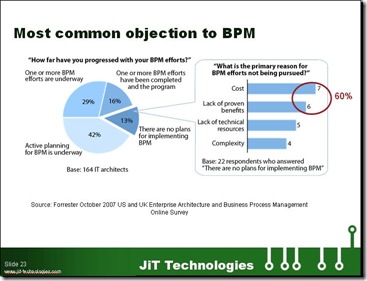 support for BPM initiatives. My message was primarily that to get traction and support for these initiatives, internal and external services organizations need to create a compelling value story. “Stories” are how these initiatives communicate how they will solve need and meet organizational goals. Here are the presentation slides for Consultative Selling and Business Cases for BPM ROI.
I am glad to see how the Denver ABPMP organization has grown over the past year and a half since its founding. I think the membership has matured as BPM has gained more acceptance. I look forward to working with Brian Brinks and his directors as they continue to grow it in the next year. Thanks also to Tony Pasma from Global 360 who co-presented.
-
How to Survive the Downturn

Is a downturn inevitable? Given all the talk in the past couple months, it seems that a downturn can no longer help but to become a self-fulfilling prophecy if it has not already set in. The only question is how long and how deep?
How should companies approach these uncertain times? Most of the companies I am talking to seem to be continuing much with business as usual. Granted, I am not currently working with investment banks nor home builders, but even a company I am working with that is focused on consumer banks is seeing strong interest in their new product. Not all banks used leverage and risky instruments to grow quickly and most have strong balance sheets. Sure there’s turmoil and risk. But only a small percent of businesses really “did anything wrong.”
Bernie Thompson has a post on Lean Software Engineering urging companies to Get Lean to Survive the Downturn. It focuses on executive priorities during a downturn and basically postulates that the right things to do before are the right things to do now. He suggests that:
…to steer the corporate ship to account for the increased external risk and uncertainty:
- Re-prioritize to focus on the highest probability, nearest term revenue opportunities
- Cut spending to preserve cash
- Look carefully for unique opportunities in the surrounding turmoil
He concludes with “The urgency of a downturn may, in fact, be the best opportunity to adopt changes that will pay off even more when things turn up again.”
I happen to agree with this assessment and especially like the third point which he elaborates on in the article. Now is a great time to continue to improve how you operate and to re-invest in the future. Sure, increase focus and tighten up on discretionary spending (both are part of being lean,) but keep delivering the fundamentals while improving on the key differentiators. And stay on the look-out for opportunities that may only be available in these more unsettled times.
Oh, and don’t forget to surround yourself with positive people and turn off CNBC. Let’s stop the prophecy in its tracks. I’m not sure the downturn has to affect the broader economy like it did Wall Street. Get out there and keep improving.
-
The Value of Process Improvement
I will be presenting at the November ABPMP event in Denver this Thursday from 4:00p to 6:00p. The topic is Using Business Cases and ROI to Justify BPM. The content is based on my work with a BPM software vendor’s sales team where we built an approach and model for them to deliver customized Business Cases with sales prospects. The approach is equally applicable to BPM Centers of Excellence looking to generate project sponsorship. This value driven approach has been shown to speed support and close more, larger projects.
You are welcome – no encouraged – to attend whether or not you are a member. The event is being hosted at the Archstone offices in the Tech Center:
Archstone
9200 East Panorama Circle, Suite 400
Englewood, CO 80112Hope to see you there.
-
Growing Centers of Excellence
Continuing a series of posts addressing some of the lessons and take aways from recent experience in establishing Centers of Excellence.
I believe different enterprises are at different levels of sophistication in their use of centers of excellence (CoEs) and view them at different levels of strategic importance. Organizational Maturity Models are a good approximation to the stages enterprises will experience in creating CoE’s. Perhaps the best know of these is the Capability Maturity Model (CMM or CMMI.)
The CMM model identifies five increasing levels of maturity for an organization:
- Initial (chaotic, informal, ad hoc, heroic) the starting point for use of a new process.
- Repeatable (managed, documented, process discipline) the process is used repeatedly.
- Defined (institutionalized, integrated) the process is defined/confirmed as a standard business process.
- Managed (strategic, quantified) best practices are shared and process management and measurement takes place.
- Optimized (continuous improvement) includes deliberate and continuous process optimization/improvement.
– Adopted from Wikipedia Capability_Maturity_Model
Applying these concepts to CoEs, we see that the initial stage usually exists before organizations begin to recognize the need for CoE’s. Capabilities may initially live in functional organizations or with individuals.
Typically organizations begin to move to a repeatable stage when they start viewing CoEs as an asset to project teams. With this project centric view, they know that teams need support and are looking for a home for the deeper skills they require. My company with 13 centers took this view. They created CoE’s for Architecture, .NET, Business Intelligence, Content Management, QA, Scrum, Database, etc. By the most basic definition, all were CoEs. They drafted owners for each CoE and created a charter defining each center. They began coordinating across projects, helping plan and set scope, and monitoring the capabilities they were responsible for building.
The next step for the CoE’s was to begin to define and document the standards and practices for their competency. In this stage they captured best practices in a wiki format and began to more actively manage associated risk and quality. They created basic training and became more active in communicating the competencies across the organization.
Many competency areas do not need to fill all the responsibilities of a mature CoE and may not make the leap to a more mature levels. Most will be satisfied with achieving the first few levels of maturity. Making the leap to the next higher level requires strong coordination and, therefore, strong commitment across executive levels.
Organizations that can gain this commitment can begin to build managed, strategic CoEs. The focus should no longer be within a division, but across an organization. They will begin to support corporate goals and plans, integrate with corporate score cards, and actively manage a portfolio of initiatives across the organization that use their service. The true power of CoE’s begins to be unleashed as more formal career paths are created and development and mentoring become available for the competencies the CoE supports.
Optomized CoE’s continue to build increased corporate value. At this level, the CoE is an asset that is recognized across the organization. They will feel ownership for corporate goals and will ensure success of projects supporting those goals. Assessments will ensure consistent application and improvement of the competencies needed to meet the goals. They take responsibility for the corporate score cards and their associated value. Audits, skill assessments and certifications further improve capabilities.

About Me
The sky is not completely dark at night. Were the sky absolutely dark, one would not be able to see the silhouette of an object against the sky.
Follow Me On
Subscribe To My Newsletter
Subscribe for new travel stories and exclusive content.
 Horizon Line Group