

Hello, I’m Veronica
The sky is not completely dark at night. Were the sky absolutely dark, one would not be able to see the silhouette of an object against the sky.


-
What is a Center of Excellence
Continuing a series of posts addressing some of the lessons and take aways from recent experience in establishing Centers of Excellence.
I’ve never really liked the term. Sounds so haughty. I prefer ‘Competency or Capability Center’ or pick any another term you like. But, ‘Center of Excellence’ seems to be what has stuck in the business world, so we’ll go with it here.
Definition: Whatever you call them, a Center of Excellence (CoE) should, at a most basic level consist of: A team of people that promote collaboration and using best practices around a specific focus area to drive business or customer-valued results. This team could be staffed with full- or part-time members.
Responsibilities: In my experience, CoEs should serve five basic needs:
- Support: For their area of focus, CoE’s should offer support to the business lines. This may be through services needed, or providing subject matter experts.
- Guidance: Standards, methodologies, tools and knowledge repositories are typical approaches to filling this need.
- Shared Learning: Training and certifications, skill assessments, team building and formalized roles are all ways to encourage shared learning.
- Measurements: CoEs should be able to demonstrate they are delivering the valued results that justified their creation through the use of output metrics.
- Governance: Allocating limited resources (money, people, etc.) across all their possible use is an important function of CoEs. They should ensure organizations invest in the most valuable projects and create economies of scale for their service offering. In addition, coordination across other corporate interests is needed to enable the CoE to deliver value.
Types: One organization I worked with defined 13 centers within just their IT department. While all of these are important competencies they need to develop within that department, I’m not sure all reach the threshold of a CoE. Some common examples of CoE’s I’ve seen are:
- Process – To me, this is the most strategic of all CoEs since all businesses are made up of processes. I’ve started to see a few companies establish it as a CoE. One I know of is currently creating a role for a ‘Global Business Improvement Executive.’ I love that. It allows for all the traditional focus of lean and six sigma as well as for creating new strategies and business capabilities. I’ll have more comments on this as a CoE in a later post (see Process Center of Excellence.)
- Strategy – Your strategy process is the process that impacts all others. I’ve extensively documented #StrategyOS as an effective approach to formulate, document, execute, and grow a strategy process for any business. Keeping your strategy alive and well in any organization can be the difference between runaway success and stagnation or failure.
- Six Sigma – Perhaps six sigma is the most mature of the CoEs that some organizations have embraced. This type CoE was invented by Motorola and popularized by GE. Many companies have grown this into a strategic asset they use to differentiate themselves and drive competitiveness. It has formal roles (Champions, Sponsors, Black Belts), a well understood methodology (DMAIC), standard set of tools (Statistical control, etc.), a formal certification process (Green Belt, Black Belt, Master Black Belt) and an active community.
- Project Management Office (PMO) – Many fail to think of themselves as a CoE and act as little more than a governance body, but the most successful PMOs grow beyond that single focus and take on a full CoE role around project management.
- Quality Assurance – Whether for new product or software development the complexity of the roles, tools and techniques needed for quality often get formalized into a CoE. This may be tied to a six sigma CoE or stand alone.
- Communications – Corporate communications, employee and customer relations are activities that are often supported by a centralized support process or function. At a basic level, their role is to support the line business around this focus area.
- Risk and Compliance – Many organizations have created this capability without formally calling it a CoE. Insurance and financial institutions without exception will have this function. Other verticals may also embrace it. They almost always have veto power on changes to business processes or external communications. In ideal cases, they will help deploy standards and facilitate understanding throughout the organization.
- Human Resources – Another “function” or support process many businesses have embraced at a strategic level that meets the definition of a CoE.
- Business Analysis – Some organizations have embraced the idea that getting business requirements, especially around software development, is a problem best addressed by a CoE. A certification for Business Analysts from the IIBA has further advanced this idea. Product Management is a more common title for the overarching integration of requirements and roadmap of software offerings. The Chief Product Officer is becoming a common chief title in software companies.
Hopefully, some of these bullet points get you thinking more broadly about what a CoE is. If I extrapolate this thought stream past its current use, CoEs can really refer to any of the support processes within an organization that complement the line businesses. Not all organizations will embrace all the CoE’s listed above, but most will have some support processes. Is product development a CoE? How about sales and marketing or finance? While I don’t think businesses are ready to broadly embrace this concept, I do think that having leaders of all support processes think like a CoE can improve their focus and the value they deliver.
-
Why Create Centers of Excellence
I’ve been focused on setting up centers of excellence recently. I will be sharing a series of posts addressing some of the lessons and take aways from that experience in a few upcoming Centers of Excellence posts.
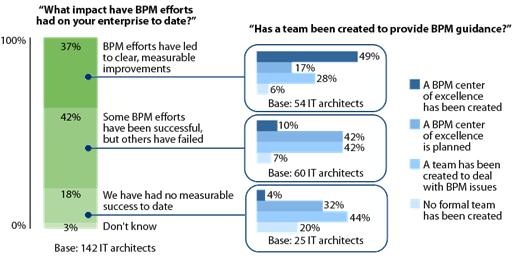
The first question many customers ask is why would I want a center of excellence? The best answer is because it drives valuable results. A recent Forrester study of BPM shows that having a center of excellence significantly enhances the ability of an organization to meet or exceed the goals that center supports.
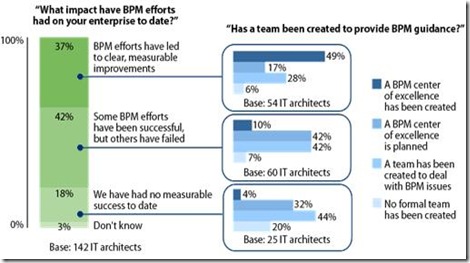
Source: Forrester October 2007 US and UK Enterprise Architecture and Business Process Management Online SurveyMy own experience bears this out. When governance, a support structure, guidance, measurements and shared learning exists across an organization, success is far more likely. Success will support organizational and specific projects goals. A need to gain results should be the primary motivation for creating any center of excellence. Or stated another way, the motivation/need for and expected results from a center of excellence should be well thought out and articulated unambiguously to server as the foundation for the creation of any center of excellence. Without this, it cannot be successful.
-
Value Driven Sales
I’m in Dallas today co-presenting at the global sales conference for a large BPM software provider. The topic, using return on investment to drive strategic sales, was well received by the audience. The CEO and VP of Marketing in the company were familiar with the case study I presented from previous work together. The CEO highlighted the effect that linking operational measures to key performance indicators and return drivers had on sales in the past software company he ran. By his measures, this approach had closed sales 30% faster, improved close rate by 35% and increased deal size by 75%. He also pointed out how this approach got the discussion out of the IT shop and into the CO/FO’s office. If you’re in the Denver area, I’ll also be presenting the approach at an upcoming ABPMP meeting. Stay tuned for more details.
-
Testing for Agility

Enterprise Agility Test I endorse a post by Dean Leffingewell on evaluating enterprise agility. In it he explains three key test areas:
- Variable Scope. Fixed Quality
- Incremental Value Delivery
- Empowerment and Accountability
I am going to get picky here, so read the rest at your own discretion… Perhaps, I’d rearrange the sub bullets under different main headings. For example, as I compare this to my definition, I wonder whether the test for customer alignment should be more explicit?
I also notice my definition does not explicitly dictate variable scope or even iterations. To me, scope size is more about keeping lean and ensuring flow than a test itself. Effective workload management enables many benefits. If a company demonstrates rapid delivery, regular inspection, adaption, customer alignment, quality, etc. by other means (eg: kanban, FDD, etc.) then they pass the test. I’d perhaps change this to “Can teams effectively manage workload?” which allows for more flexibility in how scope gets managed. Test should be for the result, not necessarily for a specific means to that result.
-
Agile Development is so Old Fashioned
 The functioning principles of Agile (and process improvement more broadly) can be found in lean manufacturing and six sigma. These concepts date back to just after World War II and include error proofing, eliminating waste, creating flow, adding customer value, and empowering workers. If you are interested in deeper understanding I suggest reading the above links and:
- 14 principles of the Toyota Way
- 2 pillars of the Toyota Production System (Just-in-time and smart automation)
- 5S methodology
- Total Quality Management
- Deming’s 14 points
While more comprehensive, notice how similar these ideas are to the often referenced 7 principles of lean software development. One of the items I wanted to highlight when editing the Agile definition on Wikipedia was that the principles predate the Agile Manifesto in 2001. I think the idea that these concepts were crafted there for the first time sometimes stifles creativity in how Agile gets applied and creates the mind-set that practitioners need to invent as we go.
Going back to established principles and their associated tools and practices offers a proven base to grow from and an opportunity for surfacing new ideas for continuous improvement. I also find in them core ideas for applying concepts outside of development teams to grow a more agile enterprise.
Oh, and of course, I recommend my own Laws of Agile Development series. Please let me know if you are aware of any others I’ve missed.

About Me
The sky is not completely dark at night. Were the sky absolutely dark, one would not be able to see the silhouette of an object against the sky.
Follow Me On
Subscribe To My Newsletter
Subscribe for new travel stories and exclusive content.
 Horizon Line Group