
Hello, I’m Veronica
The sky is not completely dark at night. Were the sky absolutely dark, one would not be able to see the silhouette of an object against the sky.


-
Shared Business Model; Your Vision Cheat Sheet
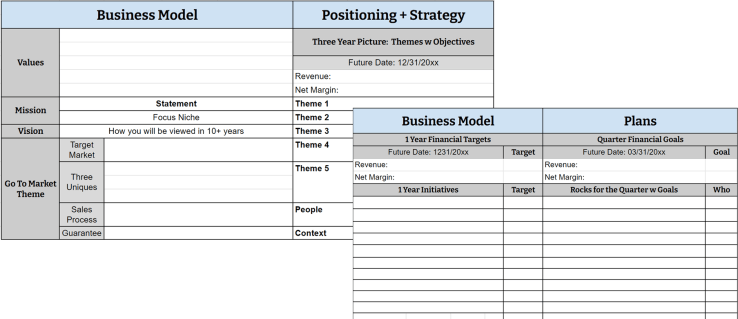
The best Business Models can be communicated in a few words, documented in a couple pages, and managed with a few meetings. Your Business Model should fit on one or two pages. It should be shared, known and worked on by everyone in your business.
Create a Cheat Sheet (n: a written or graphic aid that can be referred to for help in understanding or remembering something complex).
Let’s explore how to document your business model.

What is a business model:
Simply put, your business model documents how your business works and what makes it unique from the many other business out there. It should:
1. Identify and make explicit what is unique
2. Document and communicate those differences in a way that creates a compelling vision for the future and aligns the performance of all activities
3. Ensure progress toward implementing, sustaining, and improving to deliver the visionI use the following format to help give definition to the elements that make up a business model:

On the right side of the diagram is the hierarchical list of elements that define your Business Model. Your Business Model focuses mainly on these elements. As we go down the list, terms are getting more near-term and more detailed.
- The Positioning terms are the elements that are ten plus years out and should endure time, technology and people in the organization. They define why the business exists.
- The Strategy terms are three to five years out and create a picture of what outcomes are priorities.
- Plans are made annually and quarterly to guide how to achieve the Strategy through daily, weekly, and quarterly actions.
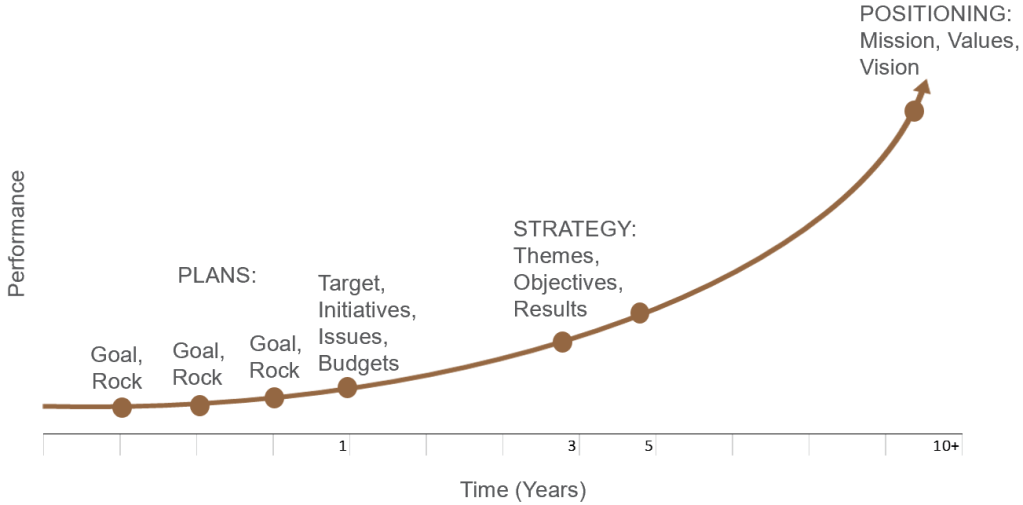
Issues are called out under Plans, but can impact success at any level of the strategy. As such, it is important for teams to rigorously manage and solve Issues at all levels. It starts with uncovering and tracking a prioritized list of Issues. This includes any important decisions or problems that can impact success. Teams must then have a shared approach for solving Issues that identifies their root cause and first principles. This exposes the best solution to solve them and make them go away in a verifiable way.
All of this projects on a shadow of the Context that impacts strategy through internal resources and capabilities relative to external trends like customer needs, innovation, competitive positioning and social and regulatory impacts. This Context can help to accelerate your success or create impediments. Your business model must consider and define how you will compete to win within this Context through a good product market fit, go to market activities, and other Themes.
The left funnel is the people piece of the Business Model. It documents the concepts needed to be great at people.
How to Create Your Business Model
Positioning
Positioning includes the strategy elements that should be rock solid: Mission, Values, and Vision. These guide key choices and help to give direction when uncertainty rises. When you get them right, you can carve them in stone to endure beyond anyone’s tenure in the company.
You may already have positioning statements documented for your company. If they serve you well, you may not need to modify them. But, most businesses that are just starting to implement a Strategy OS will want to revisit them to ensure they are solid touch stones for at least the next 10 years and ideally indefinitely. If you are stuck, look to other companies, brands, and people for inspiration. Here are a few examples:
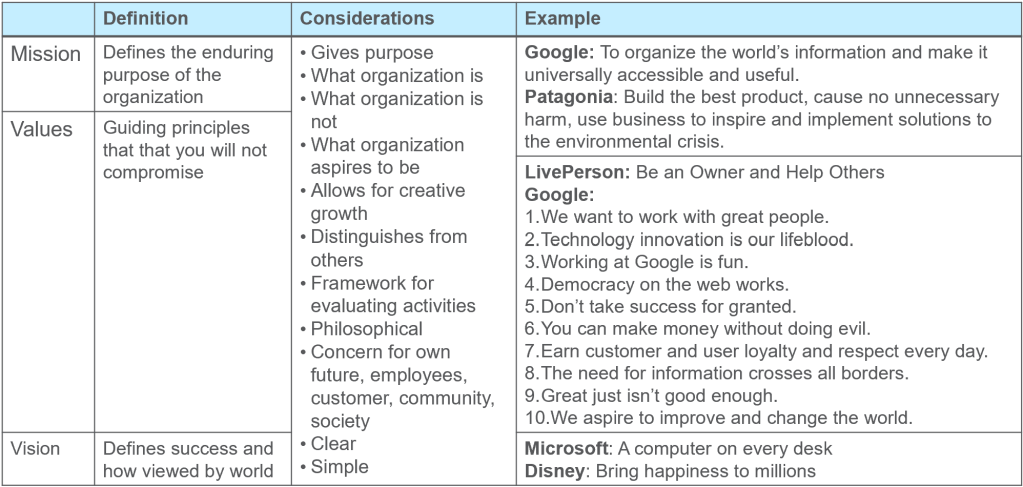
To start, make sure you have a documented statement for each Positioning element as you start to implement your Strategy OS. Create your Mission, Vision and Values in a working session that allows key leaders and influencers in your company to give input. This will produce a better result than any individual can create. Test drive your positioning for a quarter and revisit whether it is serving the intent at the next quarterly meeting (see 6, Execution Rhythm.) When you have a couple quarters with no changes, it is time to start making these statements the corner stones on which the Strategy OS is built and run. Publish them widely. Refer to them when evaluating all other components of your strategy and your people. Point to them for decision guidance.
Strategy:
Strategy in this context refers to the dictionary.com definition: “a plan of action or policy designed to achieve a major or overall aim.” In this case, the overall aim is to achieve the Positioning created above. Strategy connects near term action from Plans to the long-term why of Positioning.
A useful construct in creating your strategy is to organize around the major Themes that advance your Positioning. Themes are broader than plans or programs in that they offer guidance about what is needed without limiting possible plans of action or timeframes. They are destination statements describing with details what the business looks like at some future date from a variety of perspectives. Since it is difficult to envision a clear future much further out than about three years, use this as your timeframe to create destination statements describing your major next achievements. Make these statements challenging and motivational, but within the realm of possible outcomes.

These destination statements come from assessing how you can best use your business talents and unique capabilities to win given the business’ Context. Being good at talking to your customers to uncover issues, ideas and insights is the best way to understand context.
From the universe of possible destinations, group, prioritize and focus on the top 3 to 5 (no more than 7) that can have the largest impact on success. Give them short titles that become your Themes.
Once you have your priority Themes, ensure they are well understood by giving each at least one descriptive Outcome and Measure that demonstrates attainment of the Theme at the end of the planning horizon. This process helps make the Theme more concrete and allows the right focus of resources needed to achieve the Theme. Be flexible; as the example suggests, some Themes’ Results may be less tangible than specific measures in this planning horizon. But it should always be easy to determine whether the Result was achieved or not.
Every Strategy must include two specific Themes: Your “Go to Market” and “Financial” themes. The Go to Market or marketing strategy Theme is how you will sell and win business within your Context. If you need a structure, borrow from what is described by Wickman (pg 55-65.) The elements are summarized with examples below:
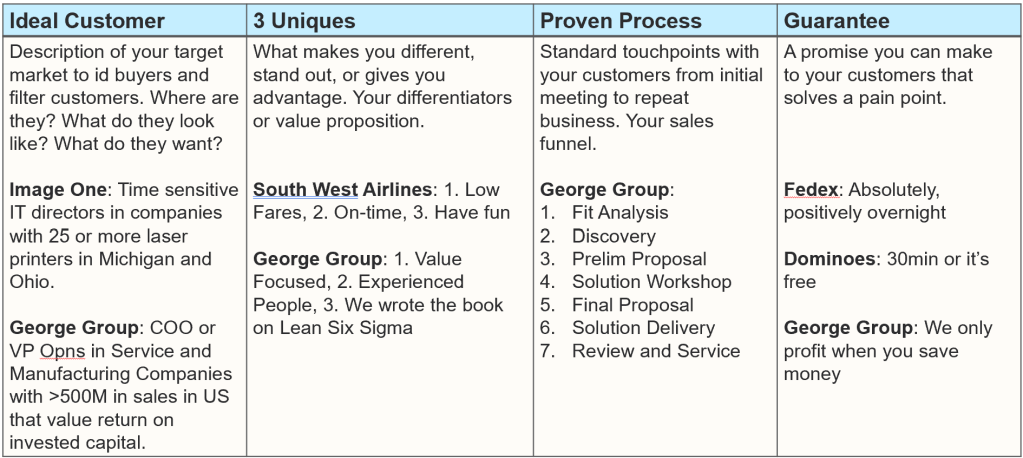
The Financial theme defines your revenue model and includes at least two associated Objectives: revenue and net margin with associated Results. As you learn key drivers of your financial results add them as leading Results to give early indication of success. SaaS companies for example generally emphasize financial drivers by including Results like annual recurring revenues, customer acquisition costs, retention rates, customer lifetime value, and average revenue per user. Service companies focus on utilization and average hourly rates. Find the few key leverage points that drive your bottom line success and give early indication of the health of your business. Elevate these measures to the Financial Theme and give them Objectives and Results matching your strategy time frame. Finally, you must ensure the company never runs out of funds to operate. Cash management and fund raising are essential parts of the Financial theme especially for early stage companies.
Plans – Annual
Annual planning, as the name suggests, involves envisioning the company one year out and setting Targets and Initiatives for the next 12 months. This step works much like the strategy exercise to create Themes, but the timeframe is narrowed to one year and more detail is added to create clarity of focus for the next year about key results that will work toward the Strategy outcomes. Stay light weight. Planning can be as simple as creating Targets and Initiatives for each strategy Theme. Then give these a Budget that includes people and dollar allocations. Annual planning is a special iteration of the Quarterly Strategy Refresh meeting.
All plans come with risks and uncertainties. Creating plans is a good time to raise known or possible Issues that could impact your ability to deliver them. The Issues list is a key tool for decision making, barrier removal, and problem solving. You might solve a couple priority issues in your annual planning. Most Issues are managed by keeping a priority list that is worked on during recurring leadership team meetings.
Plans – Quarterly
People are programmed in a way that makes it difficult for them to stay on plan much past 3 months without a need to refocus on priorities. Quarterly Refresh creates the checkup and resetting that ensures efforts are still aligned and making progress toward the annual plan created above and ultimately the overall Strategy. The format is much like above, but this time the timeframe is narrowed to only 3 months, again with more detail. Create quarterly Goals that support the annual Targets, and Rocks that support annual Initiatives. These define key results for the near-term that ensure progress on a daily and quarterly basis is contributing to deliver longer-term Objectives.
Rocks are a Stephen Covey, 7 Habits “First things first” concept. It uses and analogy of filling a jar (representing limited time and resources.) Consider that you have a pile of sand (everyday tasks) and rocks (big priorities) to fill the jar. If you put the sand in first, there is not enough room for the rocks. But, if you put the rocks in first, the sand can fill empty space left between them allowing all to fit. So, if you want to accomplish big things with limited time and resources, prioritize and work first on the big priorities represented by Rocks. Rocks and Goals are set quarterly to make commitments to the next key milestones that are most important to be delivered in the near term.
Each Rock and Goal has an owner. Each person on your executive team should have 1 to 4 in total. These are decided, tracked, and refreshed in Quarterly (or more frequent) Strategy Refresh meetings.
In most companies, Budgets are set annually and only adjust if circumstances change dramatically. We continue to measure quarterly progress against the annual plan. This adds stability and commitment to planning. In more nimble companies, dollar and people changes can be made quarterly as long as revenue and margin target impacts are acceptable and people don’t feel whip lash from frequent, dramatic changes.
You can find my editable Business Model Cheat Sheet here.
If you would like help in creating and executing a Strategy OS, find out more about workshops I run or schedule time with me on the About page to discuss your specific needs.
-
Be Great at People
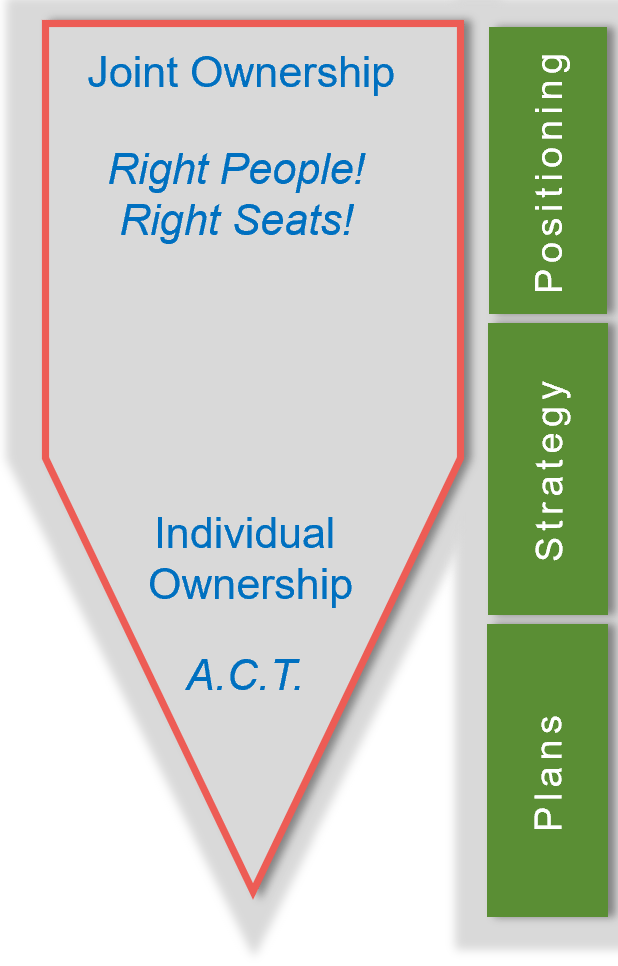
The left funnel of the Business Model highlights people elements that are needed to successfully deliver a business vision. There are 5 key practices:
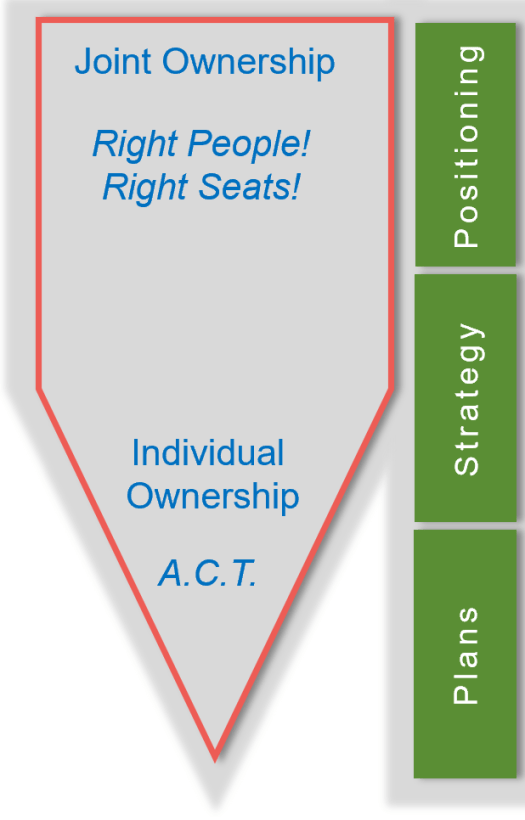
- 1. Joint Ownership for coordination & monitoring
- 2. Individual Ownership by all for action
- 3. Right People
- 4. Right Seats with the right responsibilities
- 5. ACT to develop people who grow with the vision
Being great at the people part of business requires improving across these practices.
Lets explore the tools and best practices for them.
Joint Ownership of for Coordination & Monitoring
The funnel shows that the high-level Positioning elements, Themes and Context of the business model are jointly owned. This is not just a lofty idea. Everyone in the business should know the Mission, Vision and Values. Leaders must Communicate and share positioning regularly. They should share and give access to the Vision Cheat Sheet and reference it as needed. All should understand how the work they do conforms to and helps to deliver Themes and the long-term vision. They should work to deliver the parts they can impact.
Your business model must continue to update and refine how you will compete to win within an evolving business environment through your product market fit, go to market activities, and other Themes. Everyone should Monitor this business Context while they work. Take note to ensure the Business Model remains relevant. Consider how internal resources and capabilities are impacted by external trends. Identify what could affect strategy elements as they go about their day and capture:
- Issues: Any problem, bottleneck, or mistake that you have identified
- Insights: Any fact, observation, or experience that you learned
- Ideas: Any solution, improvement, or innovation that you identified
The most important monitoring is listening to customers and employees. Support reps on sales calls. Conduct customer surveys. Check your support desk and other customer facing processes that define your business to the world. Understand their needs and ensure customers see you how you want to be seen.
Another tool to employ is scheduling regular Adapt and Grow Time. Leaders especially should schedule time blocks that focus on creating the feedback loop that all complex systems need to be successful. Schedule alone time to work “on” the business away from the day-to-day “in” the business work. Many leaders I know schedule at least one hour per week for this “thinking time.” The best leaders schedule longer blocks of time weekly and schedule full day or longer blocks each quarter.
Traction (pg 214) calls these Clarity Breaks. This is not time to catchup on work tasks. Instead be alone, away from work, with a note pad, and no distractions. Focus on important questions like Positioning, context, priorities, people, processes, themes, products, nagging issues, emerging trends, ACT feedback, and how you structure your own time and work. You can start with written questions from the week, or focus on what comes to you. The outcome should be ideas that can lead to expanded opportunities, accelerated success and more relevance.
Many of the issues, insights, and ideas from this monitoring can be added as Issues for your Leadership Team meetings and implemented quickly. Or, they can be larger Issues to work on at the next Quarterly. The most important insights create a learning loop that feeds back into you Business Model. In early stage companies, it can create a pivot causing major changes in Positioning. Or, more typically in established companies, it impacts the understanding of Positioning and feeds annually into your strategy review to clarify priorities of existing Themes or create new ones.
Other team members coordinate the issues, insights, and ideas generated from monitoring in monthly Council meetings to create a strategy dialogue that discuss what they believe could affect shared business model elements. These meetings check across all Themes to ensure continued:
- Relevance: Do we still have the right business model?
- Progress: Are we making the right progress?
- Mood: Is everyone still onboard?
The output of these meetings is action items specific to each team with individual ownership to make incremental improvements to how they deliver business model Positioning elements and their part of Strategy and Plan elements. Learning is shared with the leadership team to help them understand any impacts to the business model or need for adjustment to Positioning or Themes.
Individual Ownership by All for Action
As we go down the list and get more specific and nearer-term, more focused teams and responsible individuals take primary ownership for delivering specific Plans and related action items.
All teams should know how work contributes to delivering Themes. Each member of the team should know the impact their actions have.
Some teams will have ownership for specific initiatives that help to deliver company Themes. For example, in a new product launch, development may be responsible for creating the product, while procurement sources materials, marketing works on the go to market plan, and sales generates pre-launch orders.
Rocks, Issues, Action Items, and measures all have One DRI who is the owner or ‘directly responsible individual.’ Others can help with any of these, but there is only one DRI. This owner will lead decision making, and coordinate input and activities, and do work to deliver what is needed to meet the goal and deliver results.
Beyond that, One Hour Strategy suggests that everyone should Reserve Time to work on strategy related actions. Senior leaders should reserve at least 1 hour per day, team leaders 1 hour per week, and all others 1 hour per month to help deliver the business model. For most, this means real work to monitor Theme elements, deliver the Rocks and other action items they own.
Get good at managing actions and Make it part of Daily Acts. Create a shared team accountability tracking. Tracking can be in Google Sheets or, better, adopt a shared tool like Monday, Trello, Clickup, or Asana.
Right People
The term “Right People, Right Seats” from Traction reminds us that first priority is to have the “right team on the bus” (Good to Great) even before we know where we want to drive it.
Values are the initial screen for deciding whether people are right. People that do not embody the company values create distractions by not getting along well with others, and making decisions that do not best support the vision. Evaluate for Values; people either believe in the values in a way that adds value (+), subtracts from value (-) or is neutral (+/-).
Next, for each person Evaluate if On-board. Are they on the bus to deliver the business model. Start with Vision and Mission elements then evaluate around specific Themes where they contribute. Traction suggests using three criteria; decide ‘yes’ or ‘no’ whether they:
- Get it: do they understand and buy into what is needed
- Want it: do they have a self-motivated dedication to make an impact
- Can do it: do they have the time, experience, discipline, and the right disposition to do the work

Rate everyone. Ensure they buy into the Values, Vision, and Mission of the business and want to make the positive impact it delivers. For any shortcoming, either coach improvement if possible, or likely you need to find people that want to embody the company positioning.
If they are not the right people, changing their seats on the bus won’t make problems better. It is best to change people quickly if they are not right for the business. Help people that are not right for your business to transition to a place that is a better fit for them.
Live by this advice from Jim Collins:
“To let people languish in uncertainty for months or years, stealing precious time in their lives that they could use to move on to something else, when in the end they aren’t going to make it anyway—that would be ruthless. To Deal with it right up front and let people get on with their lives— that is rigorous.”
Practical Discipline #1: When in doubt, don’t hire—keep looking.
Practical Discipline #2: When you know you need to make a people change, act.
Practical Discipline #3: Put your best people on your biggest opportunities, not your biggest problems.”
Right Seats with the Right Responsibilities
Each person must fill a needed role where they can perform best. Design how roles should be structured. This is first done without considering who is currently working there. How best can you Organize to support Themes and the work of the business.
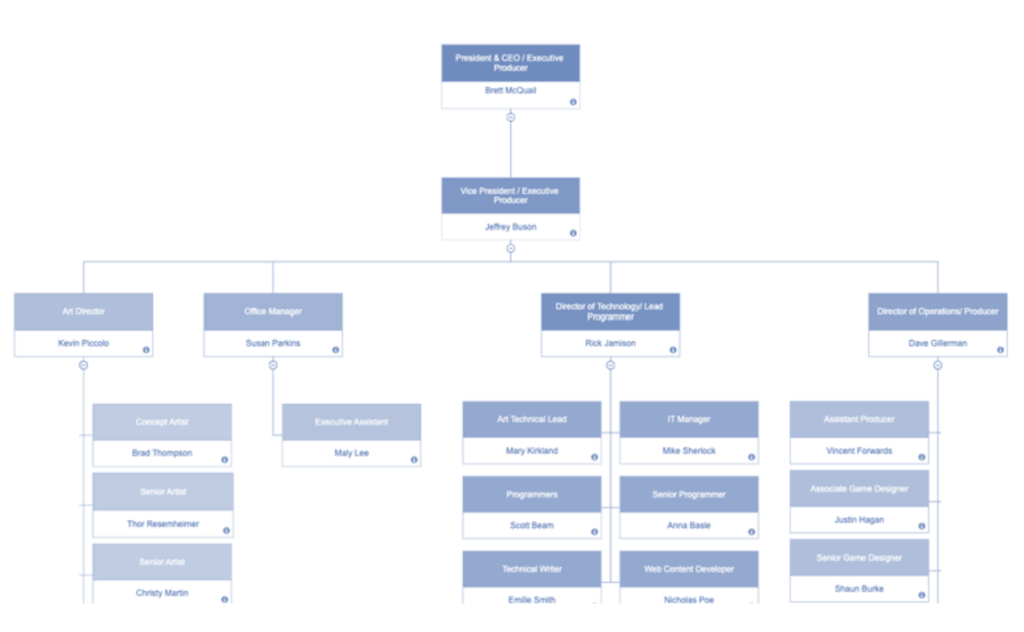
You can create this design with any number of online tools. It does not need to be complicated. A simple design can include only a hand full of roles with a couple of levels.
Once the role design makes sense, evaluate each person on the bus for which seat they can fill better than anyone else. Be realistic. If a role is needed and there is no one to fill it, accept that a new hire is needed. If a person is in the wrong role, move them to one that fits their unique capabilities.
Now, with the people in mind, Create an AOR = area of responsibility list. Great CEO Within suggests you: “Create a document that lists all of the company’s functions and, for each, the directly responsible individual (DRI.) This is the AOR list. It serves as a routing layer for any questions and ensures that no functions fall through the cracks. Make sure everybody in the company knows how to access the list, and update it as new functions arise or as responsibilities shift.”
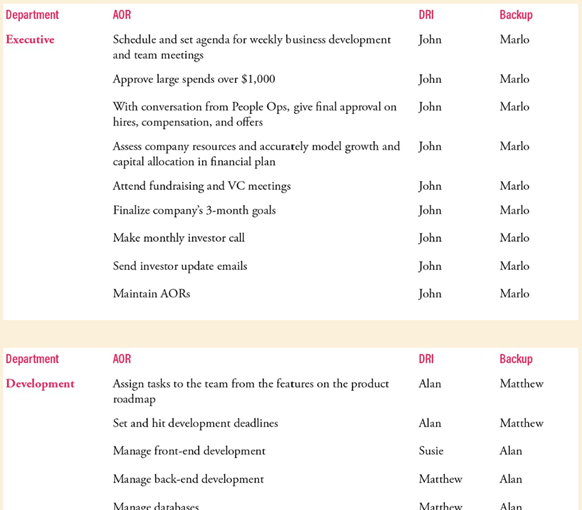
Organize this list to match the structure of your org chart. Ensure that it covers Themes in your business model and all routine work done in the business. Pay special attention where you have shared executive leadership (President vs SVP, CEO vs COO, Visionary vs Implementer) to ensure they jointly agree to where there are boundaries and if any shared responsibilities exist.
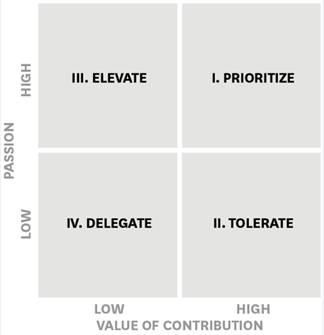
A final useful tool is to actively monitor the work you do to look for areas where you can create focus and offload work. Focus on the things you enjoy most and that add the most value. Traction uses a 4×4 matrix. You should:
- Q I – Prioritize: create more time and focus for this work.
- Q II – Tolerate: make time to do the work until you can give it to others with your oversight; help them deliver the same value as you.
- Q III – Elevate: either make the work more valuable, or stop doing it or give it to others; help them find joy in the work.
- Q IV – Delegate: stop doing it, or automate or offload this work to others completely if it must still be done.
This can help others grow their contribution and highlight the need to hire a new role to take over the required work if there is no more capacity for you or others. And it makes your work more valuable and joyful.
ACT to Develop People who Grow with the Vision
ACT is an acronym developed in The Great CEO Within that reminds leaders how to motivate people and create great cultures. It stands for:
- Accountability: getting things done by Leading and Managing well
- Coaching: asking for and providing help
- Transparency: creating trust and 2-way feedback
Start improving your team’s culture and performance by setting up Recurring ACT meetings. These are 1-on-1 meetings between managers and their reports. They should happen about weekly at all levels of the organization.
At these meetings, the three elements of ACT should get focused discussion:

Accountability is agreeing to:
- A priority outcome (vision, theme, objectives, results, goals, measures);
- Actions to deliver it (action items, rocks, initiatives, resolving issues);
- Whether actions were completed
- If you achieved the desired outcome
Coaching is assessing the current health of a person, team, department, initiative or business.
State both the good and the not good.
For the not good detail:
- What the issue is and its causes
- A proposed solution (by the person raising it)
- The best solution together
Solutions can include providing resources for success like:
• Training
• Tools and Technology
• People
• Focus
• Advice and Guidance
• SupportTransparency is sharing (to a manager, peer, or report) feedback on what they are doing, using the following format:
Like: “These are the specific actions that I like that you are doing.”
Wish that: “These are the specific actions that I wish you would do differently.”
The receiver of the Feedback should practice emotional intelligence by reflecting on any feedback. Always get an A at hear feedback:
- Ensure understanding by rephrasing it
- Thank and let giver know that you will consider how to address it
- Decide what changes, if any, you will make
- Get back to giver with decision and reasoning
- Follow-up later to see if changes help
Once you see some success at 1-on-1 meetings, you can Add ACT elements to any meeting or event:
- Retrospectives with each person noting a team good and a needs improvement idea
- Set goals, track and share outcomes as a team
- Make problem solving an agenda item
- Rate meetings and share improvement ideas
- Identify needs and support each other as a team
- With radical transparency, individual feedback can be shared openly in group meetings
In addition, teams should periodically Rate yourself on ACT around how well you are implementing components. Look for the areas where you can most improve. Get all team members to rate themselves, then problem solve solutions for areas with low average scores.
Find out more about evaluating ACT and get the check-up survey here.
In summary, Being great at people covers these practices…
Joint Ownership for Coordination & Monitoring:
• Communicate and Share Positioning, Themes, Context
• Monitor:
o Issues: Any problem, bottleneck, or mistake that you have identified
o Insights: Any fact, observation, or experience that you learned
o Ideas: Any solution, improvement, or innovation that you identified
• Adapt and Grow Time
o Alone with a note pad
o Work on the business: positioning, emerging trends, context,
processes, themes, products, nagging issues, priorities, people,
ACT feedback, and how you structure your own time and work
• Council Meetings – All levels, All People, All Themes, Monthly (1 hr)
o Relevance: Do we still have the right business model?
o Progress: Are we making the right progress?
o Mood: Is everyone still onboard?
• On-going part of Leadership Team Meetings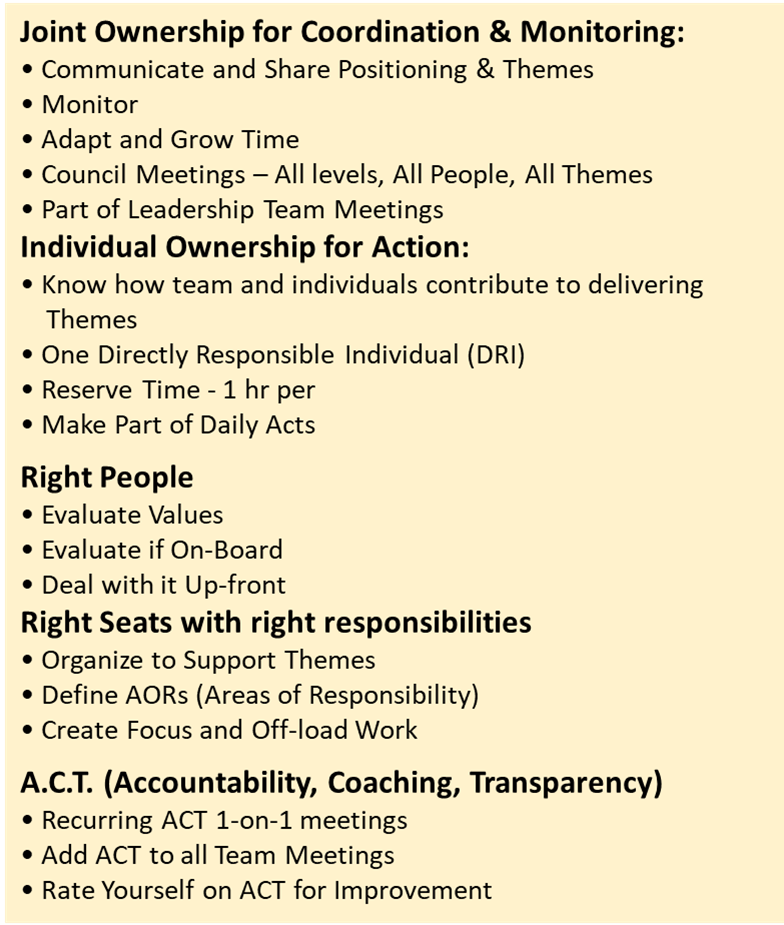
Individual Ownership for Action:
• Know how teams and individuals contribute to delivering Themes
• One Directly Responsible Individual (DRI) for:
– Rocks – Cheat Sheet
– Issues – Issue Tracking
– Action Items – by Team
– Measures – Score Card
• Reserve Time – 1 hr per
• Make Part of Daily Acts
– Shared Accountability Tracking
– Google Sheet, Monday, Clickup, Trello, AsanaRight People
• Evaluate Values
• Evaluate if On-Board
– Get it
– Want it
– Can do it
• Deal with it Up-frontRight Seats with Right Responsibilities
• Organize to Support Themes
• Define AORs (Areas of Responsibility)
• Create Focus and Off-load WorkA.C.T. (Accountability, Coaching, Transparency)
• Recurring ACT 1-on-1 meetings
• Add ACT to all Team Meetings
• Rate Yourself on ACT for Improvement
-
Keep Score

Today, we look at the Keep Score practice on the strategy row of fundamental practices for success. Leaders can reach their vision by adopting these 8 practices.
StrategyOS works with these fundamentals by creating a process to execute them as part of your daily work.
Now, here’s today’s newsletter covering setting up scorecards to ensure action leads to delivering your vision…
A scorecard is the best way to ensure progress toward your vision. Completing rocks and action items and resolving issues is only valuable if it can eventually be measured on the score card that demonstrates results are achieved and you are working toward your Vision.
Scorecards check the health of the business model by monitoring quantifiable results. They create fast cycles of feedback to help steer daily activities. A company scorecard with key measures ties together all the strategy elements in a way to verify progress and achievement.
Use Themes to organize measures into groups. Have two or three of the most important Measures that show performance for each. Measures are only useful if they support Themes and ultimately track progress toward your Business Model Vision, so use them as the basis for evaluating the utility of any measure on the scorecard.
Start simple. You don’t need fancy dashboards or real-time tracking to get started. Start with a matrix of past scores. There is no need to wait for all your metrics to be available to begin regular tracking. As soon as you have one metric, use the scorecard on a regular basis. Add other measures as soon as you are able.
In addition to result metrics that might not change each week, be sure to include leading measures to give early indication of success and key diagnostic measures to help determine if potential trouble areas need more or less focus. Include measures to ensure you are monitoring work that may be needed around non-operational improvements like developing your people, new competencies and the right customers.
Show the Theme Outcome (typically 3 year target) annual Target and at least quarterly goals for each Measure. Since quarterly performance can vary, normally performance is tracked against the annual Target. Use smart goals to set a threshold, target, and stretch goal for each Measure. This allows you to have an objective way to code and color performance across the scorecard as outstanding (green – at or above Target), satisfactory (yellow – between threshold and Target), or unacceptable (red – below threshold.) Trends might also impact the performance coding of a metric; err on the side of highlighting where attention is needed.
I also add Rocks related to the Theme to the score card and show them color coded to indicate whether or not they are on track or at risk. Often reaching a goal requires having a Rock complete.
Assign owners that are responsible for tracking each metric and its performance. Update your scorecard weekly and review it as part of the pre-work for your Leadership Team Meeting. This ensures you know whether you are getting results from daily and weekly actions that work toward quarterly goals and yearly Targets.
If not, raise the issues that the metrics highlight. Track and resolve these according to your problem resolution approach.
Give scorecards extra scrutiny at quarterly and annual meetings to ensure you are ultimately progressing to deliver your strategy Themes and your longer-term Vision.
You can find an example Scorecard here. How will you use a scorecard to evaluate progress toward your vision?
Please follow, share, comment, like, and reach out. Message me on LinkedIn if I can answer any questions or help address a specific need you have.
Follow your Passion, find Joy in your work, and create Freedom to pursue all life’s priorities.
-
Great Leadership Team Meetings
Great strategy execution starts at the top with an aligned, coordinated, and supportive leadership team. It is built on a great weekly Leadership Team Meeting. Many teams never realize the full value these meetings can deliver.
Let’s explore how to do it right.
Start with meeting objectives. This meeting is the one time reserved each week when leadership works together “on the business.” The meeting incorporates ACT objectives:
- Support and hold each other accountable – A
- Review and track progress for key priorities – A
- Solve issues – C
- Help each other improve how work gets done – C
- Uncover Issues, Insights, Ideas – T
- Share feedback – T
- Build trust and coordination – T
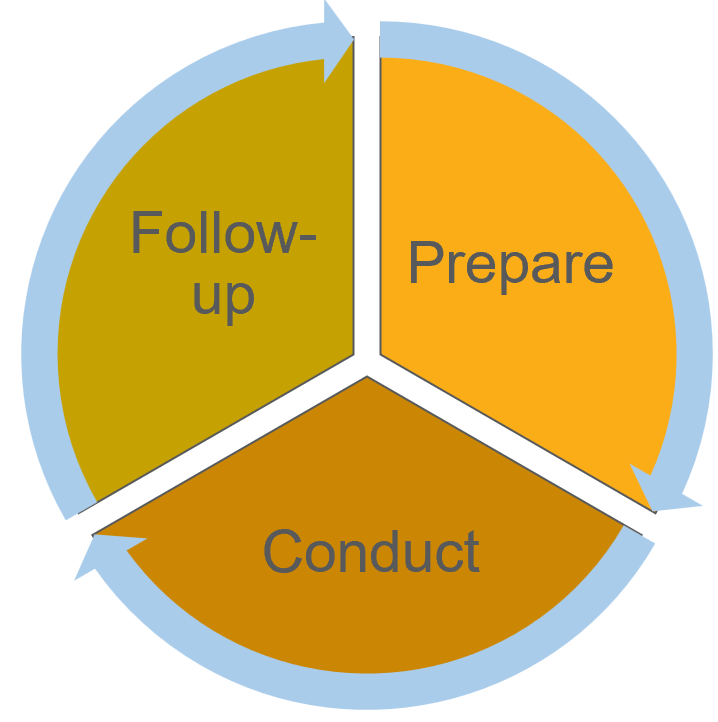
But, Jon, we’re too busy getting things done to spend 90 minutes away from our day jobs! If all participants don’t get a 10x return from spending this time together, you need to radically change how you prepare for, conduct and follow-up on these meetings. Let’s explore each.
Prepare
The first preparation step is to ensure you have a business model with a current quarterly plan. As the philosopher Seneca elegantly put it, “If one knows not to which port he sails, no wind is favorable.” Create shared goals, and plans to reach them, so that all agree to where they are sailing. Ensure team alignment around the high level positioning items of Mission, Vision and Values down through the current 90 day plan with your most important Goals and Rocks that work toward them. Keep your business model cheat sheet current and available for review.
Next prepare by scheduling the meeting with standing:
- Time and day of week
- Place
- Agenda
- Members
- Pre-work
Most teams will make the best progress when they meet weekly. This is a good cadence to keep coordinated and allow enough progress between meeting. Some teams may be moving faster and need to meet twice a week or add shorter standups between meetings. Others may find they can make good progress meeting ever other week if other coordinating activities keep them aligned.
Tuesday mornings are my favorite time to meet. This sets the right opportunity for prep and allows for progress throughout the week on priorities and action items discussed at the meeting. In person meetings are best for dynamic interaction, but allow for remote when circumstances prevent in-person participation by anyone. Attendance should include 5-9 standing members that lead key areas.
Pre-work by all participants is the most important preparation step to keep meetings productive and within the 90 minute time frame.
First, ensure the scorecard is updated with current metrics each week. Distribute it at least a day before the meeting to allow review.
Next, consider ways for participants to share written updates prior to the meeting and move other meeting items forward asynchronously outside of the meeting. This creates documentation for the meeting and allows the meeting to have more value added interaction that probes and clarifies rather than taking most of the time for routine updates.
For example, I’ve seen good implementation of weekly standup content that is created by all the day before. Have each person share Rock accomplishments, next steps and any issues before the meeting. This streamlines that part of the meeting while allowing good interaction. Add an update of action item tracking and bulleting any company highlights by each and all can come ready to support each other with good understanding of collective status. Create an asynchronous issue ranking system to pick the most important issue to start working at the meeting and another agenda item is streamlined.
Conduct
After much experimentation, the agenda I find that works best for most is:
5 min – Segue: Each person briefly shares something good from the week to transition. Keep it brief. Topics shared can launch more personal discussions throughout the week.
5 min – Score Card Review: This reminds team of goals and rocks for the quarter. Identify where team is on track for achieving goals, and where they may be trending poorly or underperforming. Identify any issues and document them on the issues list. Issues may be assigned an owner. It is not the time to solve them.
5 min – Company Highlights: Share good and bad news around key prospects, customers, partners and employees. Anyone can share wins and concerns. Again, any issues go on the list and may be assigned an owner. It is not the time to solve them.
15 min – Rocks Stand-up Meeting: Each member should review and discuss Rocks they own:
1. Accomplishments since last meeting
2. Action Items planned for the coming week, and
3. any Blocking Issues – only identify and capture on list; not quite time to solve.
50 min – Issues Resolution Process: It’s time to problem solve with the brain-trust of the business. Agree to priority and owners. Work them one at a time starting with the highest priority issue. Find root causes and decide on best solutions and action items. If not possible to solve in timely manner at the meeting, agree to a resolution approach and timeframe. Take the decision process offline using and approach like RAPID when possible.
10 min – Wrap up: Review decisions and action items from the meeting, identify if any company communications need to happen, and ensure team is ready for the next meeting. Evaluate each meting to identify at least one good to continue and one needs improvement to work on.
Analyzing this agenda, about 1/3 of the meeting time is focused on coordinating action and uncovering issues and insights. More than half is spent solving issues. The remainder is used for good meeting practices.
At the end of the meeting, all should have confidence that their current ideas around shared elements of business model continue to have good:
- Relevance: Do we still have the right business model?
- Progress: Are we making the right progress?
- Mood: Is everyone still onboard?
And all know how they will work in the coming week to continue to move these forward to deliver quarterly and longer-term outcomes.
Pair this agenda with with good meeting practices that include:
- Start and End on Time
- A Meeting Facilitator
- Time box each section
- Document Outcomes
- Track Action Items
Starting and ending on time shows respect for everyone. This is a high-cost meeting and no one wants to spend the first 5 minutes waiting for a quorum or knowing that they can’t schedule anything else on their calendars for an hour after the meeting. Having a standing meetings allows all to protect it on their calendars. A focus on promptness results in higher evaluation scores, because no one feels like the meeting becomes a time sink. Keep true to the clock first, then focus on getting the most out of the time reserved.
The meeting facilitator is responsible making sure attendees follow the agenda, stay on track and document decisions. They don’t need to do all these things themselves, but they can set an example by modeling the correct behavior. Everyone should help make this successful and encourage participation. I like to rotate facilitation so that all attendees feel ownership for getting good results and understand how their behaviors can benefit and detract from good outcomes. Often, the best results are when the senior leader is last to speak and not facilitating. To get started, it can help to have an experienced third party lead a session or critique newer facilitators.
Time boxing reinforces clock management, ensuring no one part of the meeting gets bogged down. Have a time keeper that alerts the team when the allotted time on the agenda has expired. Or have a safe word that anyone can use to call “time out” when rabbit holes are being dug. Agree in advance about how to reconcile when there is a desire to continue a topic past this time. A best practice is to document the point of discussion as an issue or action item and move on within no more than a few minutes of running over time. It’s always OK to use less than the allowed time.
Finally, this meeting is about getting stuff done and holding each other accountable. Documentation is the best way to make this happen. Record all decisions on the appropriate list during the meeting to ensure team agreement:
- Some decisions are documented as resolutions in your issue tracking.
- Most will require capturing action items to implement and communicate.
Try to make action items things that can be accomplished by the next meeting. The list should document next steps for delivering rocks and for implementing issue resolution decisions. If new action items need a long time to implement, realize that they may displace focus on rocks for the quarter and ensure they are true priorities over existing rocks.
Some teams find minutes useful. You can record meetings by including a Zoom, Teams or Google option in meetings. Tools like Otter, Anchor and Hypercontext can create transcripts without anyone in the meeting being bogged down with note taking.
Follow-up
The best way to ensure follow-up from the meeting is to make any action items a part of your everyday execution. Your meeting documentation should be shared with the whole team. All team members will consult it throughout the week to set their priorities and to-dos. Have them track status on this documentation as they work on issues, rocks and action items.
The easiest way to get started with good meeting documentation and tracking is to use a google doc. This doc should share the business model and current plans for easy access. The current weekly score card should be kept up to date. Issues and Action Items should be tracked. This is the leadership meeting template I use. Note the tabs for each area documented:
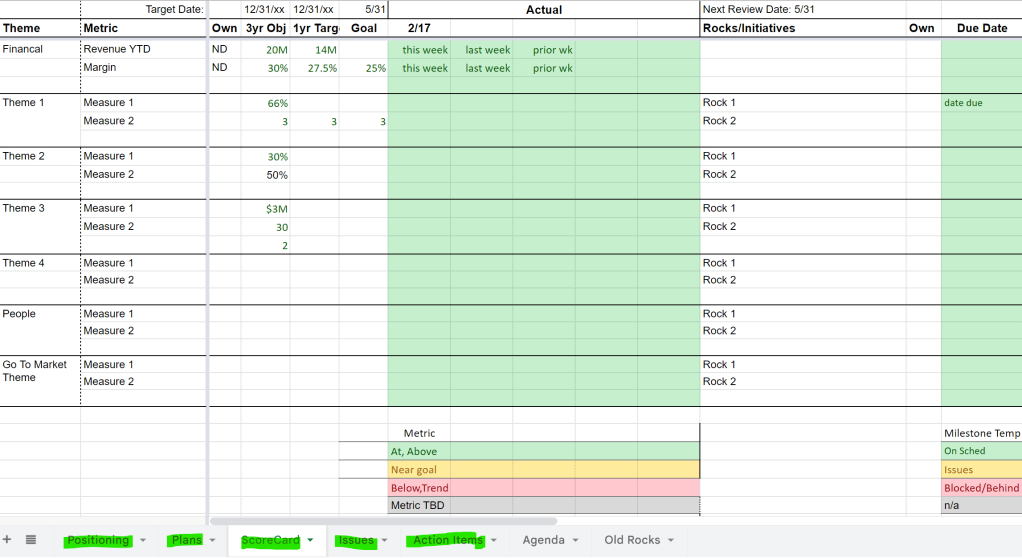
If teams are using a tool like Monday, Clickup, Trello, or Notion, create a template and manage this meeting along with other team activities. These tools add structure in an easy to integrate way with other team accountability tracking
Most teams want to be self-managed. Some teams invite an admin or staff member to help administer the meeting to ensure updates and communication happen more smoothly. But, I find self-management is required at least for accountability portions. Make a commitment among all to be ready each week, to track activities, to properly prepare, and to fully participate and support all team members.
If a member is not doing their part, consider how to coach them to success. Continued failure to meet team standards may be reason for people changes. As with all other areas of success, having the “right people on the bus” is the most important requirement for success. Not meeting expectations at this meeting is a fail on values in people evaluations.
As with other areas of the #StrategyOS, adapt the Leadership Team Meeting to your team’s unique needs and values. These meetings can happen at any level of the business and are most valuable when the span of influence is big enough. Cascade meetings in larger organizations. Smaller teams should consider a periodic standup meeting with ad-hoc problem solving as a way to stay coordinated with less overhead.
The weekly leadership team meeting is part of the execution meeting rhythm that also includes quarterly and annual strategy refreshes.
TL/DR: Experience shows these fundamental needs for success:
- Standing meeting place, time, date, attendees
- Standing agenda
- Everyone completes pre-work
- Meeting owner/facilitator
- Document during the meeting
- Track follow-up actions
Please follow, share, like, and reach out. Contact me from the about page or on LinkedIn if I can answer any questions or help address a specific need you have.
For more about effective meetings, read Perfect Meetings.
Remember to follow your Passion, find Joy in your work, and create Freedom to pursue all of life’s priorities.
-
Workshops Going Virtual
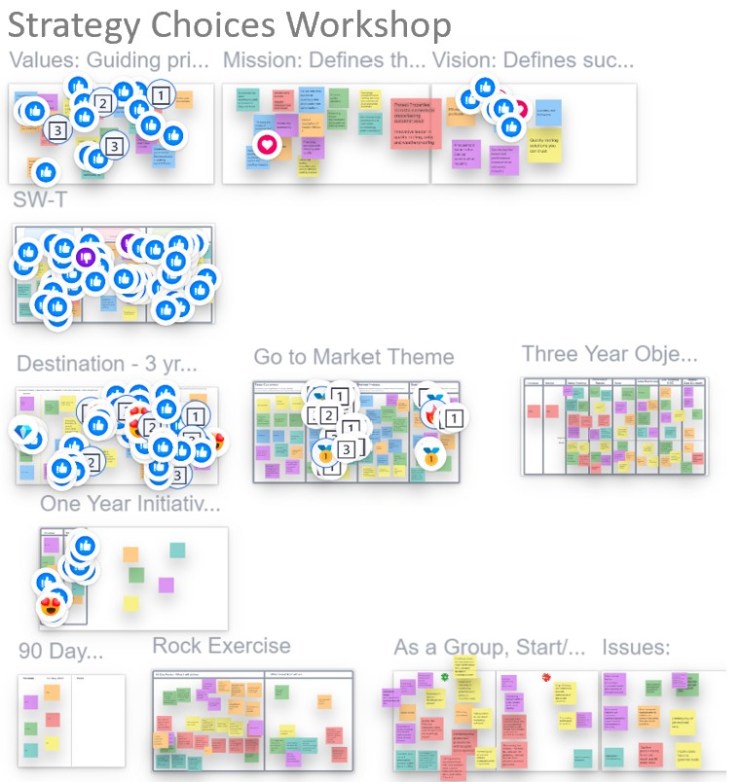
This week I held my first fully remote Strategy Choices Workshop with the leadership team from Formula Roofing. Here’s some good and needs improvement things I learned through the process.
Let’s start with social validation:
“This high focus forum has been a very effective way to discuss high level issues with the whole management team”
“Love the opportunity to reflect on macro issues in a controlled and guided environment”
“The use of the whiteboard software and your template setup has been a very helpful way to explore the perspectives of the team without talking over one another”
“Discovered more about co-workers perspectives”
Overall, the workshop felt as effective as in-person ones I’ve delivered. I felt like the team generated good discussion and the outputs were of similar quality to what in-person teams created.
But, it does miss some of the nuanced interaction and non-verbal clues that in-person workshops make easier. One needs improvement was:
“I felt a bit awkward at times interjecting a thought into the conversation”
And this is a real issue. I think having cameras on helps people see non-verbal cues when people speak, but it is still more challenging to get spontaneous debate and constructive inquiry. I found myself asking specific people to contribute when they were quiet or I saw hints of them wanting to say something. I need to get better at facilitating more spontaneous discourse in a remote setting.
This gets especially challenging when flipping between the meeting tab, a presentation, and the whiteboard software. This is easy in person, but hard remotely. Zoom does a good job of having faces stay on the screen when a presenter navigates to a different window or application. If you’re using Google Meet (like me,) learn to use the Picture-in-Picture option from the … menu:

This will put a 4×4 matrix of cameras in the foreground. It shows the cameras of whomever most recently spoke. You can see some of the participants to gage interaction. It also helps inform around when you are talking about a topic of interest versus need to allow for questions or move on. I still agree it felt “a bit awkward at times” and I need to get better both when presenting and encouraging group interaction. I may switch to Zoom to get a better experience for this feature.
Regarding the whiteboard software, I needed to use a third party software to get all the functionality required for an interactive workshop. Zoom, Google Meet and MS Teams have whiteboard options that are fairly good, but they do not have important features like:
- setting up templates
- having meeting members follow your view
- voting
I found 3 options that met my needs well:
- InVision
- Mural
- Miro
I eventually settled for InVision. It has all the functionality needed included in their free version. You can only start 3 boards before needing to upgrade, but it has good base functionality and pricing options for expansion. The one capability I found somewhat difficult to get people to use was their addition of sticky notes. I believe Miro has better functionality for this, but it and Mural required an upgrade to get voting functionality and to allow for the number of guests I required. I may move to Miro as I expand the number of workshops I deliver.
Some other learnings from this virtual workshop:
- Giving prework in advance of the workshop helped to set expectations, but I got responses from less than half the participants. This could be a company culture or timing issue, but I will allow more time for responses in the future and follow-up more aggressively. I believe having participants work on some of the important questions we tackle on their own prior to the workshop allows for more thoughtful and honest responses in less time. With this goal in mind, I will also expand some of the questions I have them write down prior to the meeting even if I don’t ask them to send it to me.
- I was glad that we broke the workshop over two days. Because of logistics, I’ve held in-person workshops in 1 day and find that participants and I are worn out by the end. There are more outside distractions and less time to reflect and contemplate as we move through the training and exercises. It is also easier for me to be more focused and to digest and summarize some of the early input from the first day for use in later exercises with the team on the second day.
- Keeping focus is important as exercises build on one another. This workshop felt like some of the early decisions were not as effectively translated into the most important work for team members to own that were developed in later exercises. Maybe it is earlier work is not in the room on the walls as we proceed. I will work to better remind all of those decisions as part of the setup for exercises that build on them. I think this is more important for remote workshops.
The agenda we followed is below. Brown items are facilitated exercises. Blue are where participants get to give input in less structured formats.
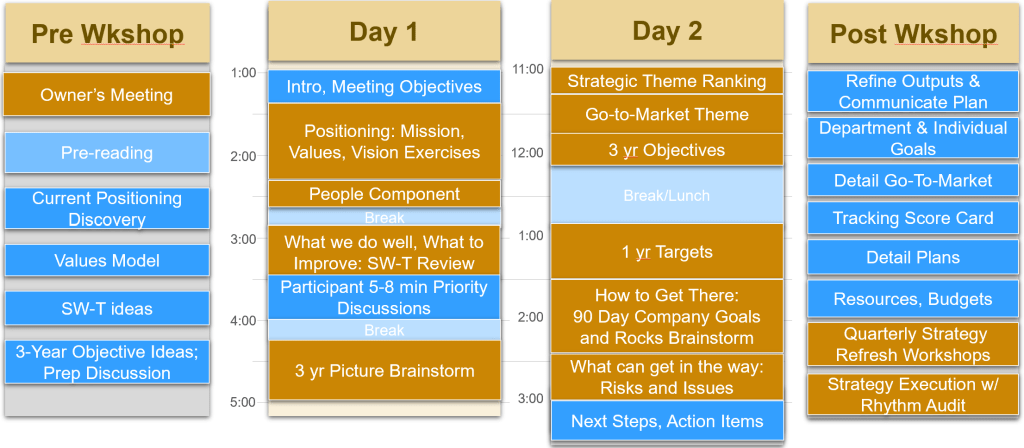
One example of a deliverable from this workshop is the draft for their new mission, vision and values statements. Starting from blank pages, the team developed this:
We protect properties from the elements to create lasting value.
We strive to be the leading, innovative, full-service provider of quality roofing, solar, and weatherproofing in and around Denver.
We lead and execute with values of:
– Quality workmanship
– Capable and efficient delivery
– Doing what’s right
– Delivering what we promise
– Staying at the forefront of innovation
– Always improving to grow our valueI am sure there are still some tweaks in store, but they are off to a good start. From what I know of the founder and their work, this gets pretty close to how they work and I think sets them up well to make important decisions as they move forward.
I am also really excited about the content we recorded as part of this workshop. Over the coming weeks, I will build this into a self-study option. I plan to use extracts from the recordings as examples. There’s a ton of work to do to make this a reality. I would love any advice from the community on how to best make this interactive and effective. I’ll share more along the way.
That’s it for this week. As always, follow, share, like and reach out on the about page or on LinkedIn if I can answer any questions or help address a specific need you have.
Don’t forget to follow your Passion, find Joy in your work, and create enough Freedom to pursue all of your life’s priorities.

About Me
The sky is not completely dark at night. Were the sky absolutely dark, one would not be able to see the silhouette of an object against the sky.
Follow Me On
Subscribe To My Newsletter
Subscribe for new travel stories and exclusive content.
 Horizon Line Group