

Hello, I’m Veronica
The sky is not completely dark at night. Were the sky absolutely dark, one would not be able to see the silhouette of an object against the sky.


-
Problem Solve for Success
Many leaders fail to recognize when issues hold them back. Others decide to work around them or fail to fix root causes. Issues continue to nag at their success and make work less enjoyable.
Let’s explore how a well run, recurring problem solving approach can 10x any team’s success.
In my experience, the most successful leaders start with the Toyota mindset of Jidoka. It suggests that fixing a problem completely before it propagates is fundamental to success. Any worker can stop the entire assembly line in their factories if there is an issue that needs addressed.
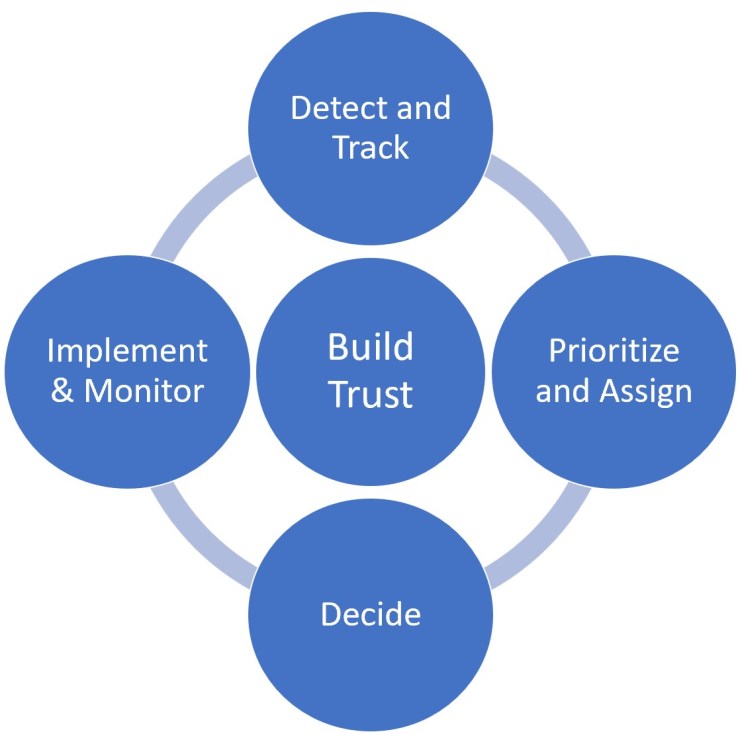
To put this mindset into practice, teams need great ways to:
- Build trust to encourage feedback – encourage all to push the Jidoka stop button
- Detect and track issues, blockers, risks, decision points, and pain points (let’s call all these ‘Issues’)
- Prioritize and assign ownership
- Decide in a way that solves root causes and prevents them from recurring
– Don’t be afraid to try something
– Only Level I, high impact get long analysis - Implement the resolution and monitor success
This article details factors to consider in how to comprehensively implement these practices to create a world class issues resolution process. Incorporate them into your weekly Leadership Team Meetings and your overall StrategyOS execution process. You may choose to simplify your approach to start. Adopt the right level of rigor that is appropriate for your team.
Build Trust
Good issue discovery starts with an environment of trust that encourages feedback. Trust is built with behaviors that:
• Leaders show humility with credit to team for success and a shared desire to be better
• Take personal responsibility for failures and don’t react defensively to issues
• Respect all when raising and solving issues
• Say what is true to you, starting with facts and building to context and feelings
• Allow other to express with candor
• Kill all gossip, bullying, harassment, politicsCombine these behaviors with regular opportunities for team members to share feedback, communicate clearly, share reasoning behind decisions, and build interpersonal relationships at and away from work.
If you want to learn more about building strong cultures including feedback and trust, read Building Great Cultures. You can also read about the 10 Commandments of Good Decision-Making.
Detect & Track
Create good detection methods that uncover issues to add to your issue list:
• Listen to what customers, partners and employees have to say and add concerns to your issues tracking
• Note reasons for key sales wins or losses if they suggest issues
• Use a score card to track progress toward shared goals and notice when you are falling short
• Track action items and Rocks to know when any is in jeopardy of missing timelines or outcomes
• Allow for thinking time to reflect on trends and changes in your industry that may impact future performance
• Note major decisions that could have a large impact on the business
• Reserve time at meetings to raise issues and brainstorm issues, risks, blockers, key decisions as a team.Next create a tracking mechanism to track known issues. This can be a wiki (like Notion.io) or a simple shared spreadsheet or document. Share this list with the team. Capture enough initial detail for all to understand each issue and its potential impact on business success. Where possible document outcomes that will indicate the issues is solved. Your issue tracking mechanism should have headings similar to the following:
- Issue Name
- Date Opened
- Date Closed
- Opened By
- Description (with impact)
- Proposed Solution (with outcome)
- Type
- Priority
- Decision Maker
- Discussion
- Decision
- Implementation (Action Items w Owners)
Your headings may vary, but these are typical. Anyone on the team should be able to add Issues to this tracking mechanism. To raise an issue, they should fully complete heading items 1, 2, 4, 5, and 6.
A best practice is to start issues with one of two statements:
“I wish …”
“How to …”
This phrasing starts the conversation in a manner that encourages problem solving in a more productive fashion than naming them as problems and pain points. I wish all issue names started in this way on the tracking list. Save the impact and pain points for the discussion section.
Prioritize & Assign
Once an Issue is properly captured and documented, the team should work on the issue together for the next steps.
Understand that not all decisions are created equally. Start with the Jeff Bezos concept of whether the issue raises a Type I: one-way door, or a Type II: two-way door issue. This dictates who may own decision making and impacts the right method for decision making.
Working together, have the team read the issue, and agree on items #7- Type, and #8- Priority:
- Type I: These are irreversible decisions that cannot be changed once executed. Therefore, they require careful evaluation. Type 1 decisions are owned by the team leader (eg: CEO.) They can delegate collecting facts and alternative evaluation, but cannot delegate final decision making authority.
- Type II: These are reversible decisions. Even after executing them, you can change them if you get new information or learning. Most decisions fall into this category. These decisions can and should be delegated to a responsible individual other than the team leader. Its ownership could stay with whomever raised the issue, or move to another that has more impact, experience or capacity to resolve the issue.
- Within these Type classifications, teams can usually solve only a few issues at a time. Use a H, M, L priority classification to determine which issues are highest priority and should be next in line to solve.
Only one or two Type I issues should be in process at any given time. In addition, you might pick one or two type II issues for each member on the team to be working on at one time.
Have the team agree which issues are a priority to be worked and together assign a #9 – Decision Maker. This individual has final accountability in deciding the issue resolution. If there is any lack of agreement about who should be the Decision Maker, the team leader will assign the person.
Discussion up to this point may make the resolution obvious. If so, document it with a clear resolution statement as a team and move on to Implement. If you don’t get to agreement on the resolution statement quickly, use an appropriate technique from Decide to take decision making off-line and keep the team from bogging down.
If issues are urgent, temporary measures may be needed. Acknowledge and document when these measures are not final and continue to work the process toward a final resolution. The Decision Maker should issue temporary directives when needed with advice from the larger team.
Decide
The Decision Maker gets to decide the approach for reaching his final decision. This does not mean that individual can make the decision without following a process. Teams should have a few shared problem solving methods they agree to use.
In choosing the method consider how much impact the issue has. Include the issue’s potential to impact overall success and how many people are impacted. More impact on success suggests more detailed information is needed to make the decision. More impact across a diverse group suggests more people may need an opportunity to give input to understand the best alternatives and to create buy-in to make implementation easier.
Keep it as light weight as possible and only add more structure for the hardest to solve issues with the most impact that cannot be modified once an initial decision is made.
Type II, Low Impact Issues:
This type of decision can be made after a brief discussion of available information. Use a method like IDS (Gino Wickman, Traction, pg 136). The Decision Maker is responsible to facilitate this approach and make the final documentation of resolution. Time box the method to keep appropriate focus.
– Identify: Fully understand the issue and the impact it is having. Review and detail the issue as originally documented and expand as needed. Search for true underlying root causes that need fixed.
– Discuss: Get all facts on the table. Let those that have an opinion be heard. If more information is needed to help decide, make that an action item before continuing discussion. Uncover potential approaches that could solve the issue and information to help choose the best alternative.
– Solve: Once facts are out and no new information is needed, the Decision Maker should pick a resolution that best corrects the issue. Document the decision with a statement that all agree to.Type II, High Impact Issues:
This type decision can require more input and testing. But, given its reversable nature, should still be made as quickly as possible with the best available information. You can add more rigor by using Deming’s PDCA, or Bain’s RAPID approach.
PDCA is an acronym for a continuous improvement approach. It is suitable for resolving many types of issues with an appropriate amount of rigor. It that stands for:
– Plan (an outcome)
– Do (try best solution to solve root causes)
– Check (is it working)
– Act (scale solution if working)
– repeat (new solution or next issue)RAPID is a way to asynchronously gather input about a decision from a broader constituency of the people required to successfully implement the decision. The Decision Maker circulates a document to gather input from RAPID participants and then issues a decision based on that input. It stands for:
– Recommend = whomever proposed the Issue and Solution
– Agree = colleagues whose input is vital to the decision (like legal or hr)
– Perform = people who will have to enact any decision
– Input = people who have valuable input
– Decide = The decision MakerSee further reading on the PDCA and RAPID approaches. You can find an example of RAPID in Matt Mochary’s book (The Great CEO Within, pg 67) and here.
Type I, Low Impact Issues:
Because of their low impact, these issues can be decided using similar approaches as Type II, high impact. Often questions need answered or more information needs gathered before decisions are made. You can add greater structure to data gathering and evaluation using six sigma’s DMAIC approach. Or stick with PDCA or RAPID with the added information.
Like all type 1 Issues, the Decision Maker should be the team leader (eg: CEO.)
Whenever possible, these decisions should be broken into milestones that allow for keeping decisions reversable as long as possible and phasing impact so that as much information as possible can be gathered before the final impact is recognized.
Type I, High Impact Issues:
These decisions usually require projects to gather alternatives, run scenario analysis, model possible decisions, quantify and mitigate risk, and negotiate outcomes. Decisions should be made carefully. Create Action Items and Rocks to gather and analyze needed information.
Break the decision into milestones with gateways that create opportunities to recognize impact in a phased approach and cut losses if the decision outcomes are not as expected.
Regardless of the method used to reach it, be sure the resolution decision is in line with company Values. Use Values as guidelines throughout the problem solving process. Also make an explicit check before finalizing any decision. Modify until all are satisfied that no Values are compromised.
A decision is not completed until it is fully documented and agreed to by the team. Complete #10- Discussion as you execute the decision process and # 11- Decision on issues tracking when a decision is made. Ensure that your Issues tracking mechanism documents details of the decision so that there is no disagreement in the future.
Implement
Once a decision is made and documented, it is time to implement it. Two steps are still needed:
- Create Action Items/Rocks to implement the decision
- Implement monitoring to ensure the actions create the desired outcome and the issue does not resurface
The Decision Maker can delegate implementation to one or more other responsible individuals. Document implementation broadly on your issues tracking #12- Implementation.
Then move them to your routine tracking for Action Items and Rocks and add new metrics to your shared Scorecard as needed. These should become part of your #StrategyOS execution routine. Set a follow-up date to ensure implementation is complete and the results are as expected.
Once complete, close the Issue with a #3- Closed Date and move on to assign your next most important issue and begin to work it to a solution.
If you found this article useful please consider the following:
- Hit the like button on this post
- Find more insight and ideas to help you reach your business vision, on the blog at HorizonLineGroup.com
- Visit the about page if you’d like to schedule time with me to share ideas or ask questions specific to your team
- Follow me on Twitter and LinkedIn
- Forward this article to a friend or colleague that may benefit
-
Military Leadership Lessons
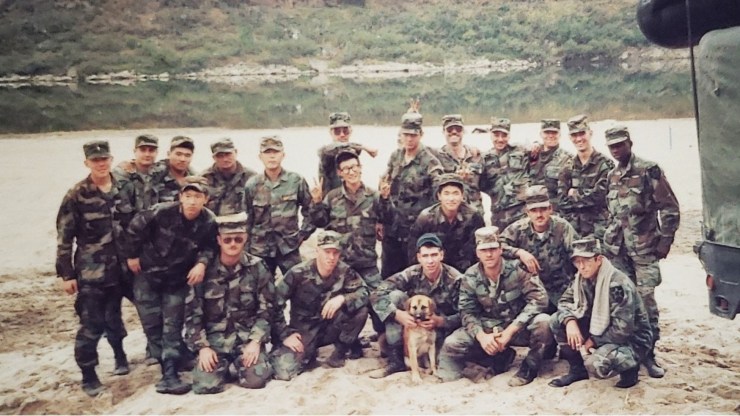
The military teaches that leadership is about caring for those in your charge. Yes, that’s me on the far left as a new army Lieutenant with my first platoon on a field exercise in Korea. Here are 8 lessons I learned to better care for others on your team:
1. Empathy: Really listen to those on your team to gain understanding of their challenges, needs and experiences. Build inclusion, diversity and collaboration across your team.
2. Encouragement: Inspire and motivate others with joy. Give recognition and credit for achievements to the team. Acknowledge fear, but don’t let it limit you or others.
3. Ownership: Accept that ultimately, failures and mistakes are your responsibility and look for ways to build team capabilities that deliver success.
4. Transparency: Seek feedback while communicating openly about why decisions are made and acting fairly to build trust.
5. Commitment: Always be on time and an available team member when needed. Always work to help the team reach goals even in the face of difficultly and setbacks.
6: Coaching: Provide opportunities for growth and development and help grow team members, both professionally and personally.
7. Support: Provide resources needed for success including people, budget, tools, and training.
8. Health and wellness: Encourage and support team members’ physical and mental well-being. Set an example through your own actions and team policies.
If you found this article useful please consider the following:
- Hit the like button on this post
- Find more insight and ideas to help you reach your business vision, on the blog at HorizonLineGroup.com
- Visit the about page if you’d like to schedule time with me to share ideas or ask questions specific to your team
- Follow me on Twitter and LinkedIn
- Forward this article to a friend or colleague that may benefit
-
The purpose of work is to earn freedom so you can spend your time how you want.

Judge success not by the cost of possessions, but by the quality of time spent and richness of experiences.
-
Meta Work

If you’re an entrepreneur, you need to do three things well to realize your vision:
- Work in the business
- Work on the business
- Work on improving how you work on the business
These three areas build on one another and compound success. Let’s dive deeper into each…
1. Work in the business means using your unique skills and insight to help create and deliver the products and services your customers value. Leaders at all levels need to contribute work output that keeps them close to their customers and allows them understand what their customers need and value. Contrary to some popular opinion, working in the business is valuable work for leaders.
2. Work on the business means taking time to assess how well the business is able to deliver your products and services and to continually improve how effective, efficient and adaptable your are in adding customer value. This includes:
- Developing and articulating a clear mission and vision.
- Understanding the context in which the business runs and how internal resources and capabilities must adapt relative to external trends like customer needs, competitive positioning and social and regulatory limitations.
- Defining how you will compete to win within this context through your product market fit and go to market activities.
- Implementing projects and initiatives that create priority new capabilities and offerings.
- Measuring and achieving objectives and goals that grow the business.
- Solving problems that prevent you from fully reaching your goals and vision.
- Working to acquire the people, skills, resources, processes and tools needed for the business to run well and thrive.
- Organizing how you and others work best together.
Let’s call this work that creates a differentiated strategy.
3. Work on improving how you work on the business means improving your ability to understand, articulate and deliver your differentiated strategy. While working on the business may sound daunting, real growth comes from improving how well you work on the business. This is work on the process that is used to work on the business.
Leaders benefit first from acknowledging that working on the business is a process. Call it the strategy process. Recognize that it is on-going work that requires regular attention and focused time.
Next, adopt a strategy process that is tested and proven. Once adopted, work relentlessly to make it work for your business. Adapt and grow it as your needs change. Engage other leaders in the process. Continually improve your ability to continually improve your strategy and your ability to work toward your vision. Work on being the best at implementing a strategy process.
For more detail on what a strategy process is and how you can adopt one for your business, start with the StrategyOS I use. It is borrowed and blended from tested ideas that fit most companies who have at least a few employees and and some customers. I typically modify it depending on company maturity and size as you might do for your company.
Or, you might pick another author’s “packaged” system. Most small to medium sized companies will find the EOS from Gino Wickman’s Traction is a light weight way to quickly add a common process with minimal overhead. Matt Mochary’s The Great CEO Within documents another approach worth adopting, especially for startups that are starting to get product market fit. Early stage companies may look to Erik Reis’ The Lean Startup or Kim & Mauborgne’s Blue Ocean Strategy for ideas. More mature companies might like more structure from Kaplan & Norton’s Balanced Score Card.
Keep in mind that success comes from finding time and focus to always work on these 3 areas that deliver your vision. Don’t work harder, work harder on the things that will most impact success using these three as foundational building blocks.
If you found this article useful please consider the following:
- Hit the like button on this post
- Find more insight and ideas to help you reach your business vision, on the blog at HorizonLineGroup.com
- Visit the about page if you’d like to schedule time with me to share ideas
- Follow me on Twitter and LinkedIn
- Forward this article to a friend or colleague that may benefit
-
Become Level 5 to go from Good to Great
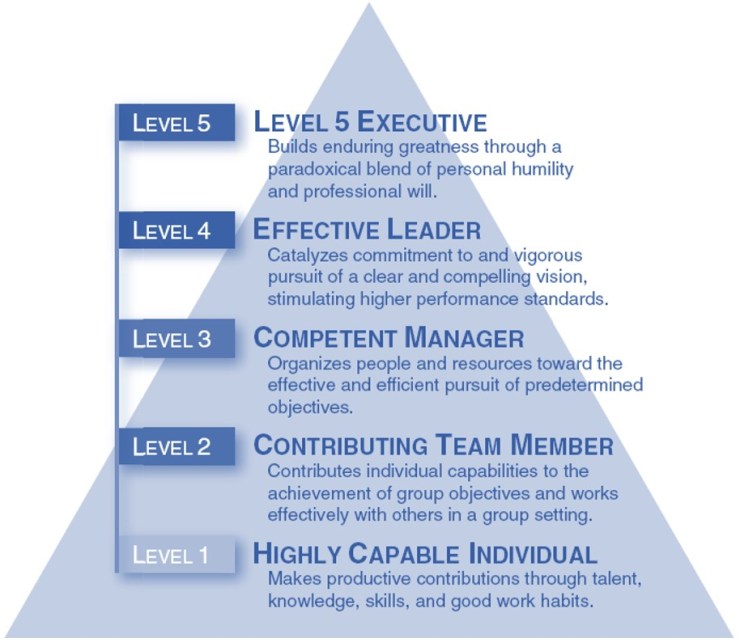
In his book, Good to Great, Jim Collins credits level 5 leadership as a defining characteristic of those who guided their companies to great success by outpacing the average in his study.
As a point of entry, these leaders demonstrated foundational skills of finding and organizing the best people, and catalyzing commitment with compelling vision and values. Those leaders who were most successful added these defining traits:
1. Humility: Level 5 leaders do not seek personal glory or attention. They credit their success to the efforts of their team and the organization as a whole.
2. Professional will: Level 5 leaders have a strong determination to succeed and are willing to do what it takes to achieve their goals. They are unrelenting in their desire to produce sustained results and to make a lasting impact on their organizations.
3. Personal responsibility: Level 5 leaders know intuitively that their actions ultimately determine the success or failure of their team or organization. They do not blame others or make excuses. They build up, coach, and support all those on their team to deliver their best.
4. Fanatic discipline: Level 5 leaders are highly organized, focused on the most valuable contributions they can make, and follow through on their commitments, even if faced with difficult challenges.
5. Thoughtful reflection: Level 5 leaders are reflective and seek to learn from their experiences and the experiences of others. They reserve time for the deep work needed to to make the business better. They are open to feedback and continuously seek to improve themselves and their team.

About Me
The sky is not completely dark at night. Were the sky absolutely dark, one would not be able to see the silhouette of an object against the sky.
Follow Me On
Subscribe To My Newsletter
Subscribe for new travel stories and exclusive content.
 Horizon Line Group