
Hello, I’m Veronica
The sky is not completely dark at night. Were the sky absolutely dark, one would not be able to see the silhouette of an object against the sky.


-
Simplified Problem Solving
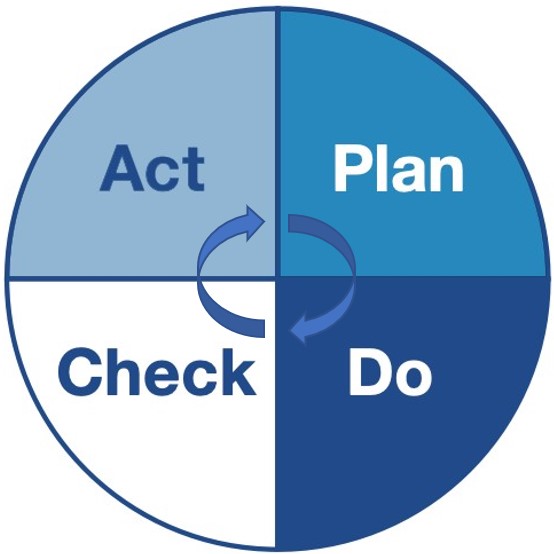
Deming’s PDCA continuous improvement approach can be well applied to most goals or decisions in business:
– Plan (an outcome)
– Do (try best solution to solve root causes)
– Check (is it working)
– Act (scale solution if working)
– repeatFast cycles = fast improvement.
As with many problem solving approaches, Plan is especially important: Make sure all participants in problem solving identify and agree to the desired outcome. Be specific in setting an objective that defines a desired impact that can be verified within a set timeframe. Ask why 5 times to get basic understanding and to uncover the most important issues that are preventing achieving the outcome. Start with first principles and work to develop alternative actions that could correct root cause issues and achieve the outcome. Evaluate each alternative action as best as possible with input from all participants working to solve the problem.
The next steps can happen quickly.
Do: Test the action that is most likely to produce the outcome desired. This could be through a pilot that address a limited scope of the problem or could be implemented with temporary tools or processes.
Check: Implement metrics early that can objectively evaluate whether the goal is met. Ensure that the metrics show whether the desired outcome was achieved.
Act: If the action works, it is time to make the solution scalable and stable. Create any new tools or processes that are needed. Expand the action to address the full problem. Continue to ensure full implementation and monitor that the outcome continues to deliver results.
If the action did not work, go back to Plan; with the learning from this iteration, pick the next best action to Do and continue until the outcome is achieved.
Once solved, move on to your next most important issue, decision, or new goal you want to achieve.
Save more difficult problem solving techniques for issues and decisions that have a large impact and cannot be changed or undone once a decision is made. For most problem solving, PDCA has the right balance of rigor and efficiency.
-
<100 Employees = You need a PEO
People are your biggest asset. Your biggest cost. And your biggest risk.
- There are specific laws that must be adhered to when hiring and firing
- Benefits are costly, especially for smaller companies
- Learning and running HR compliance, benefits and payroll is time consuming
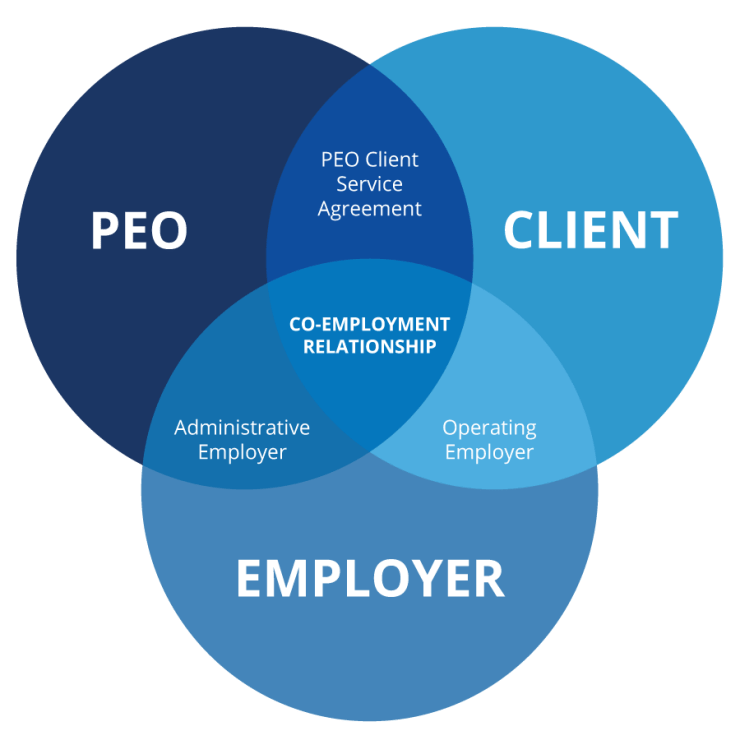
Most businesses don’t know about professional employer organization (PEO.) These providers take away the concerns of hiring. Outsourcing to a PEO means your team works as employees of the PEO. On your behalf, they:
- Hire and fire
- Ensure legal compliance
- Streamline payroll and expenses
- Offer benefits (medical, dental, life, PTO, etc.)
- Support employers and employees
If you are considering hiring your first employee or have less than about 100 employees, strongly consider outsourcing to a PEO. Until you reach 100 to 150 people working on your team, a PEO makes good sense.
Some PEO’s you can investigate are:
- TriNet
- Sequoia One
- Justworks
Once you outgrow a PEO at around 150 people, you’ll need a good payroll provider like:
- Gusto
- Zenefits
- Rippling (also offers PEO)
-
Build Great Culture with A.C.T.
If you have direct reports, you are a leader and manager. Your most important job is to create a productive culture and motivate your team. Many fail.
ACT is a pneumonic that is useful in reminding leaders how to motivate and create great cultures. It is an acronym standing for:
- Accountability: getting things done by Leading and Managing well
- Coaching: asking for and providing help
- Transparency: creating trust and 2-way feedback
Start improving your team’s culture and performance by incorporating these ideas into all team meetings and by setting up recurring ACT meetings. ACT meetings are 1-to-1 meetings between managers and their reports. Schedule them about weekly at all levels of the organization.
At these meetings, the three elements of ACT should get focused attention:
Accountability is agreeing to:
- A priority outcome (vision, objectives, results, goals, measures);
- Actions to deliver it (action items, rocks, initiatives, resolving issues);
- Whether actions were completed
- If you achieved the outcome
Coaching is assessing the current health of a person, team, department, initiative or business.
State both the good and the not good.
For the not good detail:
- What the issue is and its causes
- A proposed solution (by the person raising it)
- The best solution together
Solutions can include providing resources for success like:
• Training
• Tools and Technology
• People
• Focus
• Advice and Guidance
• SupportTransparency is sharing (to a manager, peer, or report) feedback on what they are doing, using the following format:
Like: “These are the specific actions that I like that you are doing.”
Wish that: “These are the specific actions that I wish you would do differently.”
The receiver of the Feedback should:
- Ensure understanding by rephrasing it
- Thank and let giver know that you will consider how to address it
- Decide what changes, if any, you will make
- Get back to giver with decision and reasoning
- Follow-up later to see if changes help
Once you see some success at 1-to-1 meetings, you can add ACT elements to any meeting or event:
- Retrospectives with each person noting a team good and a needs improvement idea
- Set goals, track and share outcomes as a team
- Make problem solving an agenda item
- Rate meetings and share improvement ideas
- Identify needs and support each other as a team
- With radical transparency, individual feedback can be shared openly in group meetings when the team is properly trained
In addition, teams should periodically rate how well they are implementing the ACT components to look for the areas where they can improve most. Get your team to rate themselves, then problem solve solutions for areas with low average scores.
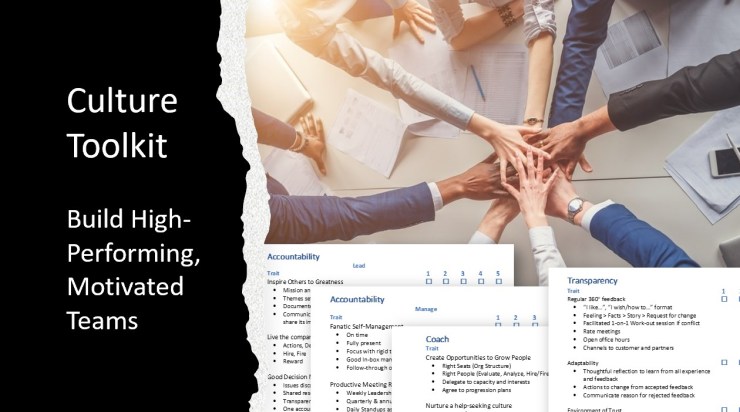
Use the ACT Checkup to learn how I went from ignoring culture to using ACT to build high performing teams. It is an exercise that is intended to teach how to build great culture and create high performing, more motivated teams at all levels.
After taking about 30 minutes to have your team members complete the checkup, you’ll have the context and information you need to prioritize action items that will start delivering the culture you want. With continued practice, you will see noticeable results quickly.
The checkup can help you to incorporate these practices into your team’s routines. It has 5 checkpoints that evaluate team behaviors for each ACT area. Accountability has two sub-areas, Lead and Manage. These work together to deliver Accountability. This creates a total of 20 checkpoints of evaluation.
Find out more about evaluating ACT and get the check-up survey here for free.
This article was adapted by practicing and adapting the ideas of A.C.T. as as introduced in: Mochary, Matt; MacCaw, Alex; Talavera, Misha. The Great CEO Within: The Tactical Guide to Company Building (p. 133). The concept of Accountability being a result of Leading and Managing well comes from the LMA discussion in: Wickman, Gino. Traction (p. 96).
-
Self-Care is the Best Care
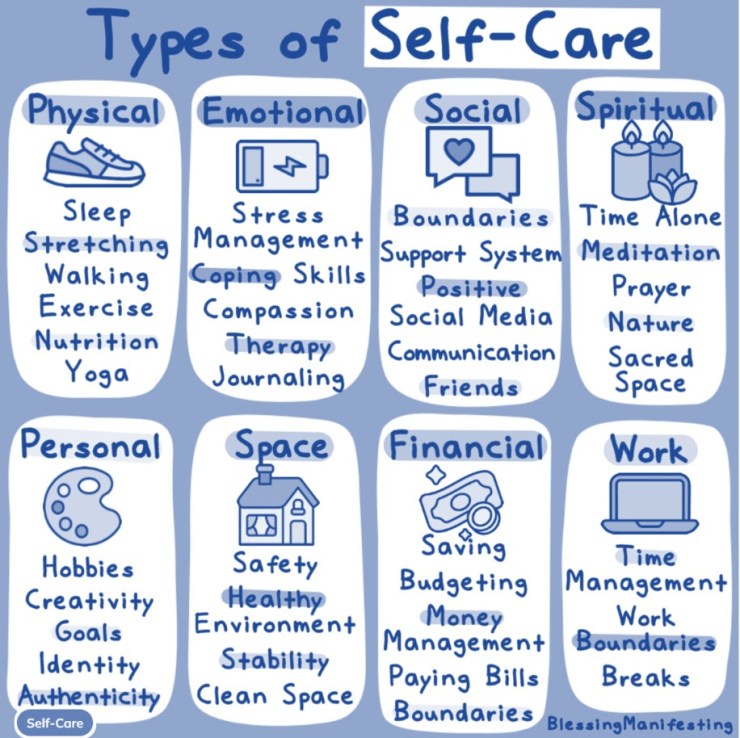
Many leaders see putting themselves first as greedy and self absorbed. But, it can be one of best ways to help others and your business. Here is how self-care makes you a better leader.
Putting yourself first does not mean prioritizing your needs and desires at the expense of others’. Instead, it means taking time to take care of your physical, mental, and emotional well-being so that you can better help and support others.
This creates the energy, clarity, and focus to be your best and lead effectively. It can also inspire others to do the same, creating a positive, healthy work culture that is more productive.
When you are at your best from self-care, you can be more:
– Authentic and genuine
– Resilient to bounce back from challenges and setbacks
– Present and focused in the moment
– Compassionate and understanding towards othersSo, be greedy. Lead by example and show others that self-care is important and valued.
If this article was useful please consider:
1. Following me on Twitter @JonDnvr and http://linkedin.com/in/jonst/
2. Exploring more articles at https://horizonlinegroup.com/category/envision/…
3. Exploring how I can help your success on the About page.
-
Strategy OS – An Overview

Most business leaders assume that by working harder in the business, they will reach their vision.
Instead what they need is a StrategyOS that delivers success in a dependable way. What is a Strategy OS and how can you use it in your business?
Much like a computer operating system that runs programs to create outputs, a Strategy OS runs your Business Model. Its outputs are products and services, growth, profits, impact, and ultimately, your Mission and Vision.
So, start by defining your Business Model:

Your business model is made up of elements that define success and the people needed to deliver it.
It operates within a Context that can impact success and is influenced by customer and other trends in your work environment relative to internal resources and capabilities.
As we go down the list of elements, we are getting more near-term and more detailed.
- Positioning terms are the elements that are ten plus years out set by Vision. They define why the business exists. They give purpose and inspire.
- Strategy terms are two to five years out set by Themes that describe a picture of how to build to reach the vision. They connect the action of near-term plans to the long-term vision.
- Plans are made annually and at least quarterly to guide what to do to best move your strategy forward. Rocks are set at least quarterly as the most important next thing to focus on delivering. They can be stand-alone deliverables, or milestones of longer-running Initiatives or Themes.
The business model also addresses people practices. It shows that the high-level elements are jointly owned. More specific and nearer-term items are owned by more focused teams and responsible individuals. You must also have the right people in the right seats with the right roles, and you must help to develop all your people to grow with the vision.
Finally, all this operates within a Context that is influenced by customer and other trends in your work environment relative to internal resources and capabilities.
Next, run this business model on the Strategy OS. Use these 8 steps:
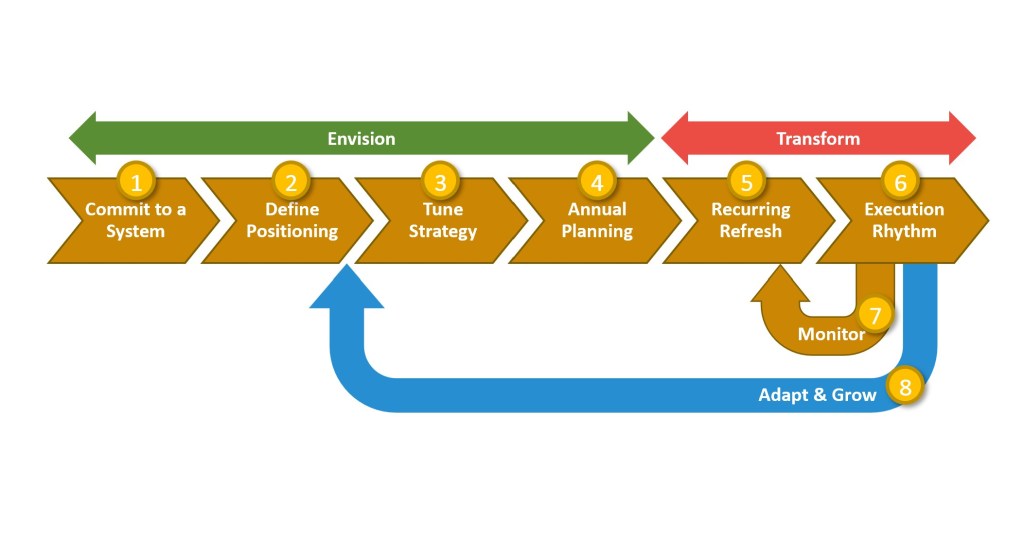
1) Agree to a Strategy OS System for your business. Then:
– Publicly commit to it
– Share it across the business to create common process, language, and tools
– Make it part of your work every day2) Define positioning that includes elements that should be rock solid:
– Vision: How you will be viewed long term; your BHAG
– Values: Guiding principles for decisions and actions
– Mission: Why you are in businessThese guide key choices and help to give direction when there is uncertainty. When you get them right, you can carve them in stone to endure beyond anyone’s tenure in the company.
3) Tune strategy by organizing around major Themes that advance your Positioning. Themes are broader than plans or programs in that they offer guidance about what is needed without limiting possible plans of action or timeframes.
Themes are destination statements describing with details what the business looks like within a timeframe that can be reasonably imagined from a variety of perspectives(in 3 years for most, 2 years for fast moving businesses, up to 5 years for slower moving companies in mature industries.)
Two must have themes are:
- Go to Market: How you differentiate, target, market and sell
- Financial: How you make profits and maintain cash flow
Give these extra focus in your business model.
Prioritize to have 5-7 Themes.
Ensure priority Themes are understood by defining success with:
– Descriptive Outcome
– Tracking Measures4) Conduct annual planning to set Targets and Initiatives for the next 12 months.
Stay light weight. Planning can be as simple as creating Targets and Initiatives for each strategy Theme created in Step 3.
Then give these a Budget that includes people and dollar allocations.
5) Recurring Refresh with Goals that support the annual Targets, and Rocks that support annual Initiatives. Because people can keep focus for no longer than about 90 days, the refresh should happen at least quarterly. Faster moving teams may want to refresh more often, but none should be less frequently.
These define key results for the near-term that ensure actions on a daily and weekly basis are contributing to deliver longer-term Outcomes and ultimately the vision.
In addition to allowing renewed focus each quarter, use the Refresh Cycle as an extension of annual planning to allow focus on priority Themes and important issues at least every 90 days.
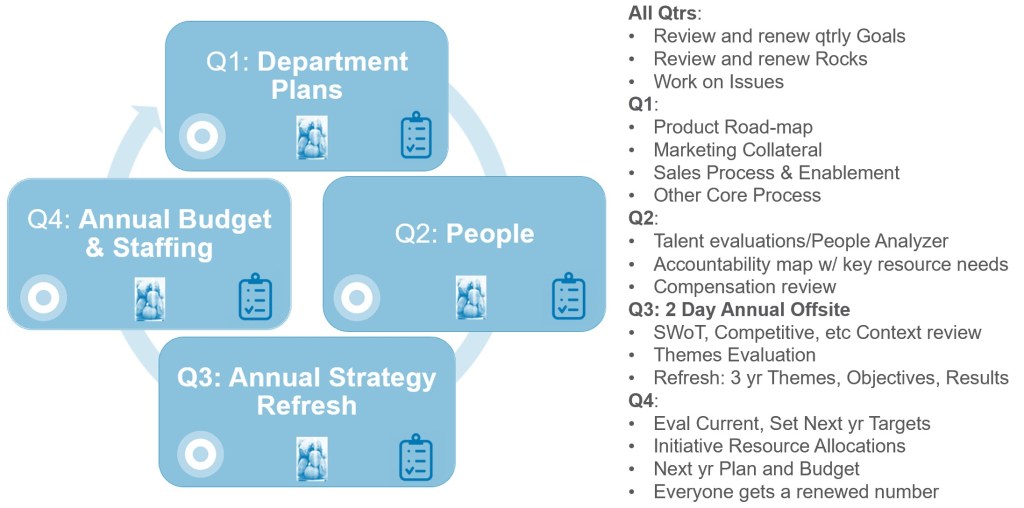
Two must have focus areas are:
- People: How to structure, hire, incent, train, evaluate, and fire
- An annual strategy tune: two day planning that revisits step 3
6) Execution Rhythm is created by holding standing meetings listed in brown on this diagram.
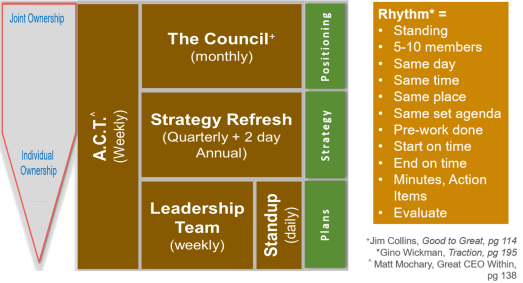
These standing meetings focus on delivering the key sections of your Business Model to their right:
- Leadership Team meetings: to ensure progress, stay accountable and solve issues that accelerate success.
- Strategy Refresh meetings: to track quarterly and annual progress and renew Rocks.
- Council meetings: to communicate strategy and allow everyone to contribute to jointly owned parts of the strategy.
- ACT meetings: to develop good culture and help teams and individuals continue to grow and deliver results using – Accountability: getting things done; – Coaching: providing help; – Transparency: 2-way feedback
Create rhythm by following the bullet points to the right. These meeting should have a standing: time/day, place, attendance, and agenda. Use perfect meeting practices to maximize impact.
7) Monitor results by checking the internal health of the organization and strategy using a company score card.
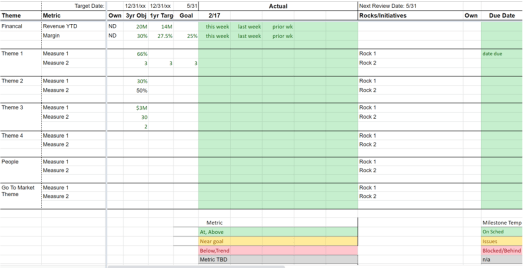
It creates fast cycles of feedback to help steer daily activities in a way to verify progress and achievement.
8) Adapt and Grow by monitoring the environment or Context in which your company competes to ensure Positioning and Strategy remain effective.
– Talk to customers, prospects & employees
– Audit customer facing processes
– Create time to think on business needs
– Use Council meetingsThis creates the feedback and learning adaption that all complex systems need. Ideas can:
– Be solved as Issues with your Leadership Tm and implemented quickly (Step 6)
– Be worked on at the next Quarterly Mtg (Step 4)
– Create new Themes and priorities (Step 3)
– Create a pivot (Step 2)
Let’s Recap:
- Define your Business Model
1) Positioning – why we exist
2) Strategy – how it looks
3) Plans – what to do to get there
4) People – right people, right roles, right responsibilities, right support structures
5) Context – external business environment that impacts success - Make StrategyOS part of your daily practice
1) Commit to a System
2) Define Positioning
3) Tune Strategy
4) Annual Planning
5) Recurring Refresh
6) Execution Rhythm
7) Monitor
8) Adapt and Grow
Implement a #StrategyOS and you’ll deliver business success.
If you found this helpful, please share, like and subscribe below.
Schedule time to see if I can provide more personalized help through the about page or on LinkedIn or Twitter.
Explore StrategyOS in more detail in Strategy OS Delivers Success – Part1 and Part2
Keep following your Passion and creating Joy and Freedom in your work to pursue all of life’s priorities.

About Me
The sky is not completely dark at night. Were the sky absolutely dark, one would not be able to see the silhouette of an object against the sky.
Follow Me On
Subscribe To My Newsletter
Subscribe for new travel stories and exclusive content.
 Horizon Line Group